
Affiliate Disclosure: This article may contain affiliate links. If you purchase through links on this page, we may earn a commission at no additional cost to you. As an Amazon Associate, LiftQube earns from qualifying purchases.
If you’ve spent any time researching rowing machines, you already know the Concept2 RowErg comes up constantly — in CrossFit boxes, college training rooms, and home gyms alike. That’s not an accident, but it also doesn’t automatically mean it’s the right machine for your space, budget, and goals.
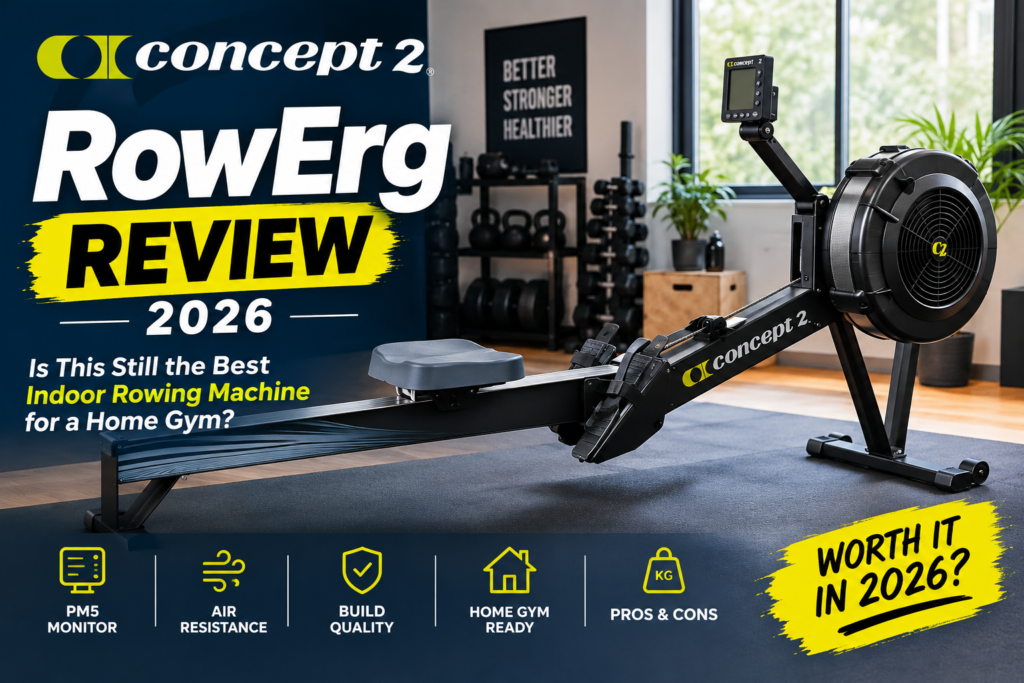
This Concept2 RowErg review breaks down what the machine actually is, how it performs, what it costs to own long-term, and where it genuinely falls short — so you can decide whether it deserves a spot in your home gym in 2026.

- Integrated Device Holder allows you to keep your Smart Phone or Tablet securely in place. Compatible with over 40+ apps.
- 14-inch seat height fits most uses. Adjustable footrests and ergonomic handle
- Indoor rowing is an effective full-body and low-impact workout; flywheel design minimizes noise while maximizing a smoot…
Quick Verdict: Is the Concept2 RowErg Worth It?
Overall rating: 4.6/5 for serious home-gym use.
- Best for: CrossFitters, HYROX athletes, serious cardio trainees, and anyone who wants a rowing machine that will still be accurate and functional in ten years.
- Main strength: Best-in-class data accuracy and durability, backed by a PM5 monitor that’s become the industry benchmark for rowing metrics.
- Biggest weakness: It’s louder than magnetic rowers and its screen looks dated next to touchscreen connected rowers.
- Value assessment: Expensive relative to budget air rowers, but the resale value, parts availability, and lifespan make the cost-per-year very reasonable.
- Worth buying in 2026? Yes, if you want a machine built for training rather than entertainment. If you want streaming classes and a big touchscreen, look elsewhere.
Concept2 RowErg at a Glance
| Spec | Details |
|---|---|
| Resistance type | Air resistance (flywheel), adjustable damper setting 1–10 |
| Monitor | PM5 Performance Monitor |
| Standard seat height | 14 in (36 cm) |
| Tall seat height | 20 in (51 cm) |
| Overall length | 96 in (244 cm) |
| Width | 24 in (61 cm) |
| Product weight | 57 lb standard legs / 68 lb tall legs |
| Maximum user weight | 500 lb (227 kg) per Concept2’s own testing |
| Storage | Separates into two pieces, no tools required; can be stored vertically |
| Power requirement | 2 D-cell batteries (included); monitor also draws power from the flywheel while rowing |
| Warranty | 5 years on frame; 2 years on moving parts and monitor |
| Subscription required | No |
For the full breakdown straight from the manufacturer, see the official Concept2 RowErg specifications page.
- Integrated Device Holder allows you to keep your Smart Phone or Tablet securely in place. Compatible with over 40+ apps.
- 14-inch seat height fits most uses. Adjustable footrests and ergonomic handle
- Indoor rowing is an effective full-body and low-impact workout; flywheel design minimizes noise while maximizing a smoot…
What Is the Concept2 RowErg?
The Concept2 RowErg is an air-resistance indoor rowing machine designed and manufactured by Concept2, a company that has built rowing equipment since the 1970s. If the name sounds new but the machine looks familiar, that’s because it is: Concept2 rebranded its long-running Model D as the “RowErg” in 2021. The mechanics, frame, and PM5 monitor stayed essentially the same — only the name changed.
The machine became a standard in competitive and recreational rowing for a straightforward reason: it produces consistent, comparable data. Because thousands of gyms, rowing clubs, and competitions use the same monitor and resistance system, a 2,000-meter score on one RowErg is directly comparable to a score on another. That consistency is why you’ll find it in nearly every CrossFit affiliate, university training room, and Olympic training center, and it’s a big part of why the RowErg — not a specific “smart” competitor — remains the reference point for rowing performance.
Concept2 RowErg Design and Build Quality
The RowErg uses a welded aluminum frame with a stainless-steel seat track and an aluminum I-beam monorail. Depending on which leg option you choose, the front and rear legs are made from either aluminum and steel (standard legs) or steel front-and-rear (tall legs). The flywheel housing is a fan-style enclosure that pulls air through fins as you row, and the chain connecting the handle to the flywheel is nickel-plated steel, chosen for corrosion resistance and smooth articulation over the sprocket.
For an ordinary home-gym owner, what this construction actually means is:
- The frame won’t flex or wobble under hard pulls, even during max-effort sprints.
- The seat rolls smoothly on the aluminum rail and typically doesn’t need replacement for years of regular use.
- The footrests, handle, and monitor arm are all field-serviceable — nothing requires shipping the machine back to a service center for routine wear.
- The chain is the main wear item, and it’s inexpensive and simple to replace when it eventually needs it.
None of these components are exotic or flashy, but that’s the point: the RowErg is built from parts that are easy to inspect, maintain, and replace, which is a major factor in why so many machines from a decade ago are still rowing today.
- Integrated Device Holder allows you to keep your Smart Phone or Tablet securely in place. Compatible with over 40+ apps.
- 14-inch seat height fits most uses. Adjustable footrests and ergonomic handle
- Indoor rowing is an effective full-body and low-impact workout; flywheel design minimizes noise while maximizing a smoot…
Air Resistance Explained: How Does the RowErg Actually Feel?
This is one of the most misunderstood parts of the Concept2 RowErg, so it’s worth explaining carefully.
The RowErg doesn’t have a “resistance level” in the way a stationary bike or magnetic rower does. Instead, resistance comes from a flywheel with fins that spin inside an enclosure, generating air resistance. The harder and faster you pull, the more resistance you feel — the machine responds to your effort in real time rather than being preset to a fixed intensity.
Damper setting is the lever on the side of the flywheel housing (adjustable from 1 to 10). It doesn’t set the resistance directly — it controls how much air can flow into the flywheel housing, which changes how quickly the flywheel accelerates and decelerates. A low damper setting (1–3) feels light and quick, similar to a small boat; a high damper setting (7–10) feels heavier and more like accelerating a loaded barge. Most competitive rowers actually train in the 3–5 range, not at 10, despite the common assumption that “higher is harder.”
Drag factor is a numerical measurement (visible on the PM5) of how much the flywheel is actually decelerating between strokes — essentially the real-world effect of your damper setting combined with the specific machine and environment. Two RowErgs on the same damper setting can have slightly different drag factors, which is why serious rowers dial in drag factor directly rather than relying on the damper number alone.
Actual workout intensity is determined by you — how hard and fast you pull — not by the damper setting. A beginner on damper setting 10 pulling gently will produce less power than an experienced rower on damper setting 3 pulling explosively. This is a critical distinction that a lot of competitor reviews get wrong or oversimplify.
PM5 Monitor Review
The PM5 is Concept2’s in-house performance monitor, and it’s arguably the single biggest reason the RowErg has stayed relevant. It displays:
- Pace (time per 500 meters)
- Distance rowed
- Stroke rate (strokes per minute)
- Calories burned (estimated)
- Watts (power output)
- Heart rate, when paired with a compatible chest strap or armband
Beyond real-time metrics, the PM5 includes built-in workout programming (intervals, target-distance and target-time pieces, and custom workouts), on-board memory for past sessions, and wireless connectivity via both Bluetooth and ANT+. For a plain-language breakdown of everything the monitor tracks, Concept2’s own PM5 monitor guide is worth a read before you buy.
Workouts sync automatically to the free ErgData app over Bluetooth, which then feeds into Concept2’s Online Logbook — a free, permanent training log that many rowers have used for a decade or more without ever paying a subscription fee.
The honest downside: the PM5 is a small, monochrome LCD screen. It is not a color touchscreen, and it doesn’t run built-in workout classes or streaming video the way some connected rowers do. If you’re expecting a Peloton-style entertainment experience, the PM5 will feel basic.
That said, many serious rowers actually prefer this simplicity. The PM5’s interface hasn’t needed to change much because it does its one job — displaying accurate, glanceable data — extremely well, without software updates, account logins, or subscription paywalls interrupting your workout.
- Integrated Device Holder allows you to keep your Smart Phone or Tablet securely in place. Compatible with over 40+ apps.
- 14-inch seat height fits most uses. Adjustable footrests and ergonomic handle
- Indoor rowing is an effective full-body and low-impact workout; flywheel design minimizes noise while maximizing a smoot…
Concept2 RowErg Performance
Because the RowErg uses direct mechanical air resistance rather than a motorized or magnetic system, the stroke feel is immediate: there’s no lag between effort and resistance. This makes it well-suited to a wide range of training styles:
- Sprint work and HIIT — the flywheel responds instantly to sudden bursts of power, which is why it’s a staple in CrossFit and HYROX programming.
- Steady-state endurance rowing — the consistent air resistance and accurate pace data make long, controlled sessions easy to pace correctly.
- 2K and 5K testing — the RowErg is the machine used for most official indoor rowing time trials and competitions, so times recorded on it are directly comparable to results from other rowers worldwide.
- Beginner workouts — new users can row at low intensity without the machine feeling artificially heavy, since resistance scales with effort rather than being locked to a preset level.
Independent published testing from outlets like GarageGymReviews and Men’s Health has generally rated the RowErg highly for stroke smoothness and mechanical consistency, and CrossFit competitions and rowing federations continuing to standardize on it is itself a strong signal of its performance reliability. We haven’t independently lab-tested the machine ourselves, so we’re relying on Concept2’s specifications and the consensus of published expert reviews rather than making unverified performance claims.
Is the Concept2 RowErg Comfortable?
Comfort on any rowing machine depends heavily on body type, flexibility, and technique — but there are a few consistent themes worth knowing before you buy.
- Seat: The stock seat is a firm, contoured plastic design. It’s functional but not plush, and some users — particularly those with less natural padding — find it uncomfortable on rides longer than 20–30 minutes without an aftermarket seat pad.
- Handle: The ergonomic handle has a slight bend designed to keep the wrists in a more natural position through the stroke, which most reviewers and users find comfortable across long sessions.
- Footrests: Adjustable and secured with a simple strap system; sizing correctly for your shoe size matters for both comfort and rowing technique.
- Seat height: Standard legs put the seat 14 inches off the floor — fine for most users but low to get in and out of repeatedly if you have knee or hip mobility limitations. Tall legs raise that to 20 inches.
- Long workouts: Rowing technique matters as much as hardware here — poor form (rounding the lower back, over-gripping the handle) will cause discomfort on any rowing machine, not just this one.
If you know you’ll be doing longer, low-intensity endurance sessions, budgeting for an aftermarket gel seat cover is a common and inexpensive upgrade many long-term owners make.
- Integrated Device Holder allows you to keep your Smart Phone or Tablet securely in place. Compatible with over 40+ apps.
- 14-inch seat height fits most uses. Adjustable footrests and ergonomic handle
- Indoor rowing is an effective full-body and low-impact workout; flywheel design minimizes noise while maximizing a smoot…
How Loud Is the Concept2 RowErg?
This deserves an honest answer, because it’s one of the most common regrets among first-time buyers.
Air resistance rowers are inherently louder than magnetic or water rowers because the noise-generating mechanism — air being pulled through a spinning flywheel — is the same mechanism that creates resistance. The faster and harder you row, the more air noise you’ll hear, layered with a lower mechanical hum from the chain and sprocket.
We’re not going to cite a specific decibel figure here, because Concept2 doesn’t publish an official noise rating and independent decibel testing varies by room, flooring, and rowing intensity. What’s consistent across published reviews and long-term owner feedback is the general character of the noise:
- At low-to-moderate effort, the RowErg is comparable to a box fan or air purifier — noticeable but not disruptive.
- At high stroke rates and hard damper settings, the fan noise becomes considerably louder and can be heard through walls or floors, especially in apartments or multi-family housing.
- The chain and sprocket add a mechanical clicking/whirring sound that’s separate from the fan noise, though it’s generally quieter than the airflow itself.
- Early morning or late-night workouts in shared housing are where this matters most — if you live above or beside neighbors, this is worth taking seriously before you buy.
For apartment dwellers or noise-sensitive households, this is a legitimate consideration, and it’s worth reading our full breakdown in Best Rowing Machine for Apartments if quiet operation is a top priority — a magnetic rower may be a better fit than the RowErg in that specific scenario.
Standard Legs vs Tall Legs
| Feature | Standard Legs | Tall Legs |
|---|---|---|
| Seat height | 14 in (36 cm) | 20 in (51 cm) |
| Accessibility | Lower to the floor; harder to mount/dismount repeatedly for some users | Easier on/off for users with knee, hip, or mobility limitations |
| Storage | Slightly more compact when separated | Slightly larger footprint when separated |
| Stability | Very stable, lower center of gravity | Equally stable, marginally higher center of gravity |
| Suitable users | Most users, including taller rowers (fits inseams up to 38 in on either version) | Users with mobility limitations, or anyone who simply prefers a higher, chair-like seated position |
| Price | Lower base price | Priced higher than the standard-legs version |
| Who should choose it | Default choice for most home-gym buyers | Buyers with joint issues, older adults, or anyone repeatedly getting on/off the machine throughout the day |
Both versions use identical rowing mechanics — the leg height doesn’t change the resistance, monitor, or stroke feel, only how high off the ground you sit. Check current pricing directly on the official Concept2 RowErg product page, since Concept2 occasionally adjusts pricing.
- Integrated Device Holder allows you to keep your Smart Phone or Tablet securely in place. Compatible with over 40+ apps.
- 14-inch seat height fits most uses. Adjustable footrests and ergonomic handle
- Indoor rowing is an effective full-body and low-impact workout; flywheel design minimizes noise while maximizing a smoot…
Storage and Space Requirements
At 96 inches long and 24 inches wide when assembled, the RowErg needs a dedicated rowing lane — Concept2 recommends roughly 9 feet by 4 feet of clearance to row comfortably and safely, accounting for the length of your stroke and space to get on and off.
The good news for home gyms with limited square footage:
- The machine separates into two pieces without tools in seconds, which cuts the stored footprint roughly in half.
- Front caster wheels make it easy to roll the machine (or each half) out of the way after a workout.
- Vertical storage is possible — many owners stand the machine on its end against a wall between sessions, which is especially useful in garage gyms or shared living spaces.
- Small home gyms benefit most from the two-piece breakdown; you don’t need a permanently dedicated 8-foot lane if you’re willing to assemble/disassemble each session.
- Garage gyms with more permanent space can simply leave it assembled and rolled to one side.
- Apartments are the trickiest use case — between the noise profile discussed above and the need for a genuine 9-foot rowing lane during use, it’s worth reading our dedicated guide to the best rowing machine for apartments before committing to the RowErg specifically.
If you’re planning a broader small-space home gym around the RowErg, our guides to a foldable weight bench for small spaces and adjustable dumbbells for home gyms cover equipment that pairs well with a similarly space-conscious setup.
Concept2 RowErg Maintenance
One of the RowErg’s genuine long-term advantages is how simple its maintenance is, according to Concept2’s own maintenance guide:
- Daily: Wipe down the monorail after use with a cloth and mild cleaner to keep the seat rolling smoothly.
- Every 50 hours of use: Lubricate the chain with a small amount of purified mineral oil or similar lubricant, wiping off any excess.
- Every 250 hours of use: Inspect the chain for stiff links, check the chain-to-handle connection for wear, tighten the shock cord if the handle isn’t returning fully, check that all assembly screws are tight, and check inside the flywheel housing for dust buildup.
None of this requires special tools or professional service — it’s the kind of routine maintenance most owners can handle in under 15 minutes every few weeks. Replacement parts (chains, cables, sprockets, seats) are widely available directly from Concept2 and typically inexpensive, which is a meaningful advantage over rowers from brands with less established parts pipelines.
- Integrated Device Holder allows you to keep your Smart Phone or Tablet securely in place. Compatible with over 40+ apps.
- 14-inch seat height fits most uses. Adjustable footrests and ergonomic handle
- Indoor rowing is an effective full-body and low-impact workout; flywheel design minimizes noise while maximizing a smoot…
Concept2 RowErg Warranty and Durability
Concept2 backs the RowErg with a limited warranty covering five years on frame parts and two years on moving parts and the monitor, according to the official RowErg warranty page. This is not a lifetime warranty — don’t let any secondhand claims tell you otherwise — but it’s a solid warranty period for a machine in this price range, and it reflects genuine confidence in the frame’s longevity.
In practice, the RowErg’s durability reputation extends well beyond the warranty window. Commercial gyms and CrossFit boxes routinely run these machines for a decade or more under daily, multi-user abuse, replacing only wear items like the chain along the way. Combined with widely available replacement parts, this is a major factor in the RowErg’s strong resale value on the used market — used units in good condition routinely sell for a meaningful percentage of their original price years after purchase.
- Integrated Device Holder allows you to keep your Smart Phone or Tablet securely in place. Compatible with over 40+ apps.
- 14-inch seat height fits most uses. Adjustable footrests and ergonomic handle
- Indoor rowing is an effective full-body and low-impact workout; flywheel design minimizes noise while maximizing a smoot…
Concept2 RowErg Pros and Cons
| Pros | Cons |
|---|---|
| Extremely accurate, industry-standard performance data | Louder than magnetic or water rowers, especially at high intensity |
| Commercial-grade durability with a proven multi-decade track record | PM5 monitor screen looks basic next to modern touchscreens |
| No subscription required, ever | Requires a genuine 8–9 foot lane to row comfortably |
| Simple, inexpensive, field-serviceable maintenance | Stock seat can feel firm on longer sessions for some users |
| Widely available replacement parts and strong resale value | Premium price compared to basic budget air rowers |
| Accommodates a wide range of user heights and weights (up to 500 lb) | No built-in streaming classes or entertainment content |
Who Should Buy the Concept2 RowErg?
- Serious or competitive rowers who want data that’s directly comparable to official results
- CrossFit and HYROX athletes training for events that use the RowErg specifically
- Home-gym owners who want a cardio machine that will still work reliably in 10+ years
- Buyers who value accurate, no-subscription training data over streaming entertainment
- Anyone who wants a machine that scales naturally from beginner to advanced without needing to be replaced as fitness improves
- Integrated Device Holder allows you to keep your Smart Phone or Tablet securely in place. Compatible with over 40+ apps.
- 14-inch seat height fits most uses. Adjustable footrests and ergonomic handle
- Indoor rowing is an effective full-body and low-impact workout; flywheel design minimizes noise while maximizing a smoot…
Who Should NOT Buy the Concept2 RowErg?
- Apartment dwellers or anyone in shared housing who needs genuinely quiet equipment
- Buyers who specifically want interactive touchscreen classes and streaming content
- Households with very limited floor space who can’t accommodate an 8–9 foot rowing lane, even temporarily
- Buyers on a tight budget who mainly want light, occasional cardio rather than structured training
- Users who have tried air resistance before and strongly prefer the feel of magnetic resistance
Is the Concept2 RowErg Good for Beginners?
Yes — despite its reputation as “the machine elite rowers use,” the RowErg is genuinely approachable for first-time rowers. A few basics help beginners get started safely and effectively:
- Damper setting: Start low (around 3–5), not high. A lower damper setting makes the flywheel spin up and down faster, which is easier to control while you’re learning technique, and it more closely matches the feel that experienced rowers actually train at.
- Stroke rate: Beginners often row too fast, too soon. Aim for a controlled 20–24 strokes per minute while learning the sequence (legs, then back, then arms on the drive; arms, then back, then legs on the recovery) rather than chasing speed.
- Technique first: Good rowing form protects your lower back and knees far more than any resistance setting does. Several free instructional videos from Concept2 and USRowing walk through proper form step by step.
- Starting workouts: Short, low-intensity sessions (10–15 minutes) are a reasonable starting point while you build both fitness and technique.
- Avoiding excessive intensity: As with any new form of exercise, it’s worth easing in gradually and paying attention to how your body responds, rather than jumping into high-intensity intervals in week one. If you have any pre-existing health conditions, checking with a doctor before starting a new training program is always a sensible step.
- Integrated Device Holder allows you to keep your Smart Phone or Tablet securely in place. Compatible with over 40+ apps.
- 14-inch seat height fits most uses. Adjustable footrests and ergonomic handle
- Indoor rowing is an effective full-body and low-impact workout; flywheel design minimizes noise while maximizing a smoot…
Concept2 RowErg vs Modern Smart Rowers
Connected, touchscreen rowers have become popular in recent years, and it’s a fair comparison to make before you buy.
- Subscription: The RowErg requires none. Most connected rowers require an ongoing monthly subscription to unlock full functionality, which adds meaningfully to the total cost of ownership over several years.
- Screen: Connected rowers generally offer larger, full-color touchscreens with streaming workout content; the PM5 does not.
- Interactive classes: This is where connected rowers clearly win if built-in entertainment and guided coaching are a priority for you.
- Data: The RowErg’s data (pace, watts, stroke rate) is standardized and directly comparable across machines and competitions; connected-rower metrics vary by brand and aren’t always comparable to official rowing benchmarks.
- Durability and noise: This varies significantly by specific model, so we won’t make unsupported claims comparing the RowErg to any particular competing product — but generally, air-resistance rowers as a category tend to be louder than magnetic-resistance connected rowers.
- Price and long-term ownership: The RowErg’s one-time cost with no subscription tends to be more economical over a 5+ year ownership period than a connected rower with an ongoing monthly fee, even if the connected rower’s upfront price is similar or lower.
Concept2 RowErg vs Cheap Rowing Machines
It’s reasonable to ask why you’d spend roughly $1,000 on a RowErg when budget air rowers exist for a few hundred dollars. The honest answer: for casual, occasional use, a cheaper machine may genuinely be sufficient.
Where the RowErg earns its price premium:
- Build quality that withstands years of hard daily use without the frame flexing or components loosening
- Data consistency that’s trusted by competitions and training programs worldwide
- Parts availability — replacement components are easy to source years after purchase, unlike many budget brands that discontinue parts support
- Training ecosystem — free workout programming, a permanent online logbook, and a massive base of published training plans built around this exact machine
- Resale value — a well-maintained used RowErg retains a meaningful percentage of its original price, unlike most budget rowers
If you’re rowing casually a few times a month and don’t care about precise data or long-term durability, a budget air rower can absolutely get the job done for less money. The RowErg is the better investment specifically for buyers who plan to train consistently and want the machine to last.
Is the Concept2 RowErg Worth It in 2026?
Worth it if:
- You want a rowing machine built for genuine training, not entertainment
- You value accurate, comparable performance data over flashy features
- You plan to use it consistently for years and want it to hold up to that use
- You don’t want an ongoing subscription fee added to your fitness budget
- You have the floor space (even temporarily, thanks to the two-piece breakdown) for a proper rowing stroke
Not worth it if:
- You live in an apartment or shared housing where noise is a serious constraint
- You specifically want streaming classes and a large touchscreen experience
- Your space genuinely cannot accommodate an 8–9 foot rowing lane, even briefly
- You’re only looking for occasional, low-commitment cardio and don’t need training-grade accuracy
- Budget is your primary constraint and a basic air rower would meet your needs
Best Alternatives to Consider
- Magnetic rower: A better fit if quiet operation is your top priority — magnetic resistance rowers are meaningfully quieter than air resistance machines like the RowErg, though they generally offer a less dynamic, less “responsive” stroke feel.
- Water rower: Appeals to buyers who want a more natural, ambient rowing sound and aesthetic wood-frame design, though water rowers are typically bulkier and can’t be broken down for storage the way the RowErg can.
- Connected/smart rower: The right choice if built-in touchscreen classes and streaming coaching content matter more to you than standardized training data or avoiding a subscription.
- Budget air rower: A reasonable choice for casual, low-frequency use where long-term durability and precise data aren’t priorities, though don’t expect the same lifespan or parts support as the RowErg.
If you’re weighing the RowErg against other pieces of home-gym equipment for a broader setup, our guides on cable machines under $1,000 and power towers for home workouts can help you plan a well-rounded space.
Final Verdict
Should you buy the Concept2 RowErg in 2026? For most home-gym owners who are serious about cardio training — CrossFitters, HYROX competitors, rowers, and anyone who wants a machine that will still be reliable and accurate a decade from now — the answer is yes. It remains one of the most durable, data-accurate pieces of cardio equipment you can buy, and the lack of a subscription requirement makes its total cost of ownership genuinely competitive over time.
If what you actually want is a quiet, entertainment-focused rowing experience with a big touchscreen and guided classes, the RowErg isn’t built for that use case, and a connected or magnetic rower will likely make you happier. But if you want the machine that competitions, gyms, and serious trainees have trusted for decades — and you’re willing to accept the noise and no-frills monitor that come with it — the Concept2 RowErg still earns its reputation as the standard other rowing machines are measured against.
