
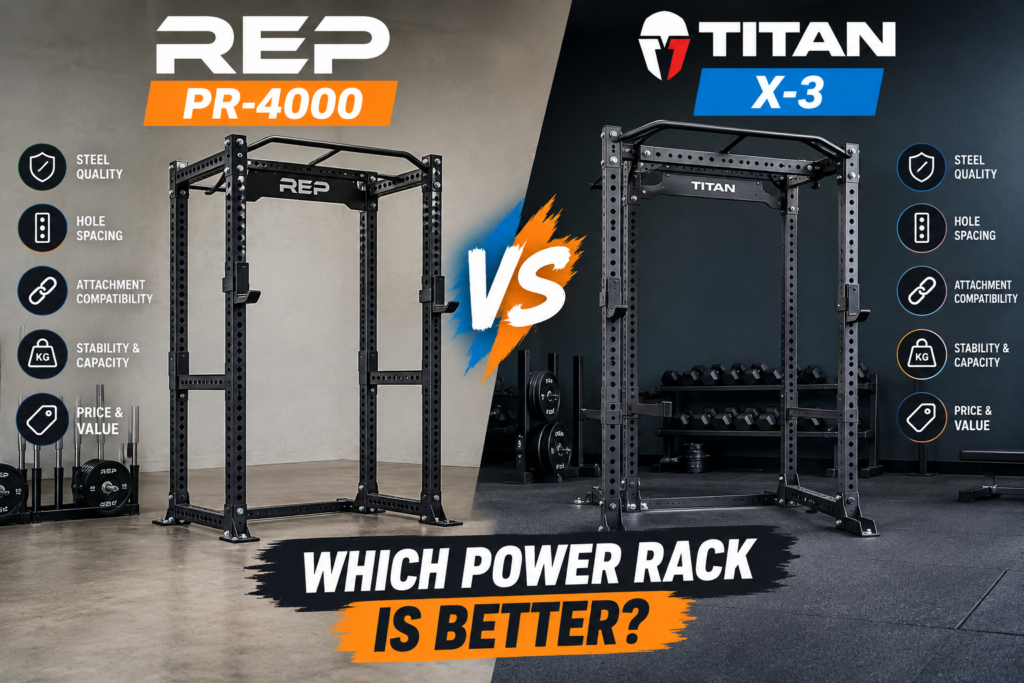
REP PR-4000 vs Titan X-3: Which Power Rack Is Better?
Disclosure: LiftQube may earn a commission if you purchase through links on this page, at no additional cost to you. LiftQube did not physically test, assemble, or measure either rack. Specs, prices, and warranty terms come from the manufacturers’ own pages, last checked October 30, 2026. Our analysis is editorial opinion.
If you plan to keep adding attachments such as cables, dips, a landmine, and storage, and you want a documented 1-inch bench zone, the REP PR-4000 is the stronger long-term pick. If you want a lower entry price, two pull-up bars in the box, and a flat-foot version that Titan designs to run without floor bolts, the Titan X-3 is the better fit. Both racks use 3×3-inch, 11-gauge steel, so the real trade-off is ecosystem and bench precision versus entry price and anchoring flexibility.
This comparison covers only the REP PR-4000 and the Titan X-3. Titan’s T-3 is a different series with smaller uprights.
- Built to Last & Stand Strong: Get a power rack that can keep up. Made with 2×2-inch commercial-grade steel, it’s built t…
- Train the Way You Want: The Major Fitness advanced dual-pulley system lets you customize your training. Use the 2:1 rati…
- Lift with Confidence: Forget shaky lifts. Our linear bearing system ensures the bar moves with zero friction. The profes…

- Maximize Space Without Compromise: Get a weight cage, squat rack, and dual-cable crossover in one compact footprint. Des…
- Engineered for Heavy Lifting: Built with 2″x3″ commercial-grade 14-gauge steel (0.08″ thick) to support a 1600lb static …
- Eliminate Frame Sway & Wobble: Our dual-triangle base design increases the contact surface area with your floor, providi…
REP PR-4000 vs Titan X-3: Quick Comparison
| Spec | REP PR-4000 | Titan X-3 |
|---|---|---|
| Steel and uprights | 3×3″ 11-gauge | 3×3″ 11-gauge |
| Hole size | 5/8″ | 11/16″ |
| Bench-zone spacing | 1″ in bench zone, 2″ elsewhere | Westside spacing through bench and clean-pull zone, 2″ above and below (exact bench increment: verify in manual) |
| Stated rackable capacity | 1,000 lb | 1,650 lb (Titan also lists 6,170 lb “whole rack”) |
| Heights | 80″ or 93″ uprights | Flat-foot: 82″ or 91″. Bolt-down: 80″ or 90″ |
| Depths | 16″, 24″, 30″, or 41″ crossmembers | Flat-foot: 30″ inside depth. Bolt-down: 24″ or 36″ inside depth |
| Width | 50.8″ (listed) | 42″ inside width. Flat-foot footprint 50″ x 48″ (82″ model) |
| Pull-up bar | Configuration-dependent (1.25″, 2″, multi-grip, or globe) | 1.25″ and 2″ bars included |
| Safeties and J-cups | Entry-level pre-selected: standard J-cups plus pin-pipe safeties. Builder: you choose | Two UHMW-lined J-hooks included. Safeties sold separately |
| Attachment ecosystem | 4000 Series (Ares/Athena cable compatible) | X-3 accessories (safeties, spotter arms, roller J-hooks, plate holders). Cable fit: not confirmed |
| Anchoring | Post-style base. REP says bolt down in most configurations | Flat-foot or bolt-down (Titan recommends bolting the bolt-down) |
| Warranty | Lifetime on rack frames and structural welds, with conditions. Pulleys and cables 1 year | 1-year limited |
| Listed price (Oct 30, 2026) | From $799.94 for the pre-selected entry-level rack. The Rack Builder page showed “starting at $1,249” | $709.97 (marked 25% off $949.99) for flat-foot and for the 90″ x 36″ bolt-down |
Prices and promotions change. Always confirm your exact configuration at checkout.
REP PR-4000 vs Titan X-3: Main Differences
Build Quality and Steel Construction
Both racks list 3×3-inch uprights in 11-gauge steel. In practical terms, that is steel roughly 0.12 inches (about 3 mm) thick, a common spec for heavy-duty home racks. Because both brands list the same size and gauge, the spec sheet alone won’t separate them.
Weld consistency, powder-coat quality, hole alignment, and hardware tolerances can differ, and we can’t judge those without hands-on testing. REP says it laser-cuts, robot-welds, and robot-paints its racks in-house. Titan’s X-3 pages describe laser-cut holes and the steel specs but make no comparable process claims. Treat both as manufacturer statements, and read recent owner feedback and return policies before buying. REP lists a 30-day money-back policy on its product page.
Weight Capacity and Heavy Lifting
Titan lists a 1,650 lb rackable capacity and a separate 6,170 lb whole-rack figure. REP lists 1,000 lb rackable. The brands set their own definitions, so don’t read this as one rack passing and the other failing.
The weakest component sets your practical limit. Titan’s bolt-down page lists the included J-hooks at a combined 1,000 lb, and its pin-and-pipe safeties are rated 550 lb. Check the rating of the exact J-cups and safeties you will use on either rack.
A higher number also doesn’t guarantee safety in every setup. Assembly, anchoring, bar path, and correct safety height all matter. Most home lifters will never approach a 1,000 lb rating, so stability and safeties usually matter more than the headline figure.
Hole Spacing and Bench Adjustments
The bench zone is the stretch of the uprights where your J-cups sit for pressing. Closer holes let you set liftoff height more precisely, which helps shorter or taller lifters and anyone using a thick bench pad. With 2-inch spacing, your best hole can sit up to an inch from ideal.
REP documents 1-inch spacing through the bench zone and 2-inch spacing elsewhere, with numbers laser-cut every fifth hole. Titan describes Westside spacing through the bench and clean-pull zone with 2-inch spacing above and below, but the pages we reviewed don’t state the exact bench increment. Confirm it in Titan’s manual.
Do not assume parts are interchangeable. REP’s PR-4000 uses 5/8-inch holes, while Titan’s X-3 uses 11/16-inch holes, and spacing patterns and attachment geometry also differ. Even within one brand, series are separate: REP’s PR-5000 uses 1-inch holes, and Titan’s TITAN Series uses 1-inch keyholes.
Dimensions, Footprint, and Ceiling Height
REP’s PR-4000 offers 80″ and 93″ uprights and 16″, 24″, 30″, or 41″ crossmember depths. Overall depth, footprint, and weight were not confirmed on the pages we checked, so use REP’s Rack Builder 3D and AR view for your space. REP says the 16″ and 24″ four-post options suit tight spaces because you can work outside the rack. It calls 30″ the most popular standard size and says 41″ suits lifters with more forward lean in the squat.
Titan’s flat-foot X-3 lists an 82″ height with a 50″ x 48″ footprint, a 42″ inside width, and a 30″ inside depth. The 91″ version’s dimensions weren’t shown on the page. Titan lists a 77″ maximum pull-up bar height on the 82″ model. The bolt-down comes in 80″ or 90″ heights and 24″ or 36″ depths. Its listed footprint (45″ x 52.5″) doesn’t match its listed outside dimensions (48″ wide, 42″ deep), so verify before you plan around it.
Before you order:
- Measure ceiling height, then subtract any lights, beams, or garage-door tracks.
- A standard Olympic bar is about 7 feet long, so plan loading room on both sides.
- Check bench clearance, especially if you use a best foldable weight bench for small spaces.
- If a car parks nearby, confirm door-swing space.
Stability: Flat-Foot vs Bolt-Down
A bolt-down rack stands on posts that you anchor to the floor. A flat-foot rack adds base members that spread the load across the floor. Titan describes its flat-foot X-3 as a no-bolt setup, and it recommends bolting down the bolt-down model.
REP is more specific. REP’s FAQ says to bolt the PR-4000 down, with one exception. A 41″-deep PR-4000 with the Rear Base Stabilizer doesn’t have to be bolted. If you add Iso Arms, Spotter Arms, or the Globe Pull-Up Bar, REP says to bolt down regardless of depth and to add Front Foot Extensions.
Stability depends on assembly, floor, and how you train. We haven’t load-tested either rack. If you can’t drill into your floor, or aren’t sure your garage slab is safe to drill, confirm that before choosing a bolt-down configuration.
Attachments and Upgrade Options
REP’s 4000 Series is the deeper ecosystem on paper. REP lists the PR-4000 as Ares and Athena compatible for cable training. Its high-end pre-selected package includes a dip station, landmine attachment, and band pegs. REP also lists spotter arms, storage shelves, and 6-post configurations. According to REP, the PR-4000 fits everything in the PR-5000 attachment lineup except the Utility Horn, Barbell Tube Stand, Barbell Hanger, and Pull-Up Bar Connector.
Titan’s X-3 pages list pin-and-pipe safeties, strap safeties, spotter arms, roller J-hooks, and plate holders. We could not confirm X-3-specific cable, dip, or landmine fit, so check Titan’s X-3 accessory listings first.
Do not mix brands without checking. REP states that it doesn’t guarantee compatibility with other companies’ products, and using them can void its warranty. If cables are your main goal, a standalone machine can be simpler. See our best cable machines under $1,000.
Included Accessories and Total Cost
The advertised base price is not a complete setup. Here is what each brand includes, per its pages:
- REP entry-level pre-selected rack: uprights, crossmembers, logo plate crossmember (required), 1.25″ pull-up bar, standard J-cups, and pin-pipe safeties.
- REP upgrades: the multi-grip pull-up bar and flat-sandwich J-cups cost more, and 6-post storage adds more again. We did not verify upgrade prices.
- Titan X-3 flat-foot: 1.25″ and 2″ pull-up bars, two J-hooks, and assembly hardware. Safeties and plate holders are extra.
On October 30, 2026, Titan’s pin-and-pipe safeties for the flat-foot X-3 were listed at $75.97. Added to the $709.97 rack, that is $785.94 before tax. That compares with REP’s $799.94 entry-level pre-selected rack, which includes safeties. These configurations aren’t identical, so treat them as a rough comparison.
Neither price includes a bar, plates, bench, or flooring. See our best bumper plates for a home gym. Both brands list free shipping, though REP’s footnote excludes Alaska, Hawaii, wholesale, and commercial orders. Taxes are calculated at checkout. REP offers optional assembly through Assembly Help, billed after service. Titan lists the flat-foot X-3 at 280 lb, so plan for a helper.
Warranty and Customer Support
REP’s warranty page lists lifetime coverage for rack frames and for structural welds on attachments and frames, and 1 year for pop-pins, pulleys, bearings, and cables. The lifetime coverage ends when the product becomes unusable for reasons other than defects. It applies only to the original purchaser, is non-transferable, and excludes products that leave the lower 48 states. REP also excludes damage from abusive bar drops, including onto spotter arms or pins. The page doesn’t itemize coverage for every non-structural attachment part, so ask REP about J-cups and safeties.
Titan’s warranty is a 1-year limited warranty for the initial retail purchaser. Claims must be filed within 90 days of a reported failure. It excludes misuse, improper assembly, and alteration, and repair or replacement is at Titan’s discretion. Titan’s product pages mention optional extended coverage through Mulberry.
Both brands list phone and email support, but we didn’t verify service quality, so read recent owner experiences yourself.
- Built to Last & Stand Strong: Get a power rack that can keep up. Made with 2×2-inch commercial-grade steel, it’s built t…
- Train the Way You Want: The Major Fitness advanced dual-pulley system lets you customize your training. Use the 2:1 rati…
- Lift with Confidence: Forget shaky lifts. Our linear bearing system ensures the bar moves with zero friction. The profes…
- Maximize Space Without Compromise: Get a weight cage, squat rack, and dual-cable crossover in one compact footprint. Des…
- Engineered for Heavy Lifting: Built with 2″x3″ commercial-grade 14-gauge steel (0.08″ thick) to support a 1600lb static …
- Eliminate Frame Sway & Wobble: Our dual-triangle base design increases the contact surface area with your floor, providi…
REP PR-4000 Review: Strengths and Limitations
What Makes the PR-4000 Worth Considering?
- Bench precision: documented 1-inch spacing in the bench zone, with numbered holes.
- Configurability: several heights, four depths, four-post or six-post builds, and seven colors.
- Ecosystem: Ares/Athena cable compatibility plus dip, landmine, storage, and spotter attachments.
- Frame warranty: lifetime coverage on rack frames and structural welds, with conditions.
Where the PR-4000 Falls Short
- Price creep: the base rack is only the start, and REP’s own pages showed two different starting prices on the same day.
- Anchoring: bolting down is the default unless you choose a 41″ rack with the Rear Base Stabilizer.
- Narrower reach than the PR-5000: a few PR-5000 attachments don’t fit, and cross-brand fit isn’t guaranteed.
- Warranty limits: the lifetime terms carry geographic, ownership, and use conditions.
Who Should Buy the PR-4000?
Buy it if you are a serious lifter planning years of upgrades, a competitive bench presser who wants documented 1-inch spacing, or someone who wants integrated cable training or extensive accessory options.
Titan X-3 Review: Strengths and Limitations
What Makes the X-3 Worth Considering?
- Lower listed entry price: $709.97 on October 30, 2026 for flat-foot or bolt-down.
- Better-equipped base rack: both pull-up bars and J-hooks are included.
- Capacity headroom: a 1,650 lb listed rackable capacity.
- Anchoring choice: a flat-foot version for people who don’t want to drill, plus bolt-down versions in six colors.
Where the X-3 Falls Short
- Shorter warranty: 1 year, versus REP’s lifetime frame coverage.
- Safeties cost extra.
- Thinner documentation: the exact bench-zone increment and cable-attachment fit weren’t confirmed.
- Flat-foot is limited to one 30″ depth, and its 50″ x 48″ footprint is larger than a bolt-down rack’s.
Who Should Buy the X-3?
Buy it if you are budget-conscious, want a rack that doesn’t require floor anchoring, or want a solid 3×3 rack without a big accessory ecosystem.
Which Rack Is Better for Different Home Gyms?
Budget-focused setup: The X-3 usually costs less to get started, especially with the two bars included. Add safeties before comparing totals.
Heavy squat and bench training: Either rack works. Pick based on safeties, stability, and bench-zone spacing rather than the capacity number.
Limited ceiling height: Compare the shorter options, which are 80″ (REP) and 80″ bolt-down or 82″ flat-foot (Titan). Measure first.
Garage gym without floor drilling: The Titan flat-foot is the more straightforward match. The PR-4000 can skip bolting only in the 41″ Rear Base Stabilizer setup, and not with Iso Arms, Spotter Arms, or the Globe bar.
Cable training and future expansion: The PR-4000 has the better-documented path. If space is the issue, a best power tower for home workouts can be a smaller alternative.
Precise bench adjustments: The PR-4000’s 1-inch bench zone is documented. The X-3’s Westside pattern is aimed at the same goal, but check its exact increments.
- Built to Last & Stand Strong: Get a power rack that can keep up. Made with 2×2-inch commercial-grade steel, it’s built t…
- Train the Way You Want: The Major Fitness advanced dual-pulley system lets you customize your training. Use the 2:1 rati…
- Lift with Confidence: Forget shaky lifts. Our linear bearing system ensures the bar moves with zero friction. The profes…
- Maximize Space Without Compromise: Get a weight cage, squat rack, and dual-cable crossover in one compact footprint. Des…
- Engineered for Heavy Lifting: Built with 2″x3″ commercial-grade 14-gauge steel (0.08″ thick) to support a 1600lb static …
- Eliminate Frame Sway & Wobble: Our dual-triangle base design increases the contact surface area with your floor, providi…
REP PR-4000 vs Titan X-3: Which Is Better Value?
Compare complete configurations, not base prices. For a basic setup, the X-3 can come out slightly cheaper or close. By our rough math, the two are about $14 apart once Titan’s safeties are added.
Value shifts as you add accessories. If you expect to add cables, dips, a landmine, or storage, REP’s documented ecosystem and lifetime frame warranty may justify paying more. If you want a straightforward rack and don’t expect to expand, the X-3’s entry price and included bars may be enough.
Either way, budget separately for a bar, plates, a bench, flooring, and any anchors or assembly help.
Final Verdict
There is no single winner. By buyer type:
- Budget buyer: Titan X-3.
- Serious lifter planning upgrades: REP PR-4000.
- Competitive bench presser: REP PR-4000, because its 1-inch bench zone is documented.
- Limited space: depends on your measurements, so compare actual dimensions.
- No floor anchoring: Titan X-3 flat-foot.
- Cable training or extensive accessories: REP PR-4000.
The main trade-offs are REP’s ecosystem and warranty against Titan’s lower entry price and flat-foot flexibility. Whichever rack you choose, we haven’t tested either, so verify specs and read return policies.
For the REP PR-4000, check pricing and options in the REP PR-4000 Rack Builder, see the pre-selected PR-4000 packages, and read REP’s rack guide. For the Titan X-3, see the Titan X-3 flat-foot rack and the X-3 bolt-down rack. Titan’s power rack comparison and pin-and-pipe safeties pages are useful for accessory planning. You can read the warranty terms directly at REP and Titan.
