

Affiliate disclosure: this post contains affiliate links; LiftQube may earn a commission on qualifying purchases at no extra cost to you. –>
Best Rowing Machine for Apartments in 2026: Quiet, Compact & Space-Saving Picks
If you’ve ever tried to fit a rowing machine into a one-bedroom apartment, you already know the problem isn’t just “which rower is good” — it’s “which rower won’t take over my living room, annoy my downstairs neighbor, or become impossible to move on laundry day.” Most buying guides treat apartment shoppers the same as garage-gym owners with 200 square feet to spare. That’s not you.
This guide is built specifically around apartment constraints: shared walls, limited floor space, weight limits on your own strength (not just the machine’s), and landlords who care about floor damage. Below, we break down the best rowing machine for apartments in 2026 by resistance type, footprint, noise behavior, and real-world storage — not just spec-sheet numbers.
Quick disclosure: this article contains affiliate links, and LiftQube may earn a commission on qualifying purchases at no extra cost to you. We have not physically tested every machine listed here; our recommendations are based on manufacturer specifications, published third-party testing, and verifiable product data, which we note throughout.
1. Quick Answer: What Is the Best Rowing Machine for an Apartment?
If you only read one section, read this one.
- Best overall for apartments: Concept2 RowErg — no subscription, separates into two pieces, quiet air resistance with adjustable damper, and the most field-proven machine in the category.
- Best budget option: Sunny Health & Fitness SF-RW5515 — folds vertically, magnetic resistance, and typically the cheapest legitimate option on this list.
- Best quiet magnetic rower: Yosuda Magnetic Rowing Machine — non-contact magnetic resistance with no chain or fan noise.
- Best for very small studios: Sunny Health & Fitness Space Efficient Rower — the shortest footprint here at 72 inches, and light enough to lift into a closet.
- Best premium apartment rower: Hydrow Wave — built-in vertical storage, whisper-quiet electromagnetic resistance, and a genuinely smaller footprint than most smart rowers.
Why these five: each one solves a different apartment problem. The Concept2 solves “I want one machine, forever, with no ongoing fees.” The Sunny SF-RW5515 solves “I have $250 and a small budget.” The Yosuda solves “I need magnetic quiet without paying smart-rower prices.” The Sunny Space Efficient Rower solves “I have a genuinely tiny apartment.” The Hydrow Wave solves “I want a premium, guided workout experience without giving up half my living room.”
We cover two more machines in detail below — the WaterRower Natural for tall users, and the Ergatta Lite for water resistance with gamified programming — because they solve problems the top five don’t.
2. Best Rowing Machines for Apartments at a Glance
| Rowing Machine | Best For | Resistance | Apartment Noise Profile | Machine Size (In Use) | Storage Method | Weight Capacity | Subscription | Approx. Price |
|---|---|---|---|---|---|---|---|---|
| Concept2 RowErg | Best overall | Air (adjustable damper) | Low mechanical noise; audible airflow “whoosh” from the fan | 96″ L x 24″ W x 14″ H | Separates into 2 pieces; can also stand vertically | 500 lbs | None | $990–$1,155 (concept2.com) |
| Sunny Health & Fitness SF-RW5515 | Best budget | Magnetic (8 levels) | Quiet; no fan or chain noise | ~82″ L x 19″ W x 23″ H | Folds vertical | 250 lbs | None (free app) | Check current price |
| Yosuda Magnetic Rowing Machine | Best quiet magnetic | Magnetic (16 levels) | Quiet; non-contact system | ~75″ L x 19″ W x 27.5″ H | Folds vertical, ~4 sq. ft. stored | 350 lbs | None (optional app) | Check current price |
| Sunny Health & Fitness Space Efficient Rower | Best for very small apartments | Magnetic (16 levels) | Quiet | 72″ L x 18.5″ W x 24.8″ H | Folds vertical, fits a standard closet | 285 lbs | None | Check current price |
| WaterRower Natural (Original) | Best for tall users | Water | Soft water “swish” instead of mechanical noise | 82.25″ L x 22.25″ W x 20″ H | Stands vertically, no folding | 700 lbs | None | From ~$1,199 (waterrower.com) |
| Hydrow Wave | Best premium | Electromagnetic | Very quiet; the loudest sound is usually the seat rail | 80″ L x 19″ W x 43″ H | Built-in vertical storage anchor | 375 lbs | $44/mo. recommended for full library | $1,695 (hydrow.com) |
| Ergatta Lite | Best water-resistance/gamified | Water (dynamic) | Quiet; water tank plus strap noise | 82″ L x 23″ W x 38″ H | Folds and stores upright, no kit required | 320 lbs | Optional, $39/mo. (works without it) | $1,699 (ergatta.com) |
Prices fluctuate by retailer and promotion — click through to check the current price before buying rather than relying on any number printed here.
3. How We Chose the Best Rowing Machines for Apartments
We did not physically test every rowing machine in this guide inside an apartment setting. Where we reference hands-on impressions, we’re citing published, attributed third-party testing (linked throughout) rather than claiming our own. Our picks are based on specifications, available evidence, and published information, evaluated against criteria that matter specifically for apartment living:
- Apartment suitability — does the machine’s design, weight, and resistance type genuinely fit renter constraints?
- Noise behavior — what kind of sound does the resistance mechanism realistically produce (not marketing claims of “silent”)?
- Vibration potential — does the stroke motion or flywheel create floor-transmitted vibration, separate from airborne noise?
- Footprint — both in-use and storage dimensions, since these are often very different.
- Storage method — does it fold, separate, or stand vertically, and how much effort does that take?
- Resistance type and feel — air, magnetic, water, or hydraulic, and what that means for apartment use.
- Build quality and comfort — seat, rail, footplates, and overall durability based on manufacturer and reviewer consensus.
- Weight capacity — matched against realistic apartment-dweller needs.
- Tall-user suitability — rail length and inseam accommodation, verified against manufacturer specs.
- Technology — display, app support, and connectivity.
- Subscription cost — what’s required versus optional, and the real long-term cost.
- Value — price relative to what the machine actually delivers.
We prioritized brands with verifiable, published specifications over lesser-known models we couldn’t confirm. If a product’s dimensions or capacity varied across sources, we noted the discrepancy rather than picking a number at random.
4. Best Rowing Machine for Apartments: Detailed Reviews

- Indoor rowing is an effective full-body and low-impact workout; flywheel design minimizes noise while maximizing a smoot…
- Includes the performance monitor 5, giving you accurate, comparable data for every row; Adjustable monitor arm
- 20-Inch seat height, nickel-plated chain, Adjustable footrests and ergonomic handle; Construction: Welded steel
4.1. Concept2 RowErg — Best Overall for Apartments
Best for: Renters who want one durable machine with no recurring costs Resistance: Air, with an adjustable damper (1–10) to fine-tune the feel Weight capacity: 500 lbs as tested by Concept2 (300 lbs under the European EN 20957-7 standard — worth knowing if you’re near that threshold) Dimensions: 96″ L x 24″ W x 14″ H (standard legs); 20″ seat height on the tall-leg version Storage: Separates tool-free into two pieces, or can be stood up in one piece Subscription: None — the PM5 monitor works standalone, with optional free apps like ErgData Apartment score: Excellent
Why We Recommend It
The Concept2 RowErg (formerly the Model D) is the rower most gyms, CrossFit boxes, and competitive rowers train on, and for apartment dwellers that pedigree matters: it’s a known quantity with a huge secondhand market, widely available replacement parts, and a five-year frame warranty. At $990 for the standard-leg version directly from Concept2’s official site, it also undercuts most of the “smart” rowers on this list by hundreds of dollars while requiring zero ongoing membership.
Pros
- No subscription, ever — the PM5 monitor is fully functional out of the box
- Separates into two pieces in seconds without tools, which genuinely halves the storage footprint
- 500-lb weight capacity is the highest of any non-water-resistance machine on this list
- Runs on two D-cell batteries, so it doesn’t need to be near an outlet
- Enormous secondhand and parts market if something breaks
Cons
- At 96 inches long, it needs more in-use floor space than most magnetic rowers
- Air resistance produces an audible “whoosh” from the fan that some apartment dwellers find more noticeable than magnetic resistance, even though it’s not loud in absolute terms
- The basic PM5 display looks dated next to touchscreen competitors
- No guided workout content unless you pair it with a third-party app or subscription like ErgZone
Apartment Noise & Vibration
The RowErg’s main noise source is the fanned flywheel moving air — a whooshing sound that scales with your stroke intensity, plus a smooth, low-volume chain noise from the nickel-plated drive chain. It doesn’t clank or grind. Vibration is generally minimal because the seat and rail system is well-engineered and the frame is light, but any rower can transmit some low-frequency thump through hardwood or unsupported floors if you row aggressively — see Section 8 for how to reduce that.
Storage & Footprint
In use, you need roughly 8 feet by 2 feet of floor space, with Concept2 recommending 9 feet by 4 feet of clearance for full range of motion. For storage, the monorail detaches and the unit breaks into two pieces measuring roughly 25″ x 33″ x 54″ — small enough to lean in a closet corner or slide under a bed frame with clearance. You can also keep it fully assembled and tilt it up on its end against a wall.
Who Should Buy It
Anyone who wants a rower that will outlast their lease, doesn’t want a subscription, and doesn’t mind that it’s not the most compact machine when in use.
Who Should Skip It
If your studio genuinely can’t spare an 8-foot rowing lane even occasionally, or if you specifically want the mechanically quietest possible resistance type for a shared wall, a magnetic or water rower (below) may suit you better.
If you’re building out a full home gym alongside your rower, our Best Power Tower for Home Workouts guide covers another space-efficient way to add strength training without a rack.

- ROWING MACHINE: With a simple twist, you can increase or decrease the 8 levels of magnetic resistance, so your workout c…
- ADJUSTABLE MAGNETIC RESISTANCE: With a simple twist, you can increase or decrease the 8 levels of magnetic resistance, s…
- DIGITAL MONITOR: The large LCD console displays time, count, calories, total count, and scan. The convenient scan mode d…
4.2. Sunny Health & Fitness SF-RW5515 — Best Budget Rowing Machine
Best for: First-time buyers on a tight budget who still want a folding, magnetic machine Resistance: Magnetic, 8 adjustable levels Weight capacity: 250 lbs Dimensions: Approximately 82″ L x 19″ W x 23″ H (listed dimensions vary slightly by retailer, between roughly 78–89 inches long depending on the source) Storage: Folds vertically to about 43″ L x 19″ W x 52″ H, per Sunny’s own product page Subscription: None — the optional SunnyFit app is free Apartment score: Very good
Why We Recommend It
This is one of the most widely sold budget rowers in the U.S., and its magnetic resistance system is inherently apartment-friendly: there’s no fan, no chain clatter, and the folding frame genuinely collapses down to something you can wheel into a closet. It won’t match the build quality of a Concept2, but for the price, it’s a legitimate entry point for someone who isn’t ready to spend $1,000+ before they know if rowing will stick.
Pros
- Among the least expensive rowing machines with real folding storage
- 8 levels of magnetic resistance cover beginner through moderate-intensity workouts
- Built-in transport wheels
- Free companion app for basic tracking
Cons
- 250-lb weight capacity is on the low end for this category
- Resistance ceiling is modest — experienced rowers will outgrow it quickly
- LCD display is basic, with no workout programming
- Reported durability concerns after heavy, sustained use (multiple owner reviews)
Apartment Noise & Vibration
Magnetic resistance is inherently quiet because there’s no air being pushed and no chain contact — the sound you’ll hear is mostly the seat rolling on its rail and your own breathing. Vibration is low given the machine’s light weight, though a lighter frame can also feel less planted during hard pulls, so a mat helps both noise and stability here.
Storage & Footprint
In use, it’s a fairly standard rower footprint at roughly 7 feet long. Folded, it stands about 4.5 feet tall and under 2 feet wide — small enough for most closets, behind a couch, or a bedroom corner.
Who Should Buy It
Budget-conscious renters and rowing beginners who want to test the format before investing in a premium machine.
Who Should Skip It
Users over roughly 220–230 lbs who want headroom under the weight limit, or anyone planning frequent high-intensity interval training who’ll find the resistance ceiling too low.
- 💪【Full-Body Low-Impact Cardio Training】Engage over 85% of your muscles in every stroke. This rowing machine delivers an …
- 🔧【Stability You Can Trust】YOSUDA rowing machines with wider tracks outperform those with more tracks but narrower tracks…
- 🔇【Apartment-Approved Silence】Engineered with stable magnetic resistance and features industrial-grade, smooth-gliding PU…
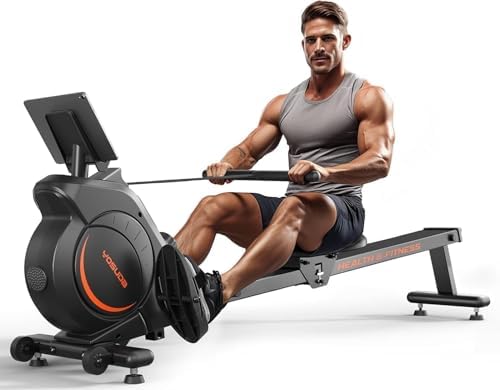
4.3. Yosuda Magnetic Rowing Machine — Best Quiet Magnetic Rower
Best for: Shared-wall apartments where mechanical quiet is the top priority Resistance: Magnetic, 16 adjustable levels Weight capacity: 350 lbs Dimensions: Approximately 74.8″–75″ L x 19.3″ W x 27.5″–27.6″ H, depending on the specific model variant Storage: Folds to roughly 28.7″ L x 19.3″ W x 51.2″ H — about 4 square feet of floor space Subscription: None — Bluetooth connectivity to a free companion app is optional Apartment score: Very good
Why We Recommend It
Yosuda’s magnetic rowers use a non-contact resistance system, meaning the flywheel never physically touches the magnets that create tension — that design is a meaningful part of why owners consistently describe it as quiet enough for early morning or late-night sessions. With a 350-lb weight capacity and accommodation for users up to roughly 6’6″–6’7″ depending on the model, it fits a wider range of bodies than most budget rowers.
Pros
- 16 resistance levels give more range than most budget-tier magnetic rowers
- Non-contact magnetic system stays quiet over years of use, with minimal maintenance
- Folds to about 4 square feet — genuinely closet-sized
- Higher weight capacity (350 lbs) than most rowers in its price range
Cons
- No subscription needed, but also no built-in workout programming — you’re rowing “naked” unless you pair a fitness app
- Basic LCD display, not a touchscreen
- Slide rail length is shorter than a Concept2 or WaterRower, which matters for very tall users (see Section 6)
Apartment Noise & Vibration
Because the resistance is fully magnetic and non-contact, there’s no fan whoosh and no chain noise — the dominant sound is the seat gliding on its rail. This makes it one of the better choices for genuinely thin apartment walls, though as with any rower, hard, jerky strokes can still transmit some vibration through the floor regardless of how quiet the resistance mechanism is.
Storage & Footprint
In use, it’s noticeably shorter than an air or water rower at under 6.5 feet. Folded, its roughly 4-square-foot footprint is among the smallest of any rower on this list, making it a strong fit for bedroom or living-room storage in a one-bedroom or studio.
Who Should Buy It
Anyone prioritizing mechanical quiet above all else, especially those in older buildings with shared walls or upstairs/downstairs neighbors.
Who Should Skip It
Serious or competitive rowers who want the precise, consistent resistance feel of air or water — magnetic resistance is smooth but feels noticeably different underhand.

- 【MAGNETIC ROWER WITH ELASTIC ROPE REBOUND SYSTEM】Newly designed rowing machine features an elastic rope rebound system, …
- 【ENHANCED STAINLESS-STEEL COVERED RAIL】Experience a quieter workout with our advanced stainless steel covered slide rail…
- 【16 LEVELS OF PRECISION MAGNETIC RESISTANCE】Tailor your workout intensity with 16 customizable resistance levels. This s…
4.4. Sunny Health & Fitness Space Efficient Rower — Best for Very Small Apartments
Best for: Studios and micro-apartments where every square foot counts Resistance: Magnetic, 16 levels Weight capacity: 285 lbs Dimensions: 72″ L x 18.5″ W x 24.8″ H — the shortest in-use footprint on this list Storage: Folds vertically; front-mounted transport wheels Subscription: None Apartment score: Very good
Why We Recommend It
At 72 inches long, this is roughly two feet shorter in use than a Concept2 or WaterRower, which is a meaningful difference in a studio where you might be rowing in a living room that doubles as your bedroom. It’s also light — reported weights range from about 49 to 53 lbs depending on the source — which matters if you’re the one lifting it into a closet by yourself.
Pros
- Shortest in-use footprint of any rower in this guide
- Light enough for one person to lift and carry, not just roll
- 16 resistance levels is generous for this price tier
- Folds to fit inside an average closet
Cons
- 285-lb weight capacity, while decent for a budget rower, is still lower than premium options
- Shorter rail length may feel cramped for users over roughly 6 feet tall
- Basic digital monitor with no app-based programming beyond simple stat tracking
Apartment Noise & Vibration
Like other magnetic rowers on this list, it avoids fan and chain noise entirely. Its lighter frame means slightly more attention to leveling and floor contact is worthwhile — a rubber mat noticeably improves both stability and vibration damping on this machine specifically, given its lower weight compared to steel-heavy competitors.
Storage & Footprint
This is the standout: a 72-inch working length is short enough to fit rowing strokes into corners or nooks that wouldn’t accommodate an 82–96 inch machine. Folded, it’s compact enough to store behind a door or in a coat closet.
Who Should Buy It
Studio-apartment dwellers and anyone who needs the absolute shortest in-use rowing lane on this list.
Who Should Skip It
Taller users (above roughly 6’1″–6’2″) who need a longer rail for full extension, and anyone who wants a higher weight ceiling.

- ORIGINAL WATER ROWING EXPERIENCE: Built around WaterRower’s original WaterFlywheel concept, this water rowing machine fo…
- HANDCRAFTED | MADE IN THE USA: Designed and manufactured in the United States using Appalachian sourced, ethically harve…
- COMMERCIAL GRADE BUILD & U.S. SUPPORT: WaterRower uses commercial grade components across its residential products, with…
4.5. WaterRower Natural (Original) — Best for Tall Users
Best for: Taller rowers who need real rail length, and anyone who wants a no-subscription water rower Resistance: Water Weight capacity: 700 lbs, per WaterRower’s own product listing Max inseam: 37″ Dimensions: 82.25″ L x 22.25″ W x 20″ H Storage: Stands vertically on its end — no folding mechanism needed Subscription: None — the S4 performance monitor works standalone; a Bluetooth ComModule upgrade is optional Apartment score: Excellent
Why We Recommend It
The WaterRower’s 37-inch maximum inseam and dual-rail wood construction mean it comfortably accommodates users up to roughly 6’6″–6’7″, which is longer than the rail length on most magnetic rowers in this guide. Its 700-lb weight capacity is also the highest on this list. It doesn’t fold, but it doesn’t need to — the entire unit tips up onto its end for storage, occupying roughly 20 inches by 22 inches of floor space while standing about 82 inches tall.
Pros
- Highest published weight capacity in this guide, at 700 lbs
- Long rail and 37″ max inseam genuinely suit tall users
- Solid hardwood frame (ash, oak, cherry, or walnut depending on model) that many reviewers describe as naturally sound-dampening
- No subscription, no required app
Cons
- Doesn’t fold — vertical storage requires roughly 7 feet of ceiling clearance
- Among the pricier non-smart options, starting around $1,199 for the base wood finish
- Water tank needs periodic tablet treatment and occasional refilling
- Heavier than magnetic budget rowers, at roughly 63.5–67 lbs dry and over 100 lbs filled
Apartment Noise & Vibration
Water resistance produces a distinctive rushing, splashing sound rather than mechanical noise — many owners describe it as soothing rather than disruptive, though it is audible, not silent, and that sound will be more noticeable through open floor plans than a magnetic rower’s near-silence. Its solid wood frame and dual-rail design are frequently cited by reviewers as contributing to a stable, low-vibration stroke compared to lighter steel-frame machines.
Storage & Footprint
In use, it needs the same roughly 8-foot lane as most full-size rowers. What sets it apart is genuinely effortless vertical storage — most reviewers note it can be tipped upright single-handedly despite its weight, then rolled on its built-in casters into a corner.
Who Should Buy It
Tall users, anyone who wants a subscription-free water rower, and renters who have the ceiling height for vertical storage but not the floor space for a permanently set-up machine.
Who Should Skip It
Buyers on a tight budget, or anyone in a unit with low ceilings (under roughly 7 feet in the storage spot) who can’t accommodate the vertical stow.

- TRY FREE FOR 30 DAYS – Every Wave row machine ships with a free 30-day Hydrow Membership trial — 6,000+ live and on-dema…
- FULL-BODY WORKOUT IN 20 MINUTES – The Hydrow Wave rowing machine engages 86% of your muscles in a single stroke — legs, …
- FEELS LIKE OPEN WATER – Hydrow’s patented electromagnetic drag technology replicates the smooth, dynamic pull of rowing …
4.6. Hydrow Wave — Best Premium Apartment Rower
Best for: Renters who want guided, on-demand workouts without the bulk of a full-size smart rower Resistance: Electromagnetic (“magnetic drag”) Weight capacity: 375 lbs Max inseam: 36″ Dimensions: 80″ L x 19″ W x 43″ H Storage: Built-in vertical storage anchor (no separate kit required, unlike Hydrow’s Origin and Arc models) Subscription: $44/month is recommended for full access to Hydrow’s workout library; per Hydrow’s own product page, the touchscreen and content library are built around an active membership Apartment score: Excellent
Why We Recommend It
The Wave is Hydrow’s compact model, and the difference is real: at 80″ x 19″ x 43″, it’s about 6 inches shorter and 6 inches narrower than the original Hydrow Pro Rower, and at 102 lbs, it’s roughly 40 lbs lighter. Unlike Hydrow’s larger models, the Wave includes built-in vertical storage rather than requiring a separate ~$80 storage kit, which is a real apartment-specific advantage.
Pros
- Genuinely more compact and lighter than Hydrow’s full-size models
- Built-in vertical storage, no extra hardware purchase needed
- Electromagnetic resistance is widely reported as very quiet
- 16″ HD touchscreen with live and on-demand workouts led by real athletes
Cons
- $44/month membership is effectively required to get full value from the touchscreen and workout library
- 375-lb weight capacity, while solid, is lower than the Concept2 or WaterRower
- At $1,695+, it’s a meaningfully larger investment than any magnetic budget rower on this list
- Requires a standard electrical outlet, unlike the fully mechanical options here
Apartment Noise & Vibration
Electromagnetic resistance has no physical contact between the flywheel and the resistance mechanism, which is why reviewers consistently describe it as one of the quietest resistance types available — you’re more likely to hear the workout audio than the machine itself. As with any rower, vigorous stroke technique can still create some floor-transmitted vibration independent of the resistance system’s own noise level.
Storage & Footprint
This is the Wave’s core selling point for apartments: its stored footprint of roughly 26.5″ W x 30″ D x 82″ H requires no additional wall anchor kit, a real difference from Hydrow’s larger Origin and Arc models, which need a separately purchased storage kit to stand upright.
Who Should Buy It
Renters who want structured, coached workouts and are comfortable paying a monthly fee for that experience, and who specifically need the smallest stored footprint among Hydrow’s lineup.
Who Should Skip It
Anyone who doesn’t want a recurring subscription cost, or who has already invested in a home gym setup — pairing a smart rower with equipment like a Bowflex SelectTech 552 adjustable dumbbell set can round out a small-space strength routine without the membership fees stacking up.
- 💪【Full-Body Low-Impact Cardio Training】Engage over 85% of your muscles in every stroke. This rowing machine delivers an …
- 🔧【Stability You Can Trust】YOSUDA rowing machines with wider tracks outperform those with more tracks but narrower tracks…
- 🔇【Apartment-Approved Silence】Engineered with stable magnetic resistance and features industrial-grade, smooth-gliding PU…
4.7. Ergatta Lite — Best Water-Resistance / Gamified Option
Best for: Renters who want gamified programming without a mandatory subscription Resistance: Water (dynamic — resistance adjusts automatically to your effort, with no manual lever) Weight capacity: 320 lbs Max inseam/height: 38″ inseam, up to about 6’4″ Dimensions: 82″ L x 23″ W x 38″ H Storage: Folds and stores upright with no additional equipment required Subscription: Optional — $39/month, with discounted annual plans as low as roughly $27/month; per Ergatta’s own FAQ, the rower is fully functional without a membership, including a Free Row mode, heart-rate support, and Strava integration Apartment score: Very good
Why We Recommend It
The Ergatta Lite is built on a WaterRower-style frame but adds a 17.3″ touchscreen with game-based, competitive workouts. Its main apartment advantage over the full-size Ergatta and over Hydrow’s larger models is weight: at roughly 72 lbs filled and 40 lbs dry, it’s meaningfully lighter and easier for one person to fold and stow than most smart rowers.
Pros
- Genuinely functions without a subscription, unlike some smart rowers where the screen is largely inert without one
- Lighter than most water or smart rowers, making solo storage realistic
- Folds and stores upright without a separate storage kit
- Water resistance offers a natural, air-rower-like feel with less mechanical noise
Cons
- 320-lb weight capacity is the lowest of the “premium” options on this list
- At 72 lbs even when empty of extra hardware, some reviewers note it feels less sturdy standing upright than heavier machines, particularly around kids or pets
- $1,699 base price, before any optional membership, is a significant investment
- Gamified programming is rowing-specific — there’s no off-machine workout content like some competitors offer
Apartment Noise & Vibration
Water resistance is inherently quiet, and because Ergatta’s system adjusts dynamically to your effort rather than using a mechanical lever, there’s no clicking or ratcheting sound during resistance changes. The main audible elements are the water tank’s natural sound and the nylon drive strap, both of which reviewers describe as unobtrusive rather than silent.
Storage & Footprint
In use, it needs a similar 7-foot lane to other full-size rowers. For storage, the touchscreen arm folds flat and the whole unit rolls upright on its own casters — no wall mount or drilling required, which matters if you’re renting and can’t modify walls.
Who Should Buy It
Renters who want gamified, competitive workouts but don’t want to be locked into paying for a subscription just to use the machine at all.
Who Should Skip It
Heavier users near or above the 320-lb capacity, and budget-focused buyers who’d rather put $1,700 toward the Concept2 plus a separate fitness app.
5. Magnetic vs Air vs Water vs Hydraulic Rowers for Apartments
| Resistance Type | Noise | Workout Feel | Maintenance | Storage | Apartment Suitability |
|---|---|---|---|---|---|
| Magnetic | Quietest of the four — no fan or chain contact | Smooth, consistent, less “natural” feel than air or water | Minimal — no fluid, no belt wear typically | Usually folds; often the lightest machines | Excellent for shared walls |
| Air | Low mechanical noise, but audible airflow “whoosh” that scales with effort | Widely regarded as the most realistic, responsive feel; resistance increases with your effort automatically | Occasional chain oiling on some models | Often separates into two pieces rather than folding flat | Good, but not the quietest option |
| Water | Soft rushing/splashing sound instead of mechanical noise | Natural, rower-boat feel; resistance responds to stroke power | Occasional water treatment tablets, rare refills | Frequently stands vertically without folding | Good to excellent, especially for those who want a “quiet but not clinical” sound |
| Hydraulic | Can produce more mechanical clunk at the stroke catch/finish than the other three types | Less smooth, often criticized for inconsistent resistance through the stroke | Cylinders can wear or leak over years of use | Usually the most compact, foldable machines | Workable in a pinch, but generally the weakest choice of the four for apartment comfort — we did not include a hydraulic pick in this guide because we couldn’t find one with verifiable specs that matched our apartment criteria |
Shared walls: Magnetic resistance is generally the safest bet, since it produces no fan or chain sound at all — only the seat rail and your own breathing.
Upstairs apartments (floor-impact concern for the unit below you): All four resistance types create similar floor contact from the seat’s back-and-forth motion; the resistance type itself doesn’t meaningfully change vibration transmitted downward. A rubber mat matters more here than resistance type — see Section 8.
Small studios: Magnetic rowers tend to be the lightest and most foldable, making them the easiest to store in a genuinely tiny footprint.
Serious rowing training: Air resistance (like the Concept2) is the standard for competitive and CrossFit-style training because its feel and metrics are the most widely recognized benchmark in the sport.
Beginners: Magnetic resistance’s forgiving, adjustable-lever feel makes it easy to dial in an appropriate intensity without needing to learn stroke power management the way air and water rowers reward.
Budget buyers: Magnetic rowers dominate the sub-$500 market, making them the most accessible entry point.
6. How Much Space Do You Really Need for a Rowing Machine?
Manufacturer dimensions only tell part of the story. Here’s what to actually measure before you buy:
- Required workout area: Most full-size rowers need roughly 7–9 feet of length and 2–4 feet of width when you factor in the extension of your arms and legs at full stroke, not just the machine’s static footprint. Concept2, for example, recommends 9 feet by 4 feet of clearance for comfortable use even though the machine itself is only 96″ x 24″.
- Clearance around the machine: Leave a few extra inches on each side beyond the frame — you’ll be swinging your arms and adjusting your seating position, and bumping a wall or furniture mid-stroke is both annoying and a fall risk.
- Storage area: Compare a machine’s storage dimensions, not just its in-use length, to the actual closet, corner, or under-bed space you have in mind — and physically measure that space rather than eyeballing it.
- Ceiling considerations for vertical storage: Machines that store upright (WaterRower, Ergatta, Hydrow Wave) need enough ceiling height to accommodate their stored height, which can run 80+ inches. A WaterRower stored vertically is about 82 inches tall — measure your ceiling and any overhead light fixtures before assuming it’ll fit.
- Door and closet clearance: If a machine folds but doesn’t detach, measure your doorway width and any hallway turns you’ll need to navigate to get it into storage — some folded dimensions are still too wide for a narrow apartment hallway.
- Moving path: Walk the actual path from your workout spot to your storage spot, factoring in furniture, and consider whether you can do this solo or will need help.
There’s no single universal square-footage number that works for every apartment — check the manufacturer’s exact dimensions for your specific machine and always allow a buffer beyond the bare minimum for comfortable use.
7. Are Rowing Machines Too Loud for Apartments?
Not inherently — but “quiet” doesn’t mean the same thing for every resistance type, and no manufacturer’s rower is genuinely silent.
- Magnetic resistance is the quietest mechanical option, since there’s no fan noise and no chain contact — the dominant sound is the seat gliding on its rail.
- Air resistance (like the Concept2) produces an audible fan “whoosh” that scales with how hard you’re pulling. It’s not loud in absolute terms, but it’s more noticeable than magnetic resistance, especially at higher intensity.
- Water resistance creates a soft rushing or splashing sound as the paddle moves through the tank — many people find it pleasant, but it is audible through open floor plans.
- Hydraulic resistance can introduce more of a mechanical clunk at the catch and finish of each stroke compared to the other three types.
- Floor vibration is a separate issue from airborne noise entirely — a mechanically silent magnetic rower can still transmit thumping through an unsupported floor if your stroke technique is aggressive or the machine isn’t leveled and padded.
- Rubber mats significantly reduce both noise transmission and floor vibration, regardless of resistance type — this is one of the highest-impact, lowest-cost changes you can make (see Section 8).
- Workout timing still matters — even a quiet machine used at 11 p.m. in a building with old floors can be audible to neighbors below.
- Shared walls transmit sound differently than shared floors — a magnetic rower against a shared wall is usually a non-issue, while the same machine on an unsupported wood floor above a neighbor may still need a mat.
No manufacturer here claims — and we won’t claim on their behalf — that any rowing machine is “completely silent.” Every resistance type produces some sound and some potential for floor vibration; the differences above are about degree, not absolute silence.
8. How to Reduce Rowing Machine Noise and Vibration in an Apartment
- Use a proper floor mat. A dense rubber gym mat placed fully under the machine’s footprint (not just under the wheels) absorbs both airborne noise and floor vibration more effectively than carpet alone.
- Level the machine. Even a slight wobble on an uneven floor can turn a quiet stroke into a rhythmic knock. Most rowers have adjustable feet or leveling pads — use them, and check level again after moving the machine.
- Check for loose hardware periodically. A rattling bolt or loose seat roller can turn a quiet machine noisy over time; a quick monthly hardware check (especially on budget magnetic rowers) prevents this.
- Avoid aggressive, jerky movement. A smooth, controlled stroke — legs, then back, then arms, in that order and reversed on the recovery — produces less impact noise and vibration than yanking the handle or slamming the seat back on the return.
- Choose quieter resistance if noise is your top concern. If you’re deciding between two otherwise-similar machines, magnetic and water resistance are generally quieter than air, and dramatically quieter than hydraulic.
- Position the machine away from shared walls when possible. Even a few extra feet of distance from a shared wall reduces how much sound transmits to a neighboring unit.
- Avoid late-night or very early sessions on upper floors. Sound that’s a non-issue at 6 p.m. can be far more noticeable to a downstairs neighbor at 11 p.m., when ambient noise in the building drops.
9. Foldable vs Upright vs Two-Piece Rowing Machines
Foldable rowers (most magnetic budget models, like the Sunny SF-RW5515 and Yosuda) hinge at the midpoint and fold the rail up toward the flywheel housing, typically standing 4–5 feet tall when folded. Best for renters who want the smallest possible footprint and don’t mind a slightly less refined fold-and-unfold ritual before every workout.
Upright/vertical-storage rowers (WaterRower, Ergatta, and Hydrow’s models) don’t fold at all — the entire assembled unit tips up onto its end. Best for those with sufficient ceiling clearance who want to avoid the wear-and-tear of a folding hinge mechanism and who value quick setup (no unfolding required, just tip it back down).
Two-piece rowers (the Concept2 RowErg is the primary example) separate at a quick-release joint into two shorter, stackable pieces. Best for those who want the smallest possible storage volume without a folding mechanism, and who don’t mind a slightly more involved reassembly process each time.
There’s no universally “best” storage method — it depends on your ceiling height, whether you’re storing solo, and how often you’ll be setting up and breaking down.
10. What to Look for Before Buying a Rowing Machine for an Apartment
- Noise: Understand what resistance type you’re buying and its realistic noise profile (see Section 5) — don’t rely on marketing language alone.
- Vibration: Check reviews specifically for comments about floor vibration or stability, not just noise.
- Dimensions: Confirm both in-use and storage dimensions against your actual measured space.
- Storage: Decide whether folding, vertical, or two-piece storage fits your ceiling height and available closet space.
- Weight: A lighter machine (40–70 lbs) is easier for one person to move solo; heavier machines (100+ lbs) may require help or reliable transport wheels.
- Weight capacity: Buy comfortably above your own body weight — a machine rated right at your weight will feel less stable and may wear out faster.
- Rail length: Check the manufacturer’s stated inseam accommodation, especially if you or anyone in your household is over about 6 feet tall.
- Resistance type: Match to your priorities — air/water for realistic feel and serious training, magnetic for quiet and low maintenance.
- Seat comfort: Padded, contoured seats matter enormously for anyone rowing more than 20–30 minutes per session.
- Footrests: Adjustable straps that securely hold a range of shoe sizes prevent slipping mid-stroke.
- Monitor: Decide whether you want a basic stat display or a full touchscreen — and whether that touchscreen requires a subscription to be useful.
- App compatibility: Check Bluetooth/ANT+ support if you plan to use a third-party fitness app.
- Subscription: Confirm exactly what’s included with the base purchase versus what’s gated behind a monthly fee before you buy.
- Warranty: Compare frame, parts, and electronics warranty lengths — they vary significantly by brand and price tier.
- Replacement parts: Established brands (Concept2, WaterRower) generally offer easier access to replacement parts than newer, less established brands.
- Return policy: A rowing machine is a large, awkward item to return — confirm the retailer’s return window and whether return shipping is covered before buying.
11. Common Mistakes Apartment Owners Make When Buying a Rower
- Buying based only on price, without checking whether the resistance type and noise profile actually suit a shared-wall or upstairs apartment.
- Ignoring storage dimensions and only checking in-use dimensions, then discovering the folded machine is still too tall for the intended closet.
- Ignoring machine weight, assuming “it has wheels” means it’s easy to move — wheels help rolling on flat ground, but lifting it over a doorway threshold or into a closet is a different task entirely.
- Choosing an air rower without considering the fan noise, especially in a studio where the rowing area is close to a shared wall or a roommate’s workspace.
- Ignoring rail length, buying a compact rower without checking whether it actually accommodates a tall household member’s inseam.
- Forgetting floor vibration entirely, focusing only on airborne noise and skipping a mat, then hearing from a downstairs neighbor.
- Ignoring subscription costs, buying a smart rower attracted by the screen and workouts shown in marketing, without budgeting for the ongoing monthly membership that unlocks most of that content.
- Not measuring doors and storage space before purchase, leading to a machine that technically fits the room but can’t physically get through the doorway or hallway to reach it.
12. Are Rowing Machines Worth It for Apartment Living?
For most renters who want a genuine full-body cardio option in limited space, yes — with some caveats.
Full-body workout: Rowing engages your legs, core, back, and arms in a single continuous motion, which is a meaningful efficiency advantage over single-focus cardio machines like a stationary bike, especially when your workout space is limited to one piece of equipment.
Low-impact cardio: Because your feet stay on the footplates throughout the stroke, rowing puts less repetitive impact stress on your joints than running — a genuine advantage for apartment dwellers who also want to avoid heavy footfall noise for their downstairs neighbors. According to the CDC’s Physical Activity Guidelines for Americans, adults should aim for at least 150 minutes of moderate-intensity aerobic activity per week, and rowing is a recognized way to meet that target without the joint impact of running.
Space efficiency: A rower’s footprint, especially when folded or stood vertically, is smaller than most cardio equipment alternatives like a treadmill, which typically can’t fold nearly as flat.
Storage: As covered throughout this guide, the better apartment rowers are specifically designed around folding, separating, or standing vertically — this isn’t an afterthought for the brands featured here.
Noise: Every resistance type produces some sound, but magnetic and water resistance in particular are realistic options for shared-wall living when paired with a mat and reasonable workout timing.
Cost: Ranges enormously, from roughly $200 for a basic magnetic rower to $2,000+ for a premium smart rower with ongoing membership costs — match your budget to how much guided programming you actually want.
Maintenance: Magnetic rowers require the least upkeep; air rowers need occasional chain oiling; water rowers need occasional tank treatment.
Who benefits most: Renters who want efficient cardio in a small footprint, people who dislike the joint impact of running, and anyone who values being able to work out at home regardless of weather or gym hours.
13. Final Verdict: Which Rowing Machine Should You Buy?
Choose the Concept2 RowErg if you want the most proven, durable rower on the market, plan to keep it for years, and don’t want a subscription of any kind.
Choose the Sunny Health & Fitness SF-RW5515 if you’re on a tight budget, want to test whether rowing fits your routine, and need vertical folding storage.
Choose the Yosuda Magnetic Rowing Machine if mechanical quiet is your absolute top priority and you live in a building with genuinely thin shared walls.
Choose the Sunny Health & Fitness Space Efficient Rower if you’re in a studio or micro-apartment and need the shortest possible in-use footprint on this list.
Choose the WaterRower Natural if you’re tall, want the highest weight capacity here, and have the ceiling height for vertical storage.
Choose the Hydrow Wave if you want premium, coached workouts and are comfortable with an ongoing membership, and specifically need Hydrow’s smallest, most apartment-friendly model.
Choose the Ergatta Lite if you want gamified, competitive water-resistance workouts with a subscription that’s genuinely optional rather than required to use the machine.
Whichever machine you land on, prioritize matching the resistance type and storage method to your specific apartment — not just your budget — since that’s what determines whether the rower actually gets used consistently or ends up as an expensive coat rack.
14. Frequently Asked Questions
What is the best rowing machine for apartments? For most renters, the Concept2 RowErg is the best overall pick for apartments because it separates into two pieces for storage, requires no subscription, and has the most established track record of any rower on this list. Budget-focused renters may prefer the Sunny Health & Fitness SF-RW5515, and those prioritizing absolute quiet may prefer a magnetic model like the Yosuda.
What is the quietest rowing machine for an apartment? Magnetic resistance rowers are generally the quietest mechanically, since there’s no fan noise or chain contact. Water resistance rowers are also quiet, producing a soft rushing sound rather than mechanical noise. No manufacturer’s rower is genuinely silent, however — floor vibration from your stroke technique is a separate consideration from the resistance mechanism’s own sound.
Are rowing machines too loud for upstairs apartments? Not inherently, but floor vibration (not just airborne noise) is the bigger concern for downstairs neighbors. A rubber mat under the full footprint of the machine, proper leveling, and smooth stroke technique all meaningfully reduce vibration regardless of which resistance type you choose.
Are magnetic rowers better for apartments? For noise specifically, yes — magnetic resistance is generally the quietest option and tends to come in lighter, more easily foldable machines. For serious training or the most realistic rowing feel, air or water resistance is often preferred by more experienced rowers.
Can you use a rowing machine in a small apartment? Yes, as long as you check both the in-use and storage dimensions against your actual space. Compact options like the Sunny Health & Fitness Space Efficient Rower (72″ in use) or the Yosuda Magnetic Rowing Machine (folds to about 4 square feet) are specifically built for smaller footprints.
How much space do you need for a rowing machine? Most full-size rowers need roughly 7–9 feet of length and 2–4 feet of width for comfortable use, though this varies by model — always check the manufacturer’s specific recommended clearance rather than relying on the machine’s static dimensions alone.
What is the best compact rowing machine? Among the machines in this guide, the Sunny Health & Fitness Space Efficient Rower has the shortest in-use footprint at 72 inches, while the Yosuda Magnetic Rowing Machine has one of the smallest folded footprints at roughly 4 square feet.
Can rowing machines damage apartment floors? Any exercise equipment can potentially mark or dent flooring over time from pressure points, moisture, or vibration, particularly on softer flooring like vinyl or engineered hardwood. A dedicated rubber gym mat placed under the full footprint of the machine is the standard way to protect flooring and is worth using regardless of resistance type.
Do rowing machines vibrate through floors? They can, depending on stroke technique, floor construction, and whether the machine is leveled and padded. This is a separate issue from the noise level of the resistance mechanism itself — a mechanically quiet magnetic rower can still transmit some vibration if used aggressively on an unsupported floor.
Can you store a rowing machine vertically? Yes, several rowers in this guide are specifically designed for vertical storage, including the WaterRower Natural, the Ergatta Lite, and the Hydrow Wave (which includes a built-in storage anchor). Vertical storage requires adequate ceiling clearance — check the machine’s stored height against your ceiling before buying.
Is a water rower good for an apartment? Yes, for many apartment dwellers — water resistance is quiet, doesn’t require electricity, and models like the WaterRower Natural and Ergatta Lite are built for compact vertical storage without folding. The main tradeoffs are a higher typical price point and the need for sufficient ceiling height to store the machine upright.
Is a Concept2 good for apartment living? Yes, with the caveat that it needs a full-length rowing lane while in use and produces more audible fan noise than a magnetic rower. Its two-piece storage design, no-subscription model, and exceptional durability make it a strong overall choice for renters who have the floor space during workouts, even if it’s not the absolute quietest option available.
If you’re building out more of a home gym alongside your rower, you may also want to check out our guides to the Best Bumper Plates for Home Gym, a second look at budget-friendly bumper plate options, and Best Cable Machines Under $1,000 for strength training that fits the same space-conscious approach as the rowers above.

Pingback: Concept2 RowErg Review 2026: Is This Still the Best Indoor Rowing Machine for a Home Gym? - LiftQube – Home Gym Equipment Reviews & Buying Guides
Pingback: NordicTrack RW900 Review 2026: Is This Premium Smart Rower Worth It? - LiftQube – Home Gym Equipment Reviews & Buying Guides