
Disclosure: As an Amazon Associate, LiftQube earns from qualifying purchases. We may earn a commission when you buy through links on our site, at no additional cost to you.
Testing Note: LiftQube has not hands-on tested the products named in this guide. Specifications come from manufacturer and retailer listings and published reviews. Prices change often, so every dollar figure here is a planning estimate. Confirm current details before you buy.
The hardest part of choosing the best home gym equipment for beginners is not finding products. It’s knowing which ones you actually need. Most first-time buyers either spend too much on a machine they stop using, or buy several cheap items that don’t work together.
This guide takes a different approach. Instead of ranking dozens of products, it shows you what to buy first, what to add later, and what to skip for now. It is built around your goals, your space, and your budget. If you want a full item-by-item list afterward, our home gym equipment checklist works as a companion to this guide.
Quick Answer: What Should a Beginner Buy First?
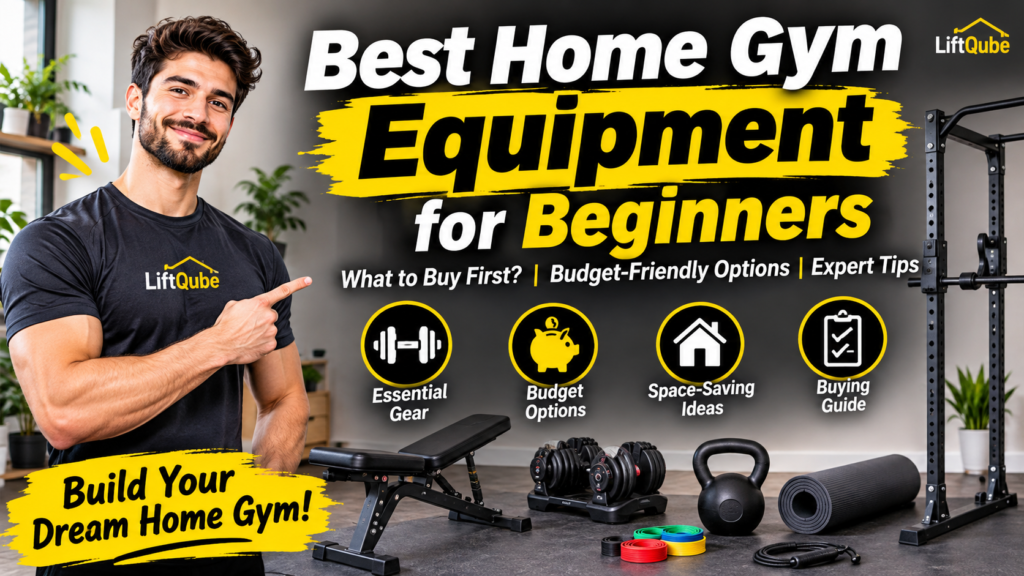
For most people, the smartest beginner home gym setup starts with three low-cost items: a set of resistance bands, an exercise mat, and a jump rope. Add one pair of adjustable dumbbells once you’ve trained consistently for a few weeks. Then add an adjustable bench and a pull-up option. A power rack, barbell, and cable machine can wait.
That order is built on one idea: you don’t know what you’ll enjoy until you’ve trained for a while. Equipment that costs little to buy and little to resell protects you while you find out.
Equipment Alone Won’t Build Muscle or Burn Fat
Before the products, a reality check. Equipment makes training possible, but results come from consistent training, sensible programming, enough protein and calories for your goal, and adequate sleep and recovery.
The American College of Sports Medicine reached a similar conclusion in its 2026 resistance training guidance. According to ACSM’s announcement of its updated resistance training position stand, the biggest benefit comes from moving from no resistance training to any regular resistance training. The specifics of a program matter less than sticking with it.
For buying decisions, this means the best equipment is whatever you’ll use three times a week. An unused rack is worth less than a pair of dumbbells you pick up every other day.
Essential Beginner Home Gym Equipment, Explained
You don’t need every item below. This section covers what each piece does, who needs it, and what to check before buying.
Adjustable Dumbbells
- Trains: Nearly every muscle group, including legs, chest, back, shoulders, and arms.
- Benefits: One pair replaces a rack of fixed dumbbells and lets you add weight in small steps as you get stronger.
- Limitations: Dial and selector systems are generally not built to be dropped, and most sets top out around 50 to 55 pounds per hand.
- Does a beginner need them? Yes. They are the most useful single strength purchase for most people.
- Space: Roughly a few square feet of floor or shelf space.
- Check before buying: Weight range, increment size (2.5 to 5 pounds makes progress easier than 10-pound jumps), locking mechanism, and warranty.
Our guide to the best adjustable dumbbells for a home gym compares specific models in depth. Two examples show how the choices differ:
- PowerBlock Sport 24: According to PowerBlock and retailer listings, it adjusts from 3 to 24 pounds per hand in 3-pound steps, replaces eight pairs of dumbbells, and cannot be expanded. Retailer listings put it at roughly $200 to $220, though prices vary by seller. It suits lighter, higher-rep beginner work. Many people will outgrow 24 pounds on lower-body exercises within months.
- Bowflex Results Series 552: Bowflex lists a 5 to 52.5-pound range, 15 weight settings, dial adjustment, and a two-year parts warranty. It carries a $479 list price that is often discounted, though availability has fluctuated. The older SelectTech 552 and 1090 models were recalled in 2025 because weight plates could dislodge from the handle. If you shop used or old stock, check the recall details with Bowflex first.
Resistance Bands
- Trains: Full body, depending on the exercise. They are also useful for warm-ups and assisted pull-ups.
- Benefits: Very cheap, portable, and easy to store.
- Limitations: Resistance is harder to measure, and bands wear out over time.
- Does a beginner need them? Yes. They’re a low-risk first purchase.
- Space: A drawer.
- Check before buying: Buy a graded set instead of a single band, and inspect bands for nicks or cracks before use.
Titan Fitness sells a four-band loop set with ranges from 2 to 80 pounds. BarBend listed it at $74.99, but plenty of cheaper sets exist.
Exercise Mat
- Trains: Nothing directly, but it supports core work, stretching, push-ups, and floor presses.
- Benefits: Cushions knees and your spine, and gives you a stable surface.
- Limitations: A mat is not floor protection for dropped weights.
- Does a beginner need one? Yes. It’s cheap and always useful.
- Space: Roughly 6 feet by 2 feet when rolled out.
- Check before buying: Choose a thickness that cushions without feeling wobbly.
Adjustable Weight Bench
- Trains: It supports dumbbell presses, rows, step-ups, split squats, and seated shoulder work.
- Benefits: It roughly doubles the number of dumbbell exercises you can do.
- Limitations: Full-size benches need storage space, and cheap ones can feel unstable.
- Does a beginner need one? It’s recommended, but not on day one.
- Space: Often 4 to 5 feet long when in use.
- Check before buying: Weight capacity (which includes your body weight plus the load), stability, the gap between seat and back pad, and the actual angle options.
REP’s AB-3000 2.0 shows what a solid full-size flat/incline/decline bench looks like. REP and independent reviews list it at a 1,000-pound capacity, with an 11-gauge steel frame and a footprint around 56.6 by 25.8 inches. REP’s list price has been around $350.
If floor space is tight, our guide to the best foldable weight bench for small spaces covers compact alternatives.
Pull-Up Bar or Power Tower
- Trains: Back, biceps, grip, and core. A power tower adds dips and knee raises.
- Benefits: Gives you vertical pulling, which dumbbells can’t fully replace.
- Limitations: Most beginners can’t do a full pull-up yet, so you’ll need band assistance or negatives to start.
- Does a beginner need one? It’s recommended as a second-phase purchase.
- Space: A doorway bar takes almost none. A freestanding tower needs a footprint and ceiling height, since many stand roughly 83 to 90 inches tall.
- Check before buying: Door frame suitability, installation instructions, weight rating, and your ceiling height.
If you want a standalone station, our guide to the best power tower for home workouts compares options.
Kettlebells
- Trains: Hips, legs, back, and grip, with swings and goblet squats as common choices.
- Benefits: Compact and good for full-body conditioning.
- Limitations: Only one weight per bell, and swings take technique practice.
- Does a beginner need one? It’s optional. One moderate bell is enough to start.
- Space: Very small.
- Check before buying: Handle width, a flat base, and a smooth finish. REP’s adjustable kettlebell was listed from $149.99 by BarBend, which is pricier than one fixed bell but replaces several.
Jump Rope
- Trains: Calves, shoulders, and cardiovascular fitness.
- Benefits: Very cheap, and a surprisingly intense conditioning tool.
- Limitations: It needs ceiling clearance and a suitable surface, and it can be noisy in apartments.
- Does a beginner need one? Not essential, but a good low-cost cardio option.
- Space: About the width of your arm span.
- Check before buying: Rope length for your height and a smooth handle swivel.
Cardio Equipment
- Trains: Heart and lungs, with some models adding leg and back involvement.
- Benefits: Makes it easy to meet weekly aerobic activity targets indoors.
- Limitations: It’s often expensive and bulky, and many people stop using treadmills and bikes.
- Does a beginner need it? Optional. Walking, cycling outdoors, or a jump rope count too.
- Check before buying: Space, noise, your height, and whether you’ll really use it.
If you do want a machine, our guide to the best rowing machine for apartments covers compact, quieter options.
Cable Machines
- Trains: Back, chest, shoulders, and arms, with smooth, constant resistance.
- Benefits: Useful for training close to your limit without a spotter.
- Limitations: Expensive and space-hungry, and cable ratios make stack weights hard to compare.
- Does a beginner need one? No. It’s an advanced, later purchase.
- Space: Depends on the machine, but most need a dedicated area.
- Check before buying: Ceiling height, cable ratio, and attachment compatibility.
When you’re ready, see our guide to the best cable machines under $1,000.
The Beginner Equipment Priority System
Here’s how each piece fits into four tiers, and why.
| Tier | Equipment | Why It Belongs Here |
|---|---|---|
| Must-Have | Resistance bands, exercise mat, jump rope | Cheap, easy to store, and useful from week one. You lose almost nothing if you change your mind. |
| Recommended | Adjustable dumbbells, adjustable bench, pull-up bar or power tower | These add progressive loading and exercise variety. Most beginners benefit within the first three to six months. |
| Optional | Kettlebells, cardio machine, suspension trainer | They suit specific goals or preferences. Not buying them won’t stall your progress. |
| Advanced | Power rack, barbell and plates, cable machine, premium cardio | They need space, money, and the ability to train safely under heavy loads. Buy them after establishing a consistent routine. |
Best Equipment by Fitness Goal
Equipment combinations differ depending on what you want. Remember that none of them guarantees results. Training consistency, programming, nutrition, and recovery still decide the outcome.
| Goal | Core Equipment | Why It Works |
|---|---|---|
| Build muscle | Adjustable dumbbells, adjustable bench, bands, pull-up bar | Lets you add small amounts of weight over time across all major muscle groups. |
| General fitness | Bands, mat, jump rope, a pair of dumbbells | Covers both strength and basic conditioning cheaply. |
| Strength training | Dumbbells, bench, later a rack and barbell | Barbells allow heavier loading, but most beginners progress well on dumbbells first. |
| Weight-loss support and cardio | Jump rope, one cardio option you enjoy, dumbbells | Cardio increases energy expenditure and strength training helps preserve muscle. Nutrition still drives most weight change. |
| Full-body workouts | Dumbbells, bench, bands, kettlebell | Covers squat, hinge, push, pull, and core patterns. |
| Small-space workouts | Adjustable dumbbells, bands, mat, doorway bar | Everything stores in a closet or under a bed. |
The CDC’s adult activity guidelines recommend at least 150 minutes of moderate-intensity aerobic activity a week plus muscle-strengthening on two or more days. That’s a useful benchmark when you plan your setup. You can meet both with a handful of inexpensive items.
A Realistic Home Gym Buying Roadmap
Beginners often feel pressure to build the whole gym at once. A staged approach is cheaper and safer, because it lets you confirm the habit before the spending gets serious.
First 30 days: Bands, mat, and jump rope.
Learn the basic movements with bodyweight and bands. The goal is to establish a routine. If you skip workouts at this stage, expensive equipment won’t fix that.
Months 2 to 3: Adjustable dumbbells.
Once you’ve trained consistently for several weeks, add one pair. You’ll know roughly what weights you need, so you can pick a range that fits.
Months 4 to 6: Adjustable bench and pull-up option.
A bench opens up chest, shoulder, and row variations. A doorway bar or power tower adds vertical pulling.
Long-term upgrades: Rack, barbell, cable machine, or cardio.
Add these only if your training has outgrown your dumbbells. For a bigger-budget plan, our guide on how to build a home gym under $1,000 goes into more detail.
Budget-Based Home Gym Setups
All prices below are estimates. Where a figure comes from a manufacturer or retailer listing, we say so. Other figures are typical ranges for generic items. Shipping and tax are not included.
Home Gym Under $250
| Item | Purpose | Estimated Price |
|---|---|---|
| Resistance band set | Rows, presses, squats, warm-ups | $30 |
| Exercise mat | Floor exercises, push-ups, core | $25 |
| Doorway pull-up bar | Pulling and hanging | $35 |
| Jump rope | Cardio and conditioning | $12 |
| One kettlebell (moderate weight) | Swings, goblet squats | $55 |
| Pair of fixed dumbbells (light-moderate) | Basic loaded strength work | $70 |
| Estimated total | $227 |
Advantages:
- Low risk and affordable.
- Covers all major movement patterns.
- Fits in a closet or small storage space.
Limitations:
- Fixed weights can be outgrown quickly.
- There’s no bench for supported exercises.
Best for: Total beginners, renters, and anyone testing their commitment to home workouts.
Home Gym Under $500
| Item | Purpose | Estimated Price |
|---|---|---|
| PowerBlock Sport 24 (listed around $219 at some retailers) | Adjustable dumbbells, 3 to 24 lb | $219 |
| Budget adjustable bench (estimate) | Presses, rows, step-ups | $140 |
| Resistance band set | Warm-ups, assisted pull-ups | $30 |
| Exercise mat | Floor work | $25 |
| Doorway pull-up bar | Pulling | $35 |
| Jump rope | Conditioning | $12 |
| Estimated total | $461 |
Advantages:
- Provides an adjustable-weight setup.
- Adds bench access for more exercise variations.
- Offers a useful progression path for beginners.
Limitations:
- The 24-pound weight cap will limit lower-body work.
- Budget benches vary widely in stability, so check capacity and reviews.
Best for: Beginners who have trained for a few weeks and want a proper progression path.
Home Gym Under $1,000
| Item | Purpose | Estimated Price |
|---|---|---|
| Bowflex Results Series 552 (list price) | Adjustable dumbbells, 5 to 52.5 lb | $479 |
| REP AB-3000 2.0 FID bench (REP list price) | Flat, incline, and decline work | $350 |
| Resistance band set | Warm-ups, accessory work | $30 |
| Exercise mat | Floor work | $25 |
| Doorway pull-up bar | Pulling | $35 |
| Jump rope | Conditioning | $12 |
| Estimated total | $931 |
Advantages:
- Provides a wide weight range.
- A stable bench supports many exercises.
- Can cover a beginner’s strength training needs for a considerable period.
Limitations:
- Doesn’t include a rack, barbell, or cardio machine.
- Bowflex discounts and availability change, which can lower or raise the total.
Best for: Committed beginners who’ve trained consistently and want one setup that lasts.
Premium Home Gym Setup
| Item | Purpose | Estimated Price |
|---|---|---|
| REP PR-4000 power rack (base configuration estimate) | Squats, presses, pull-ups with safeties | $800 |
| REP AB-3000 2.0 FID bench | Pressing and dumbbell work | $350 |
| Olympic barbell (estimate) | Squat, press, deadlift | $250 |
| Bumper plate set (estimate) | Loading the barbell | $550 |
| Rubber flooring (estimate) | Floor protection | $225 |
| Bowflex Results Series 552 (list price) | Dumbbell training | $479 |
| Resistance bands and mat (estimate) | Warm-ups and floor work | $55 |
| Estimated total | About $2,709 |
Advantages:
- Provides a complete strength-training setup.
- Offers plenty of room for progression.
- Supports heavier barbell training.
Limitations:
- Requires a large investment.
- Needs adequate floor space and ceiling clearance.
- Most of this equipment isn’t necessary for a first-year beginner.
Best for: People who have trained consistently, have the space, and want to lift heavier.
Rack, plate, and flooring prices vary a lot depending on configuration and sales, so treat the total as a rough guide.
Small Apartment vs. Garage Home Gym
Where you train changes what you should buy.
| Factor | Small Bedroom | Apartment | Dedicated Room | Garage |
|---|---|---|---|---|
| Floor space | Very limited | Limited | Generous | Often generous |
| Ceiling height | Check before pull-ups | Check before pull-ups | Usually fine | Often fine, but check |
| Noise | Neighbors and housemates | Neighbors below and beside | Less of a concern | Lower concern if detached |
| Storage | Under-bed, closet | Closet, under-bed | Wall or floor storage | Racks and shelving |
| Flooring | Mat only | Mat, possibly rubber tiles | Rubber flooring | Rubber flooring |
| Ventilation | Open a window | Open a window | A fan | Temperature and airflow vary |
Floor space and clearance: Healthdirect’s strength training guidance for beginners advises checking that you have enough floor space for yourself and any equipment before you start. Measure the equipment footprint and add room to move around it. Keep a clear path to the door.
Ceiling height: If your ceiling is around 8 feet, check whether you can fully extend overhead or hang from a pull-up bar. Tall racks and power towers can come close to or exceed that height.
Noise: Dumbbells and plates can be loud on hard floors. Use rubber flooring or mats, and avoid dropping weights in an apartment.
Foldable gear: In small spaces, prioritize items that fold, stack, or slide under furniture. That means adjustable dumbbells, bands, a foldable bench, and a doorway bar.
Garages: Temperature swings affect comfort and equipment. Plan for flooring and airflow. Our garage gym setup ideas cover layout, flooring, and climate in more depth.
Common Equipment Buying Mistakes
- Buying too much, too soon. Habit comes before hardware.
- Choosing on price alone. The cheapest bench or dumbbells can feel unstable or wear out.
- Buying oversized machines. Large all-in-one machines can take over an entire room.
- Ignoring dimensions. Measure floor space and ceiling height before ordering.
- Mixing incompatible gear. Check that barbells, plates, and racks use compatible sizes. Standard Olympic gear generally uses 2-inch sleeves.
- Ignoring warranty and replacement parts. Check what’s covered and for how long. Adjustable dumbbells have moving parts that can wear.
- Buying equipment that doesn’t match your goals. A treadmill won’t help if your main goal is lifting weights.
- Overlooking safety features. Look at locking mechanisms, safeties on racks, and stated weight capacities.
Equipment Safety and Compatibility
- Adjustable dumbbell locks: Confirm the weight is fully locked before lifting. Check for recalls and avoid old-stock or used pairs of recalled models.
- Bench stability and capacity: Capacity should cover your body weight plus the load. Check for wobbling and instability.
- Pull-up bar installation: Follow the manufacturer’s instructions. Door frame strength varies.
- Power rack safety systems: If you add a rack later, use the safeties or straps for any heavy pressing or squatting.
- Barbell and plate compatibility: Match sleeve diameter and plate hole size.
- Floor protection: Rubber flooring matters under barbells and dropped weights.
- Ceiling clearance: Measure before buying racks, towers, or anything you’ll press overhead.
- Safe placement: Leave space on all sides and keep walkways clear.
We don’t claim any product is injury-proof. The American Heart Association’s strength and resistance training guidance suggests consulting a certified fitness professional to learn safe technique before starting. That’s good advice if you’re new to lifting.
A Beginner Three-Day Full-Body Workout
This plan uses dumbbells, a bench, bands, and a mat. Train on three non-consecutive days, such as Monday, Wednesday, and Friday.
| Movement | Exercise | Equipment | Sets | Reps | Alternative |
|---|---|---|---|---|---|
| Squat | Goblet squat | One dumbbell | 3 | 8–12 | Bodyweight squat to a chair |
| Hip hinge | Dumbbell Romanian deadlift | Two dumbbells | 3 | 8–12 | Band good morning |
| Push | Dumbbell floor press or bench press | Dumbbells, mat or bench | 3 | 8–12 | Incline push-up |
| Pull | One-arm dumbbell row | Dumbbell, bench | 3 | 8–12 per side | Band row |
| Pull (vertical) | Band-assisted pull-up or lat pulldown with band | Pull-up bar, bands | 2–3 | 5–8 | Band pull-apart |
| Core | Dead bug or plank | Mat | 2–3 | 8–10 per side, or 20–30 seconds | Bird dog |
How to progress: The NHS’s strength and flexibility guidance suggests 8 to 12 repetitions per set, at least two sets, and a gradual build-up over several weeks. Start with two sets per exercise for the first couple of weeks, then move to three. Once you can do all sets at the top of the rep range with good form, add a small amount of weight or move to the next band.
Warm up first, and leave a day between sessions for the same muscle groups.
If something hurts beyond ordinary muscle fatigue, stop and consider consulting a professional. This is general information, not medical advice. If you have a health condition or haven’t exercised in a long time, check with a healthcare professional before starting.
What Beginners Should Not Buy Initially
These items are not bad. They’re just poor first purchases for most people.
- Expensive commercial treadmills: They’re costly, bulky, and easy to ignore. Walking outdoors is free.
- Large all-in-one gym machines: They take over a room and lock you into one style of training.
- Full commercial dumbbell racks: Adjustable dumbbells give you a range of weights in a fraction of the space.
- Advanced power racks: Useful once you’re lifting heavy barbells, but unnecessary for most first-year training.
- Expensive specialty attachments: Buy them when a specific need appears.
- Unneeded accessories: Straps, belts, gloves, and gadgets can wait.
Each of these suits particular users. The point is that none is a universal beginner requirement.
Best Beginner Equipment Comparison Table
| Equipment | Primary Use | Space Required | Beginner Priority | Main Advantage | Main Limitation |
|---|---|---|---|---|---|
| Resistance bands | Full-body strength, warm-ups | A drawer | Must-have | Cheap and portable | Hard to measure load |
| Exercise mat | Floor work, comfort | About 6 × 2 ft | Must-have | Inexpensive and versatile | Not floor protection |
| Jump rope | Cardio | Arm-span width | Must-have | Cheap conditioning | Needs ceiling clearance |
| Adjustable dumbbells | Strength training | A few sq. ft. | Recommended | Many weights in one pair | Not built for dropping |
| Adjustable bench | Presses, rows, step-ups | 4–5 ft long | Recommended | Doubles exercise options | Needs storage space |
| Pull-up bar / power tower | Vertical pulling | Doorway to a footprint | Recommended | Builds back and grip | Hard for true beginners |
| Kettlebell | Hips, grip, conditioning | Very small | Optional | Compact and versatile | One weight per bell |
| Cardio machine | Conditioning | Varies widely | Optional | Easy indoor cardio | Costly and bulky |
| Power rack and barbell | Heavy lifting | Large | Advanced | Allows heavy loading | Space and cost |
| Cable machine | Isolation and pulling | Large | Advanced | Smooth resistance | Costly, ceiling needs |
Frequently Asked Questions
What is the best home gym equipment for beginners?
A pair of adjustable dumbbells, resistance bands, and an exercise mat cover the most ground for the least money. Add an adjustable bench and a pull-up option as you progress.
What equipment should I buy first?
Start with bands, a mat, and a jump rope. After a few weeks of consistent training, add adjustable dumbbells.
Can beginners build muscle at home?
Yes. Beginners can build muscle with bodyweight exercises, bands, and dumbbells if they train consistently and add resistance over time. Nutrition and recovery matter too.
Is adjustable dumbbell equipment enough?
For many beginners it is, at least for the first year. Eventually you may outgrow the weight range, particularly for legs, and consider an expandable system or barbell.
Do I need a weight bench?
Not at first. A bench adds useful exercise variety, so it’s a good second-phase purchase.
What is the best home gym equipment for small apartments?
Adjustable dumbbells, resistance bands, a mat, a doorway pull-up bar, and possibly a foldable bench. All can be stored in a closet or under a bed.
How much does a beginner home gym cost?
A basic setup can run around $225 or less, a solid adjustable-dumbbell-and-bench setup around $450 to $950, and a full barbell setup well over $2,000. All figures are estimates.
Should beginners buy a power rack?
Usually not right away. A rack makes sense once you’re training with a barbell and lifting heavy enough to need safeties, and you have the space and ceiling height.
Can I start working out without equipment?
Yes. Bodyweight squats, lunges, and push-ups are valid strength exercises, and the NHS lists them among muscle-strengthening activities.
What home gym equipment should beginners avoid?
Large all-in-one machines, commercial treadmills, full dumbbell racks, and advanced racks. They can be great later, but they’re expensive early commitments.
Final Recommendation
If you’re buying your first home gym, start small. Get bands, a mat, and a jump rope. After a few consistent weeks, buy one good pair of adjustable dumbbells. Add a bench and pull-up option when you’re ready for more exercise variety. Save the rack, barbell, and cable machine for when your training has truly outgrown your setup.
Check specifications and recall notices before you purchase, and measure your space twice. When you’re ready to plan further, use our home gym equipment checklist to track what you own and what you still need.
This article is for general informational purposes and is not medical advice. Consult a healthcare professional before starting a new exercise program. LiftQube may earn a commission from qualifying purchases made through links on this page.
