
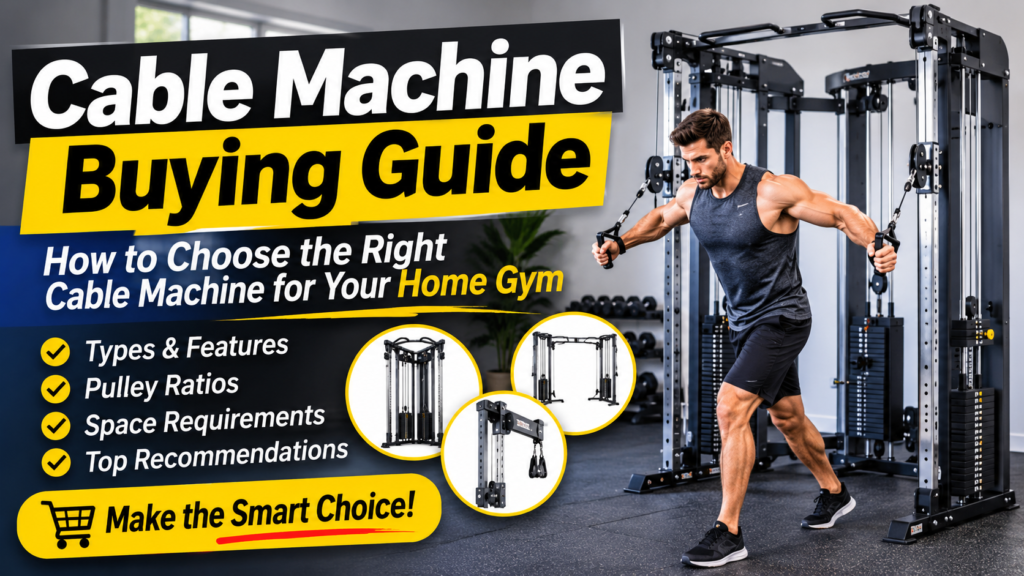
-Most shoppers focus on one number when choosing a cable machine: the weight stack. A 200 lb stack sounds like 200 lb of resistance, but the pulley ratio, number of weight stacks, cable travel, and available room all determine whether a machine is right for your home gym.
This cable machine buying guide explains the most important factors to consider before purchasing. Whether you’re building your first home gym or upgrading an existing setup, you’ll learn how to compare cable machines, understand pulley ratios, choose the right weight stack, measure your available space, and avoid common buying mistakes.
As an Amazon Associate, LiftQube earns from qualifying purchases. If you buy through links on our website, we may earn a commission at no additional cost to you.
How we put this guide together: Figures come from manufacturer product pages and support documentation, and we identify those sources where relevant. We haven’t physically tested the machines discussed here. Prices and specifications can change, so confirm current details with the manufacturer before ordering.
Cable Machine Buying Guide: Quick Answer, What Should You Buy?
If you want the short answer, start with your available space, existing equipment, and training goals.
- You have a power rack and limited floor space: A rack-mounted cable attachment usually adds the least footprint, but only if it’s designed for your rack’s hole size and upright dimensions.
- You have no rack and want maximum variety: A dual-stack functional trainer with a 2:1 pulley ratio is a versatile option for most home gyms.
- You already own weight plates and want to save money: A plate-loaded cable machine lets you reuse your existing plates instead of paying for a separate weight stack.
- You’re short on floor space and have a suitable structural wall: A wall-mounted cable machine can free up floor space, provided it’s installed and anchored correctly.
- You mainly want heavy lat pulldowns and rows: Consider a 1:1 cable machine or a machine that offers both 1:1 and 2:1 ratios.
- You’re a beginner on a budget: Avoid overbuying. A smaller stack with smooth cable movement may be enough, provided you check warranty coverage and replacement-part support.
Many home gym owners don’t actually need a standalone cable machine. We’ll explain who should skip one later in this guide.
What Is a Cable Machine and How Does It Work?
A cable machine, sometimes called a functional trainer or pulley machine, creates resistance using weights connected to a cable that runs through a pulley system.
The resistance can come from a selectorized weight stack or weight plates loaded onto a machine. When you pull the handle, the cable moves through the pulleys and lifts the resistance.
Cable machines allow you to perform exercises from different angles while maintaining tension throughout much of the movement. They’re useful for exercises such as cable flyes, triceps pushdowns, lat pulldowns, rows, curls, and lateral raises.
Three main components matter when choosing a cable machine:
- Resistance source: This is either a pin-loaded weight stack or weight plates loaded onto a weight horn.
- Pulley system: The pulley arrangement determines the resistance ratio and how far the cable travels.
- Adjustable pulley or trolley: This controls the height and angle of the cable attachment.
Understanding these components will help you compare machines beyond their advertised weight capacity.
Cable Machine Types Explained
Not all cable machines are built the same way. Some are designed for maximum exercise versatility, while others prioritize affordability, compact dimensions, or compatibility with existing home gym equipment.
Here are the main types to consider.
Cable Machine Types Compared
| Machine Type | Best For | Main Advantage | Main Drawback | Space Requirement |
|---|---|---|---|---|
| Dual-stack functional trainer | Most home gym owners | Independent adjustable pulleys | Large and heavy | Large |
| Single-stack cable tower | Smaller rooms | Compact and simpler | Limited two-arm training | Medium |
| Wall-mounted cable machine | Garage gyms and tight spaces | Frees floor space | Requires structural mounting | Small floor footprint |
| Plate-loaded cable machine | Lifters who own plates | Reuses existing plates | Slower weight changes | Medium |
| Rack-mounted pulley attachment | Existing power rack owners | Minimal additional footprint | Rack-specific compatibility | Small |
| Cable crossover machine | Larger home gyms | Wide pulling area | Large footprint | Very large |
| Smith machine and cable combo | All-in-one setups | Combines multiple systems | Can involve design compromises | Large |
Dual-Stack Functional Trainers
A dual-stack functional trainer has two independent weight stacks, each connected to its own adjustable pulley.
This design allows you to train one arm at a time or use both sides simultaneously for exercises such as chest flyes and cable presses.
Most functional trainers use a 2:1 pulley ratio, although some models offer different configurations.
The biggest advantage is versatility. You can perform exercises at high, middle, and low pulley positions without needing separate machines.
The main disadvantages are the larger footprint, heavier construction, and generally higher purchase price.
A dual-stack functional trainer is a good choice if you don’t already own a power rack and want a versatile standalone cable machine.
Single-Stack Cable Towers
A single-stack cable tower has one weight column connected to a pulley system.
The Body-Solid Powerline PFT50 is one example. Its manufacturer listing gives dimensions of 55 inches long, 61 inches wide, and 84 inches high, with a weight of approximately 329 lb.
You can verify its specifications on the Body-Solid Powerline Functional Trainer page.
A single-stack tower generally costs less and takes up less space than a dual-stack functional trainer.
However, one stack supplies the resistance, so you don’t get the same independent two-arm functionality as a dual-stack model.
It’s a practical option for beginners and people working with limited space.
Wall-Mounted Cable Machines
Wall-mounted cable machines attach to a wall or structural frame instead of standing independently on the floor.
Their biggest advantage is space efficiency. You can add cable training without sacrificing as much floor area.
However, installation matters.
The mounting surface must be strong enough to support the equipment and forces generated during exercise. Never rely on drywall alone, and always follow the manufacturer’s anchoring instructions.
Some wall-mounted cable systems are designed specifically for matching wall-mounted racks. For example, REP’s wall-mounted Athena is compatible with its 5000 Series wall-mount fixed rack.
These machines are worth considering for garage gym owners with suitable structural walls.
Plate-Loaded Cable Machines
A plate-loaded cable machine uses weight horns that allow you to add your own Olympic weight plates.
If you already own plates, this can be an affordable way to introduce cable exercises into your home gym.
However, if you don’t own plates, purchasing them separately increases the total cost.
Changing resistance also takes longer because you need to add or remove plates instead of simply moving a selector pin.
Rack-Mounted Pulley Attachments
Rack-mounted pulley systems attach directly to a power rack.
They are particularly useful when you already own a rack and don’t want another large piece of equipment taking up floor space.
However, compatibility is extremely important.
For example, REP’s selectorized Athena attaches to compatible PR-4000 and PR-5000 racks. Its published dimensions also show that the attachment adds some height, width, and depth to the original rack.
You can read REP’s guide to choosing an at-home cable machine for more information about different cable configurations.
If you’re still deciding which rack to buy, read our Power Rack Buying Guide.
Cable Crossover Machines
A traditional cable crossover uses two pulley columns positioned across a wide frame.
The design allows you to stand between the columns and perform chest flyes and other cable exercises.
Cable crossovers are useful for people who want a wide training area, but they usually require more floor space than compact functional trainers.
Smith Machine and Cable Combos
All-in-one machines combine a Smith machine, rack, and cable system into one frame.
Their main advantage is that they combine multiple training systems without requiring completely separate machines.
However, some designs involve compromises in rack usability or available training space.
REP offers combination equipment, for example, but its design has limitations for people who want unrestricted free-weight lifting inside the rack.
Choose an all-in-one system only after checking whether its different training stations meet your actual needs.
Functional Trainer vs Cable Crossover: What’s the Difference?
The terms functional trainer and cable crossover are sometimes used interchangeably by retailers, but they can describe different designs.
A traditional cable crossover has two high pulleys positioned on fixed or limited-height columns. It is mainly designed for exercises such as chest flyes.
A functional trainer usually has two columns with adjustable pulleys that move from low to high positions.
This allows you to perform a wider range of movements, including:
- Cable flyes.
- Lat pulldowns.
- Seated rows.
- Cable curls.
- Triceps pushdowns.
- Cable presses.
- Woodchoppers.
- Single-arm exercises.
For most home gyms, a functional trainer is the more practical choice because its adjustable pulleys provide greater exercise versatility.
A traditional crossover can still be useful if you specifically want its wider layout and have enough room.
Always check the manufacturer’s specifications rather than relying only on the product name.
Pulley Ratios Explained: 1:1 vs 2:1 vs 4:1
Pulley ratio is one of the most misunderstood specifications when buying a cable machine.
It directly affects how much resistance you feel at the handle and how far the cable travels.
What Does a Pulley Ratio Mean?
A pulley ratio describes the relationship between the weight stack movement and the resistance felt at the handle.
A 1:1 pulley ratio generally means that 20 lb on the stack feels like approximately 20 lb at the handle.
A 2:1 ratio means that 20 lb on the stack feels like approximately 10 lb at the handle, while the stack moves half the distance of the cable.
A 4:1 ratio provides even less resistance at the handle but allows greater cable travel.
For a more detailed technical explanation, see REP Fitness’s guide to cable pulley ratios.
1:1 vs 2:1 vs 4:1 Comparison
Consider a cable machine with a 200 lb weight stack.
| Pulley Ratio | Approximate Maximum Handle Resistance | Cable Travel per 1 ft of Stack Travel | Typical Application |
|---|---|---|---|
| 1:1 | 200 lb | 1 ft | Heavy pulldowns and rows |
| 2:1 | 100 lb | 2 ft | Functional trainer exercises |
| 4:1 | 50 lb | 4 ft | Light resistance and isolation work |
These are idealized calculations and do not account for friction.
Understanding a 200 lb Weight Stack
Imagine two machines that both advertise a 200 lb weight stack.
The first uses a 1:1 pulley ratio, while the second uses a 2:1 ratio.
The first machine provides approximately 200 lb of resistance at the handle.
The second provides approximately 100 lb.
This is why you should never compare cable machines based only on their advertised stack weight.
A machine with two 200 lb stacks may advertise 400 lb of total stack weight. However, each handle generally provides approximately 100 lb of resistance if the system uses a 2:1 ratio.
The two stacks do not automatically combine at one handle unless the machine is specifically designed to link them.
Friction and Machine Design Differences
Actual handle resistance may differ slightly from theoretical calculations.
Factors include:
- Pulley quality.
- Cable routing.
- Bearing quality.
- Trolley weight.
- Cable weight.
- Weight stack design.
Manufacturers don’t publish a universal friction adjustment, so treat the pulley ratio as a useful starting point rather than an exact measurement of handle resistance.
Which Pulley Ratio Should You Choose?
2:1 Pulley Ratio
A 2:1 ratio is a popular choice for functional trainers.
It offers longer cable travel, smaller resistance increments, and versatility for general strength training.
It’s a good option for people who want to perform a wide variety of exercises.
1:1 Pulley Ratio
A 1:1 ratio provides greater resistance at the handle.
It’s useful for heavier pulling exercises, including lat pulldowns and seated rows.
If strength-focused back training is your priority, this ratio may be more suitable.
4:1 Pulley Ratio
A 4:1 ratio provides lower handle resistance and longer cable travel.
It can work well for lighter isolation exercises, but stronger lifters may find its maximum resistance limiting.
Machines Offering Both Ratios
Some machines offer different pulley configurations.
For example, REP’s Adonis tower combines a 1:1 lat pulldown and low-row station with a 2:1 functional trainer.
This can be useful if you want both heavy pulling resistance and versatile cable movements.
Should you choose 1:1 or 2:1?
Choose 2:1 if you want an all-around functional trainer. Choose 1:1 if heavy back exercises are your priority. If you want both, consider a machine specifically designed to offer both configurations.
How Much Weight Stack Do You Need?
Don’t choose a cable machine simply because it advertises the largest weight stack.
Instead, work backward from the resistance you want at the handle.
Weight Stack Comparison
| Weight Stack | At 1:1 | At 2:1 | At 4:1 |
|---|---|---|---|
| 100 lb | 100 lb | 50 lb | 25 lb |
| 150 lb | 150 lb | 75 lb | 37.5 lb |
| 200 lb | 200 lb | 100 lb | 50 lb |
| Dual 150 lb | 150 lb per handle | 75 lb per handle | 37.5 lb per handle |
| Dual 200 lb | 200 lb per handle | 100 lb per handle | 50 lb per handle |
These are approximate ideal figures.
Single-Stack vs Dual-Stack Machines
A single-stack machine uses one resistance source connected to its pulley system.
A dual-stack machine has two independent weight stacks, allowing you to train both sides independently.
Dual-stack machines are particularly useful for:
- Two-arm exercises.
- Independent left and right arm movements.
- Cable flyes.
- Two-person training.
- Greater exercise versatility.
However, a dual-stack machine generally costs more and requires more space.
Why Weight Increments Matter
Smaller weight increments can be useful for isolation exercises and gradual strength progression.
For example, with a 2:1 pulley ratio, a 10 lb increase in stack weight results in approximately 5 lb more resistance at the handle.
Titan’s Functional Trainer uses dual 200 lb stacks with 10 lb increments at a 2:1 ratio.
Some machines also include micro-weights or additional small plates.
Check these details before purchasing if you prefer smaller resistance adjustments.
Weight Stack Recommendations for Different Lifters
Beginners: A 100–150 lb stack at 2:1 may be sufficient for many beginners and general fitness users.
Intermediate Lifters: Consider a 150–200 lb stack, depending on your training goals and preferred exercises.
Advanced Lifters: Look for larger stacks, 1:1 pulling stations, or machines with upgrade options.
For example, REP’s Arcadia Max stack configuration can be upgraded to higher capacities.
Think about your expected training progression rather than purchasing equipment only for your current strength level.
Cable Travel and Adjustable Pulley Positions
Cable travel is another specification that deserves attention.
A machine can have a large weight stack and excellent construction but still feel limiting if the cable doesn’t extend far enough for your preferred exercises.
What Is Cable Travel?
Cable travel refers to how far the cable can move when you pull the handle.
Insufficient cable travel can restrict movements such as:
- Full-extension rows.
- Standing cable presses.
- Walking lunges with a cable.
- Wide cable chops.
- Long-range pulling exercises.
Published cable travel varies significantly between manufacturers.
For example:
- Rogue’s FML-HR lists 114 inches of travel at 2:1 and 57 inches at 1:1.
- REP lists approximately 6.75 feet for the Arcadia.
- REP lists 9 feet of travel for the Adonis trolley, with 4.5 feet on its lat pulldown and low-row station.
- REP’s Athena lists different travel measurements depending on the rack height.
As an editorial guideline, approximately 6–7 feet of cable travel at the handle can cover many standard exercises.
Consider 8 feet or more if you want longer standing movements or need to move farther away from the machine.
Always check whether the advertised travel refers to a 1:1 or 2:1 configuration.
Pulley Height Adjustment
Adjustable pulley positions determine how many exercise angles you can use.
Some examples:
- Titan’s Functional Trainer offers 20 vertical positions.
- REP’s Arcadia offers 32 positions.
- Rack-mounted systems can use the rack’s existing adjustment holes.
However, the total number of positions isn’t the only thing that matters.
Check:
- Lowest pulley position.
- Highest pulley position.
- Distance between adjustment positions.
- Smoothness of carriage movement.
- Ability to swivel the pulley.
- Independent adjustment of both sides.
The lowest position is especially important for exercises such as cable curls and low cable movements.
A smooth pulley carriage also makes adjusting the machine more convenient during workouts.
How Much Space Does a Cable Machine Need?
Before purchasing a cable machine, measure your available space carefully.
The machine’s advertised footprint tells you how much floor area it occupies, but it doesn’t tell you how much room you need to use it comfortably.
What Should You Measure Before Buying?
| Measurement | What to Measure | Why It Matters |
|---|---|---|
| Machine width | Overall width | Determines whether it fits your room |
| Machine depth | Front-to-back depth | Affects walkways and access |
| Machine height | Floor to top of frame | Must fit below your ceiling |
| Ceiling clearance | Lowest ceiling point | Important for assembly and installation |
| Front clearance | Space in front | Needed for pulling exercises |
| Side clearance | Space beside the machine | Useful for wide movements |
| Cable extension space | Full cable movement area | Prevents movement restrictions |
| Plate-loading access | Space around weight horns | Important for plate-loaded machines |
| Delivery path | Doors, stairs and turns | Ensures equipment can reach the room |
Real Manufacturer Dimensions
There is no universal standard size for cable machines.
Always use the manufacturer’s actual specifications.
Here are some examples:
- Titan’s Functional Trainer measures 82 inches tall, 64 inches wide, and 44 inches deep. It weighs approximately 672 lb and requires two people for assembly.
- Rogue’s FML-HR stands 91.5 inches tall but requires at least 95 inches of vertical clearance for assembly.
- REP’s Adonis with its base is listed at 92.3 inches tall, 54.9 inches deep, and 45.5 inches wide.
You can check the Titan Functional Trainer product page for current specifications.
Cable Machines for Apartments
Apartment owners should consider more than floor dimensions.
Important factors include:
- Total machine weight.
- Floor loading.
- Noise.
- Delivery access.
- Ceiling height.
- Installation restrictions.
Wall-mounted machines may not be suitable for rented properties where drilling or structural modifications aren’t allowed.
Cable Machines for Garage Gyms
Garage gym owners should check:
- Garage door tracks.
- Garage door openers.
- Ceiling height.
- Floor slope.
- Available anchoring surfaces.
- Humidity and corrosion protection.
Concrete floors can be suitable for anchoring when the manufacturer permits the required installation method.
Cable Machines for Basements
Basements often have lower ceilings, beams, ducts, and other obstructions.
Measure the lowest point rather than relying on the room’s average ceiling height.
Also consider stairways and tight corners when planning equipment delivery.
Cable Machines for Dedicated Home Gyms
Dedicated home gyms offer more flexibility, but you should still plan space for accessories and other equipment.
Our Home Gym Equipment Checklist can help you organize your overall setup.
If space is limited, a foldable weight bench for small spaces can also be a practical addition.
Which cable machine will fit in my room?
Measure your room’s width, depth, height, front clearance, and delivery path. Compare those measurements with the manufacturer’s specifications.
For example, if a machine requires 95 inches of vertical clearance for assembly and your ceiling is 92 inches high, it won’t be a suitable choice.
Steel Quality and Build Construction
Build quality determines how well a cable machine handles repeated use over time.
A lower-priced machine may look similar to a premium model, but differences in frame construction, pulleys, cables, and bearings can affect performance and durability.
Here are the main specifications to examine.
Steel Tubing Dimensions
Check the dimensions of the machine’s steel uprights and frame tubing.
Common examples include 2-inch by 2-inch and 3-inch by 3-inch uprights.
Larger tubing can indicate a different construction class, but bigger dimensions alone don’t guarantee better equipment.
Consider the overall frame design, steel thickness, weld quality, and stability.
Steel Gauge and Thickness
Steel gauge is another specification worth understanding.
A lower gauge number generally means thicker steel.
For example, 11-gauge steel is thicker than 14-gauge steel.
On standard sheet-steel gauge charts, 11-gauge steel is approximately 0.12 inches thick.
However, gauge numbers are not always directly comparable across manufacturers without knowing the actual material specifications.
If steel thickness matters to you, ask for the manufacturer’s stated wall thickness.
Weld Quality and Frame Stability
Inspect:
- Weld consistency.
- Frame connections.
- Base construction.
- Overall stability.
- Wobbling during movement.
A stable frame is particularly important when performing heavy pulling exercises.
Wall-mounted machines also depend on correct structural anchoring.
Pulley Material and Bearings
Pulley construction influences cable movement.
Metal pulleys generally offer good wear resistance, while bearing quality affects smoothness.
Look for information about:
- Pulley material.
- Bearing type.
- Cable routing.
- Pulley size.
- Maintenance requirements.
Cable Coating and Strength
Check the manufacturer’s specifications for cable diameter, coating, and rated strength.
Avoid products that provide little or no information about their cable construction.
Corrosion Protection
Powder coating is common on home gym equipment.
If your machine will be used in a humid garage or basement, pay attention to corrosion protection and regular maintenance.
Real Manufacturer Construction Example
Rogue’s FML-HR specifications list:
- 3-inch by 3-inch 11-gauge steel uprights.
- 5/8-inch hardware.
- 3/16-inch mil-spec aircraft cable.
- Oversized aluminum pulleys.
You can review the Rogue FML-HR product guide for detailed construction specifications.
Titan also lists red anodized aluminum pulleys and fiberglass-reinforced cables on its Functional Trainer product page.
What to Inspect Before Buying
Before ordering, look for:
- A complete specification sheet.
- Cable construction details.
- Pulley specifications.
- Warranty terms.
- Replacement parts availability.
- Assembly instructions.
If important information is missing, contact the manufacturer before purchasing.
Weight Stack vs Plate-Loaded Cable Machines
One of the most important buying decisions is choosing between a selectorized weight stack and a plate-loaded system.
Both can provide effective resistance, but their convenience and long-term costs differ.
Weight Stack vs Plate-Loaded Comparison
| Factor | Weight Stack | Plate-Loaded |
|---|---|---|
| Initial cost | Usually higher | Lower if you own plates |
| Resistance changes | Move a selector pin | Add or remove plates |
| Convenience | High | Lower |
| Noise | Often quieter | Plates can clank |
| Maintenance | Guide rods and stack | Weight horns and plate fit |
| Maximum loading | Limited by stack capacity | Limited by horn capacity |
| Space | Stack housing adds depth | Requires plate storage |
| Existing plates | Not used | Can be reused |
| Long-term cost | Depends on stack upgrades | Can add plates as strength increases |
When Should You Choose a Weight Stack?
Choose a selectorized weight stack if:
- You want quick resistance changes.
- You prefer convenience.
- You don’t own weight plates.
- Multiple people use the equipment.
- You want a more organized training setup.
When Should You Choose Plate-Loaded?
Choose a plate-loaded machine if:
- You already own Olympic plates.
- You want to reduce initial costs.
- You don’t mind changing plates manually.
- You want to reuse your existing equipment.
If you need to purchase a complete set of weight plates just to use a plate-loaded machine, the initial savings may disappear.
Our adjustable dumbbells buying guide can also help you decide how to divide your home gym budget between cable equipment and free weights.
Cable Attachments and Compatibility
Attachments can significantly increase the exercise versatility of a cable machine.
However, not every machine includes the same accessories.
Before buying, check which attachments come with the machine and which must be purchased separately.
Common Cable Machine Attachments
Lat Pulldown Bars: Wide bars designed for different grip positions during back exercises.
Straight Bars: Useful for curls, triceps pushdowns, and cable rows.
D-Handles: Individual handles designed for single-arm movements.
Triceps Ropes: Commonly used for triceps pushdowns and face pulls.
Ankle Straps: Allow you to perform cable leg and glute exercises.
Multi-Grip Handles: Provide different hand positions for rows and pulldowns.
Carabiners and Connectors: Connect the attachments to the cable ends.
Included vs Separately Sold Attachments
Included accessories vary between manufacturers.
For example, Titan’s Functional Trainer ships with several attachments, including a rope, ankle strap, D-handles, long and short bars, and a triangle row attachment.
Other machines may include only a basic handle set.
Don’t assume every attachment shown in a product photograph comes with the machine.
Check the manufacturer’s included-accessories list before ordering.
Why Attachments Aren’t Universally Compatible
Cable ends, connectors, and attachment points can differ between machines.
A lat bar designed for one system may not connect properly to another.
Some manufacturers also offer proprietary accessories.
Before buying additional attachments, check:
- Connector type.
- Carabiner size.
- Cable-end design.
- Attachment compatibility.
- Manufacturer restrictions.
Rogue’s FML-HR guide, for example, describes compatibility with standard cable attachments. This is a design feature rather than a universal industry rule.
Which Cable Attachment Is Compatible With My Existing Power Rack?
Rack-mounted cable systems are often specific to a particular rack brand or series.
Before ordering, check four things.
1. Upright Size and Hole Size
Different racks use different upright dimensions and hardware sizes.
Rogue’s FML-HR uses 5/8-inch hardware and is not designed to accept Monster attachments that use 1-inch hardware.
2. Rack Series and Height
REP’s Athena supports compatible PR-4000 and PR-5000 racks.
Its cable travel also differs depending on whether the rack is 80 or 93 inches tall.
3. Mounting Type
Some wall-mounted attachments only work with matching wall-mounted rack systems.
4. Added Footprint
Even if an attachment fits your rack, it may increase the overall width, depth, or height of your setup.
If your rack comes from a different brand or series, don’t assume compatibility. Ask the manufacturer to confirm it.
You can also read our Power Rack Buying Guide before choosing compatible attachments.
Safety, Installation, and Maintenance
A cable machine is a piece of strength-training equipment that needs proper installation and maintenance.
Ignoring basic safety requirements can lead to equipment damage or injury.
Installation Requirements
Always follow the manufacturer’s assembly and anchoring instructions.
Some machines require floor anchoring, while wall-mounted units need suitable structural support.
For example, Rogue’s FML-HR guide specifies floor anchoring with a concrete anchor kit.
Never improvise an anchoring method.
If you’re unsure whether your floor or wall is suitable, contact the manufacturer or a qualified installer.
Heavy machines may also require two or more people for assembly.
Cable Inspection and Replacement
Inspect cables regularly for:
- Fraying.
- Kinking.
- Cracks in the protective coating.
- Visible damage.
- Unusual cable movement.
Rogue advises replacing cables immediately if damage such as fraying, kinking, or coating cracks appears.
A damaged cable under tension can create a serious safety risk.
Pulley and Weight Stack Maintenance
Pulley systems and guide rods need periodic attention.
Rogue recommends cleaning guide rods or plate-loaded rails monthly, applying a thin layer of suitable silicone-based lubricant, and checking bolts and pulley hardware regularly.
However, maintenance requirements vary between machines.
Always follow your own manufacturer’s manual for lubricant type and maintenance frequency.
Weight Stack and Frame Safety
Follow these basic precautions:
- Keep your hands clear of moving weight stacks.
- Make sure the selector pin is fully inserted.
- Check bolts and connections regularly.
- Avoid exceeding the manufacturer’s weight limits.
- Don’t climb or stand on the frame unless the manual specifically allows it.
Warranty, Replacement Parts, and Manufacturer Support
Warranty coverage can vary significantly between manufacturers.
Compare coverage for individual components rather than focusing only on the headline warranty.
For example:
- Rogue lists a lifetime warranty on the frame and welds and five years on pulleys, cables, and guide rods for the FML-HR.
- Titan lists a one-year warranty included with its Functional Trainer, with extended coverage available separately.
- Body-Solid’s Powerline warranty terms can differ between retailer listings. Check the current official warranty documentation before purchasing.
Also consider whether the manufacturer sells replacement cables, pulleys, and other parts directly.
Good customer support and replacement-part availability can make long-term ownership easier.
How Much Should You Spend on a Cable Machine?
Cable machine prices vary depending on construction, pulley design, resistance capacity, and included features.
Instead of focusing only on the purchase price, consider what you’re getting for your money.
Entry-Level Cable Machines
Entry-level options often include compact towers and wall-mounted systems.
They can work well for beginners and people with limited budgets.
However, quality, warranty coverage, and replacement-part support vary.
Our Best Cable Machines Under $1,000 guide covers value-focused options.
Mid-Range Cable Machines
Mid-range options may include better-built single-stack towers and plate-loaded machines.
The Body-Solid PFT50, for example, appeared at $995 on a retailer listing during the research for this guide.
Always confirm the current price and specifications before ordering.
Premium Functional Trainers
Premium machines generally offer more substantial construction, dual weight stacks, and additional adjustment options.
Titan listed its Functional Trainer at $2,199.97 on its product page when this guide was researched.
Premium equipment can cost considerably more depending on the manufacturer and configuration.
Don’t Forget Total Cost of Ownership
The machine’s sticker price isn’t the only expense.
Consider these additional costs:
- Shipping and delivery: Large machines may require freight delivery.
- Installation: You may need extra help or professional assembly.
- Anchoring hardware: Some machines require separate concrete or wall-mounting hardware.
- Attachments: Additional handles and bars may cost extra.
- Flooring: Protective mats can help protect your floor.
- Maintenance: Cables, pulleys, and lubricants may require replacement or periodic servicing.
- Weight plates: Plate-loaded machines require compatible plates.
If you’re deciding whether a cable machine fits into your overall home gym budget, read our guide to Building a Home Gym Under $1,000.
Best Cable Machine Type for Different Buyers
The best cable machine depends on your available space, experience, budget, and training goals.
Best Machine Type by Buyer
| Buyer | Recommended Machine Type | What to Consider |
|---|---|---|
| Beginner | Compact tower or smaller dual-stack at 2:1 | Avoid overbuying |
| Intermediate lifter | Dual-stack 2:1 or 1:1 pulling station | Stack capacity and progression |
| Advanced lifter | Larger stack or plate-loaded machine | Upgrade options and construction |
| Small apartment owner | Compact tower or permitted wall-mounted unit | Noise, floor loading and delivery |
| Garage gym owner | Wall-mounted, rack-mounted or dual-stack | Ceiling and anchoring |
| Budget-conscious buyer | Plate-loaded if you own plates | Replacement parts and support |
| Existing power rack owner | Compatible rack-mounted attachment | Brand and hole compatibility |
| Maximum versatility seeker | Dual-stack functional trainer | Space and total cost |
Who Should Avoid a Standalone Cable Machine?
Do you really need a standalone cable machine?
Not always.
You may be better off skipping one if:
- You already own a power rack and can add a compatible cable attachment for less money.
- You mainly train with barbells and dumbbells and rarely perform isolation exercises.
- You rent a property where wall or floor modifications aren’t allowed.
- Your room cannot accommodate the machine and its required working clearance.
- Your budget would be better spent on a bench, adjustable dumbbells, and a power rack first.
If you’re still deciding which bench to purchase, our What Weight Bench Should I Buy? guide can help you prioritize your equipment.
Common Cable Machine Buying Mistakes
Even experienced home gym owners can make mistakes when comparing cable machines.
Here are ten common issues to avoid.
1. Choosing a Machine by Advertised Weight Stack
A 200 lb stack doesn’t always provide 200 lb of resistance at the handle. Always check the pulley ratio.
2. Ignoring Ceiling Height and Assembly Clearance
Some machines require more vertical clearance during assembly than their finished height suggests.
3. Forgetting Front Working Clearance
A machine may fit against a wall but still leave insufficient room for comfortable exercise movements.
4. Assuming All Attachments Are Compatible
Check cable connectors, attachment points, and rack specifications before buying accessories.
5. Forgetting Delivery Access
Large machines can arrive in heavy boxes. Measure doorways, stairways, and turns before ordering.
6. Buying a Plate-Loaded Machine Without Owning Plates
The machine may look affordable, but purchasing a complete plate set can increase the total cost considerably.
7. Mounting a Wall Unit Without Structural Support
Drywall alone is not suitable for supporting a cable machine.
8. Ignoring Warranty Details
Compare warranty coverage for the frame, pulleys, cables, and other important components.
9. Overbuying as a Beginner
A huge weight stack and multiple accessories aren’t necessary for every home gym owner.
10. Trusting an Old Price
Equipment prices change. Always verify the current price on the manufacturer’s or retailer’s website.
Cable Machine Buying Worksheet
Before purchasing, complete this checklist to make sure the machine matches your room, budget, and training requirements.
Your Room Measurements
- Available floor width: ______ inches
- Available floor depth: ______ inches
- Ceiling height at the lowest point: ______ inches
- Assembly clearance required: ______ inches
- Delivery path checked (doors, stairs, and turns): Yes / No
Your Equipment Preferences
- Machine type: Dual-stack / Single tower / Wall-mounted / Plate-loaded / Rack-mounted / Crossover / Combo
- Desired pulley ratio: 1:1 / 2:1 / 4:1 / Both
- Required handle resistance: ______ lb
- Training goals: Strength / Hypertrophy / Rehabilitation / General fitness / Sports
Your Budget and Compatibility
- Total budget, including accessories: $______
- Required attachments: ______
- Existing equipment compatibility: ______
- Rack brand and series: ______
- Upright size and hole size: ______
- Frame warranty: ______
- Pulley and cable warranty: ______
- Replacement parts available: Yes / No
Simple Decision Guide
Follow these steps to narrow down your choices.
Step 1: Do you already own a power rack?
If yes, check compatible rack-mounted cable attachments first. They may save floor space and money.
If no, continue to the next step.
Step 2: Do you already own weight plates?
If yes, a plate-loaded machine may be worth considering.
If no, a selectorized weight-stack machine may be more convenient.
Step 3: Is floor space limited?
If you have a suitable structural wall, consider a wall-mounted machine.
Otherwise, compare compact freestanding options.
Step 4: Do you want independent two-arm training?
If yes, choose a dual-stack functional trainer.
If not, a single-stack cable tower may be sufficient.
Step 5: Is heavy back training your priority?
If yes, consider a 1:1 pulley station or a machine that offers both pulley ratios.
Step 6: Does the machine fit your room with enough working clearance?
If not, choose a smaller model or reconsider the machine type.
Final Buying Recommendations
Choosing the right cable machine becomes much easier when you start with your room dimensions, existing equipment, and training goals.
Here are the most practical recommendations:
- If you already own a compatible power rack: Start by comparing rack-mounted cable attachments. They usually add less floor space than a separate machine.
- If you don’t own a rack and want maximum exercise variety: A dual-stack 2:1 functional trainer is a versatile choice.
- If you already own weight plates: Consider a plate-loaded cable machine to reuse your existing equipment.
- If floor space is limited and you have a suitable structural wall: A properly installed wall-mounted unit may be a practical solution.
- If you’re a beginner: Choose a machine that meets your current needs while allowing reasonable room for future progression.
Before making your final decision, verify the pulley ratio, cable travel, weight stack, construction, warranty, and room clearances on the manufacturer’s current product page.
The best cable machine isn’t necessarily the most expensive or the one with the largest advertised weight stack. It’s the one that fits your home gym, supports your training goals, and provides the features you’ll actually use.
Frequently Asked Questions
Which cable machine will fit in my room?
Measure your available width, depth, height, front clearance, side clearance, and delivery path. Compare these measurements with the manufacturer’s specifications, including assembly clearance. Use the buying worksheet above before ordering.
Should I choose a 1:1 or 2:1 pulley ratio?
Choose a 2:1 ratio for an all-around functional trainer with longer cable travel and smaller resistance increments. Choose 1:1 if heavier lat pulldowns and rows are your priority. Some machines offer both configurations.
How much weight stack do I actually need?
Start with your desired handle resistance and multiply it by the pulley ratio to estimate the required stack weight. For example, a 2:1 machine with a 150 lb stack provides approximately 75 lb of resistance at the handle, while a 200 lb stack provides approximately 100 lb.
What is the difference between a functional trainer and a cable crossover?
A functional trainer typically has two adjustable pulley columns that move through multiple heights. A traditional cable crossover generally has two high or limited-adjustment pulleys and is mainly designed for flyes. Always check the manufacturer’s specifications because retailers sometimes use these terms interchangeably.
Which cable attachment is compatible with my existing power rack?
Choose an attachment designed for your rack’s specific brand, series, upright dimensions, and hole size. Some systems use 5/8-inch hardware, while others use 1-inch hardware. Confirm compatibility with the manufacturer before ordering.
Do I really need a standalone cable machine?
Not necessarily. If you already own a compatible power rack, a rack-mounted attachment may offer similar cable training with less additional floor space. If you rarely perform isolation exercises, free weights may be enough for your training goals.
Is a wall-mounted machine better than a freestanding machine?
It depends on your available space and installation options. Wall-mounted machines save floor space but require suitable structural support. Freestanding machines are easier to position but generally occupy more floor area.
How much cable travel do I need?
As a general editorial guideline, approximately 6–7 feet of cable travel can cover many standard exercises. Consider 8 feet or more if you want longer standing pulls. Always check whether the manufacturer’s measurement refers to a 1:1 or 2:1 pulley configuration.
Which cable machine features are worth paying extra for?
Quality steel construction, reliable pulleys, a good warranty, available replacement parts, smaller weight increments, smooth trolley movement, and sufficient cable travel are worth considering.
Which features are unnecessary for most home gym owners?
An oversized weight stack you’ll never use, excessive attachments you don’t need, and additional training stations that duplicate equipment you already own may not justify the extra cost.
Are cable machines good for beginners?
Yes. Cable machines provide adjustable resistance and allow exercises from different angles. Beginners can start with moderate resistance and focus on controlled technique before increasing the weight.
Can a cable machine replace free weights?
Not completely. Cable machines are useful for isolation exercises and controlled resistance movements, while barbells and dumbbells provide different training benefits. Many home gyms benefit from combining both.
How often should I replace cable machine cables?
There is no universal replacement interval. Inspect cables regularly and replace them if you notice fraying, kinking, cracks in the coating, or other damage. Always follow the manufacturer’s maintenance recommendations.
Do cable machine prices and specifications change?
Yes. Prices, dimensions, warranty terms, and product specifications can change. Always check the manufacturer’s current product page before purchasing.
