
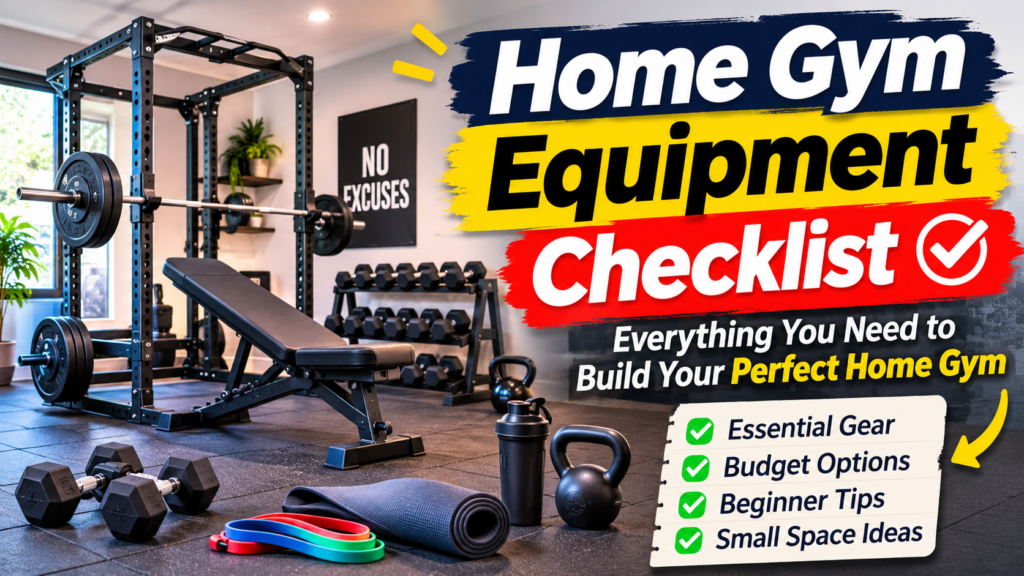
A good home gym equipment checklist keeps you from two expensive mistakes: buying too much too soon and buying the right things in the wrong order. Building a home gym doesn’t mean buying every machine in the catalog. The right setup depends on your fitness goals, available space, and budget.
This guide covers what’s essential, what’s optional, and what you should buy first. It also explains how to fit everything into a bedroom, apartment, or garage. The information is based on manufacturer specifications and published reviews, not LiftQube hands-on testing. Prices may change, so treat any dollar figures as planning estimates.
Disclosure: LiftQube may earn a commission if you buy through links on this page, at no extra cost to you.
Quick Home Gym Equipment Checklist
Short answer: A basic home gym setup needs adjustable or fixed dumbbells, resistance bands, an exercise mat, an adjustable bench, and a pull-up option. Add a rack, barbell, and weight plates when dumbbells are no longer challenging enough. Add cardio machines only if your fitness goals require them.
Here’s how to understand the equipment priorities:
- Must-have: Equipment you’ll use in almost any workout program.
- Recommended: Equipment that improves your setup for most people.
- Optional: Equipment that’s useful for specific goals, spaces, or budgets.
Essential Equipment
| Equipment | Priority |
|---|---|
| Adjustable or fixed dumbbells | Must-have |
| Resistance bands | Must-have |
| Exercise mat | Must-have |
| Adjustable weight bench | Recommended |
| Pull-up bar | Recommended |
Strength Training Equipment
| Equipment | Priority |
|---|---|
| Barbell | Recommended |
| Weight plates | Recommended with a barbell |
| Power rack | Recommended for heavy barbell training |
| Squat rack | Optional |
| Kettlebells | Optional |
| Cable machine | Optional |
Cardio Equipment
| Equipment | Priority |
|---|---|
| Jump rope | Recommended |
| Exercise bike | Optional |
| Rowing machine | Optional |
| Treadmill | Optional |
| Elliptical machine | Optional |
Accessories
| Equipment | Priority |
|---|---|
| Weight collars | Must-have with a barbell |
| Gym towels and water bottle | Recommended |
| Foam roller | Optional |
| Workout timer | Optional |
| Weightlifting belt, lifting straps, and gym gloves | Optional |
Gym Setup and Safety
| Equipment | Priority |
|---|---|
| Rubber gym flooring | Recommended, essential under a barbell |
| Equipment storage rack | Recommended |
| Adequate lighting and ventilation | Recommended |
| First-aid supplies | Recommended |
| Mirrors | Optional |
Essential Home Gym Equipment Explained
Adjustable Dumbbells
One pair of adjustable dumbbells can replace an entire rack of fixed dumbbells. This makes them one of the best space-saving investments for a home gym.
They work well for beginners, intermediate lifters, and anyone training in a small room.
Before buying adjustable dumbbells, consider three important factors:
- Weight range: Popular adjustable dumbbell sets usually reach around 50 to 55 lbs per hand. Some expandable systems offer heavier options. For example, PowerBlock Elite EXP models can expand from 50 to 90 lbs.
- Weight increments: Smaller increases of 2.5 to 5 lbs make progressive overload easier than larger 10 lb jumps.
- Drop tolerance: Many dial-based and twist-adjustable dumbbells are not designed to be dropped.
If you’re comparing different options, check out our guide to the best adjustable dumbbells for a home gym.
The Bowflex SelectTech 552 also deserves attention. Bowflex recalled the original 552 and 1090 dumbbells in 2025 because weight plates could become dislodged from the handle. The newer Results Series 552 features a redesigned locking system.
Before purchasing, read our Bowflex SelectTech 552 adjustable dumbbells review and check the serial number if you’re buying a used pair.
Fixed dumbbells have no adjustment mechanisms, but purchasing a complete set costs more and requires significantly more storage space.
Resistance Bands
Resistance bands are one of the most affordable ways to add exercise variety to a home gym. They’re lightweight, portable, and suitable for many different workouts.
The main types include:
- Loop bands: Useful for assisted pull-ups, squats, and glute exercises.
- Tube bands with handles: Suitable for rows, presses, and biceps curls.
- Mini bands: Commonly used for hip and shoulder warm-ups.
Bands are available in different resistance levels. Buying a complete resistance set is usually more practical than purchasing just one band.
The National Institute of Diabetes and Digestive and Kidney Diseases also explains that you don’t need expensive equipment to begin strength training at home. Hand weights and bodyweight exercises can provide a useful starting point.
Read its home strength-training guidance for more information.
Adjustable Weight Bench
An adjustable weight bench expands the number of exercises you can perform with dumbbells.
A bench with flat and incline positions is useful for chest presses, shoulder presses, dumbbell rows, and other strength exercises. Decline adjustment is an additional feature if you want more exercise variations.
Before buying a bench, consider:
- Stability: Look for a wide base and minimal movement around the seat and backrest.
- Weight capacity: Remember that the stated capacity includes your body weight and the weights you’re lifting.
- Pad gap: A smaller gap between the seat and back pad usually feels more comfortable during flat exercises.
If you’re working with limited space, check out our guide to the best foldable weight bench for small spaces.
Pull-Up Bar
A pull-up bar adds upper-body training options that dumbbells alone cannot fully replace.
There are several mounting options:
- Doorway pull-up bars: Affordable and removable, but you should check your door frame and follow the manufacturer’s installation instructions.
- Wall-mounted or ceiling-mounted bars: Generally provide a more permanent setup and require proper anchoring.
- Rack-mounted bars: Included with many power racks.
- Freestanding power towers: Provide pull-up, dip, and knee-raise stations without requiring wall drilling.
Many home power towers stand approximately 83 to 90.6 inches tall. Measure your ceiling before buying one.
Our guide to the best power tower for home workouts covers different options.
Always verify the weight capacity and dimensions of the exact model before purchasing.
Exercise Mat
An exercise mat provides comfort during floor exercises, improves grip, and offers some protection for your flooring.
Choose a mat that is thick enough to cushion your knees and spine but firm enough to remain stable during exercise.
Remember that a regular exercise mat is not a replacement for proper rubber flooring underneath a barbell setup.
Strength Training Equipment Checklist
Power Racks and Squat Racks
A power rack is one of the most useful pieces of equipment for people who want to perform heavy barbell exercises at home.
It allows you to perform squats, bench presses, and other movements with adjustable safety bars.
A full power rack typically has four upright posts, while a squat rack generally uses two.
Before purchasing a rack, consider:
- Weight rating: Entry-level racks commonly have ratings around 700 lbs, while heavier-duty models may support 1,000 lbs or more.
- Dimensions: Check the rack height against your ceiling.
- Safety equipment: Make sure appropriate safety bars, pin-and-pipe safeties, or straps are included or available.
- Stability: Check whether the rack requires floor anchoring and follow the manufacturer’s instructions.
For reference, REP Fitness lists its PR-1100 power rack at approximately $379.99. It has a 700 lb rating and includes J-cups and safety equipment. Prices and availability can change, so verify current details before buying.
Barbells
A standard multipurpose Olympic barbell weighs approximately 20 kg, or 44 to 45 lbs, and has 2-inch sleeves.
Popular multipurpose barbells commonly have rated capacities between approximately 700 and 1,000 lbs.
When comparing barbells, consider:
- Shaft diameter.
- Knurling.
- Sleeve rotation.
- Weight capacity.
- Overall build quality.
For most beginners, a standard multipurpose Olympic barbell is sufficient.
Olympic Weight Plates and Bumper Plates
Weight plates allow you to increase resistance as your strength improves.
There are two common options:
Iron plates: These are generally cheaper per pound and thinner, allowing more weight to fit on the barbell.
Bumper plates: These feature thick rubber construction and are designed for controlled drops on suitable lifting surfaces. They can also reduce noise compared with traditional iron plates.
Most standard Olympic bumper plates have a diameter of approximately 450 mm and a 2-inch center opening.
Make sure your barbell, weight plates, and rack are compatible before purchasing.
For more information, read our guide to the best bumper plates for a home gym.
Kettlebells
Kettlebells are optional but useful for adding variety to a home workout routine.
They work well for:
- Kettlebell swings.
- Goblet squats.
- Farmer’s carries.
- Lunges.
- Core exercises.
Instead of purchasing a complete collection immediately, beginners can start with one or two suitable weights.
Cable Machines
Cable machines provide consistent resistance throughout many exercises.
They’re useful for movements such as:
- Lat pulldowns.
- Cable rows.
- Triceps pushdowns.
- Cable flys.
- Biceps curls.
However, cable machines are relatively expensive and take up more space than basic equipment.
Dual-stack trainers are generally larger, while wall-mounted and single-tower systems can be more compact.
Pay attention to the cable ratio. A 1:1, 2:1, or 4:1 ratio affects the resistance you actually feel during an exercise. Don’t compare machines using stack weight alone.
Check out our guide to cable machines under $1,000 to explore different options.
Weight Benches
A stable weight bench is an important part of a strength-training setup.
If you’re performing barbell exercises, check that the bench capacity accounts for both your body weight and the weight you’re lifting.
For heavy bench presses, use an appropriate rack with safety equipment.
Cardio Equipment Checklist for Home Gyms
Cardio equipment can improve the variety of your home workouts, but you don’t necessarily need an expensive machine.
The UK Chief Medical Officers recommend that adults aim for at least 150 minutes of moderate physical activity per week, or 75 minutes of vigorous activity, alongside strength training on at least two days.
You can achieve these activity goals through walking, cycling, running, or other forms of physical activity.
Read the official physical activity recommendations for more details.
| Equipment | Best For | Space and Noise Considerations |
|---|---|---|
| Jump rope | Affordable, intense conditioning | Requires ceiling clearance and can be noisy |
| Exercise bike | Low-impact steady cardio | Relatively compact and often quiet |
| Rowing machine | Full-body cardiovascular training | Long during use; some models store upright |
| Treadmill | Walking and running | Requires more floor space |
| Elliptical | Low-impact cardio | Larger footprint but generally smooth operation |
The best approach is to choose one cardio machine that you’ll actually use.
Consider purchasing cardio equipment after covering your basic strength-training needs.
Home Gym Accessories You Should Consider
Accessories are not always necessary, but the right ones can make your workouts more comfortable and organized.
Essential Accessories
- Weight collars: Important for securing weight plates on a barbell.
- Gym towels: Useful for keeping equipment clean.
- Water bottle: Helps you stay hydrated during workouts.
- Cleaning supplies: Useful for maintaining benches, handles, and other equipment.
Optional Accessories
- Weightlifting belt: Can be useful during heavy squats and deadlifts.
- Wrist wraps: Provide additional wrist support during certain pressing exercises.
- Lifting straps: Help with grip during pulling movements.
- Foam roller: Useful for warm-ups and recovery routines.
- Workout timer: Helps track rest periods and intervals.
- Gym mirrors: Allow you to observe your exercise technique.
- Storage rack: Keeps dumbbells and weight plates organized.
Home Gym Equipment Checklist for Small Spaces
You don’t need a dedicated gym room to build a useful home workout area.
A bedroom, apartment, or small garage can provide enough space for a practical setup if you choose equipment carefully.
Prioritize equipment that performs multiple functions and can be folded, stacked, or stored easily.
- Adjustable dumbbells: One pair can replace multiple fixed dumbbell sets.
- Foldable weight bench: Choose a design that folds flat, rolls upright, or fits under a bed.
- Resistance bands: Easy to store inside a drawer.
- Doorway pull-up bar: A compact option for upper-body training.
- Compact storage: Wall hooks and small racks help keep the floor clear.
- Foldable cardio equipment: Consider it only if you plan to use it regularly.
A useful planning trick is to mark your workout area on the floor using tape.
Include the equipment footprint and enough room to move safely around each item.
Keep a clear entrance and exit path, and avoid overcrowding the area where you lift weights.
Equipment that takes too long to set up or blocks your living space may become less convenient to use.
Home Gym Equipment Checklist by Budget
The amount you spend depends on your fitness goals, equipment preferences, and available space.
Prices vary between retailers, seasons, and models. The following budgets are planning estimates rather than fixed shopping totals.
Alberta Health Services provides helpful advice on creating a safe and affordable home gym, including planning around your goals and considering secondhand equipment.
| Budget | Recommended Equipment |
|---|---|
| Under $300 | Resistance bands, exercise mat, pull-up bar, compact adjustable dumbbells |
| Under $500 | Better adjustable dumbbells and a budget foldable bench |
| Under $1,000 | Dumbbells, bench, pull-up setup, or starter rack and barbell |
| Under $2,000 | Power rack, barbell, weight plates, bench, and flooring |
| Over $2,000 | Advanced rack, quality barbell, plates, cable machine, and cardio equipment |
Home Gym Under $300
For a limited budget, focus on basic equipment that provides multiple exercise options.
Start with:
- Resistance bands.
- Exercise mat.
- Doorway pull-up bar.
- Compact adjustable dumbbells.
Entry-level adjustable dumbbell sets can account for most of this budget, so compare their weight ranges and features carefully.
Home Gym Under $500
With a budget of $500, you can build a more versatile home gym.
Add a foldable weight bench to your basic setup.
This gives you more exercise options, including:
- Dumbbell chest presses.
- Incline presses.
- Dumbbell rows.
- Seated shoulder presses.
- Step-ups.
Budget foldable benches can offer a useful balance between price and functionality.
Home Gym Under $1,000
At this budget, you have two realistic options.
Option 1: Dumbbell-Based Home Gym
- Adjustable dumbbells.
- Quality adjustable bench.
- Power tower or doorway pull-up bar.
- Resistance bands.
- Exercise mat.
Option 2: Barbell-Based Home Gym
- Entry-level power rack.
- Budget Olympic barbell.
- Weight plates.
- Weight bench.
- Basic flooring.
An entry-level REP PR-1100 rack has been listed around $379.99, while suitable barbells may cost around $200 or more. Adding weight plates can push the total beyond $1,000.
Consider secondhand equipment if you’re working with a strict budget.
Home Gym Under $2,000
A $2,000 budget makes a more complete strength-training setup possible.
Consider investing in:
- A sturdy power rack.
- Multipurpose Olympic barbell.
- Weight plate set.
- Stable adjustable bench.
- Rubber gym flooring.
REP Fitness’s PR-4000 has been listed from approximately $799.94 in its basic configuration. Additional accessories, weight plates, and other equipment increase the final cost.
Home Gym Over $2,000
With a larger budget, you can build an advanced home gym.
Potential upgrades include:
- Heavy-duty power rack.
- High-quality Olympic barbell.
- Bumper plates.
- Cable machine.
- Advanced adjustable bench.
- Treadmill or rowing machine.
- Dedicated storage equipment.
Don’t purchase expensive equipment simply because you can afford it. Focus on the equipment that supports your training routine.
Home Gym Equipment Checklist for Beginners
Beginners should avoid purchasing too much equipment immediately.
A simple setup can provide plenty of opportunities to develop strength and improve fitness.
Follow this purchasing order:
- Start with basic resistance equipment, such as bands and an exercise mat.
- Add adjustable dumbbells.
- Purchase a suitable weight bench.
- Add a pull-up option.
- Upgrade to a power rack and barbell when needed.
- Add cardio machines according to your fitness goals.
Why is this approach better?
New lifters may change their training preferences as they gain experience. Expensive equipment can also be difficult to resell.
Starting with a few essential items allows you to learn proper movements and understand what you actually need.
Healthdirect’s strength training advice for beginners recommends warming up, using proper technique, increasing weights gradually, and seeking professional advice when appropriate.
How Much Space Do You Need for a Home Gym?
There isn’t one universal minimum space requirement for every home gym.
The amount of space you need depends on the equipment you purchase and the exercises you plan to perform.
| Available Space | Equipment That May Fit | Important Considerations |
|---|---|---|
| Bedroom | Dumbbells, bands, bench, and bar | Furniture clearance and noise |
| Apartment | Compact strength setup | Floor protection and neighbors |
| Small garage | Rack, barbell, plates, and bench | Parking clearance and temperature |
| Dedicated room | Full strength setup and cardio | Ventilation and ceiling height |
Measure your equipment before purchasing it.
Pay particular attention to ceiling clearance. Many full-size power racks and power towers stand close to 7.5 feet tall.
An 8-foot ceiling may leave limited room for pull-ups and overhead movements.
You should also leave enough space to load a barbell, move around equipment, and exercise safely.
Flooring, Storage and Organization
Flooring and storage are important parts of a functional home gym.
Rubber mats or tiles can protect floors and provide a more suitable surface for many workouts.
If you plan to use a barbell, consider thicker rubber flooring or a suitable lifting platform.
Good storage also helps prevent accidents.
Keep dumbbells, weight plates, and resistance bands organized rather than leaving them scattered across the floor.
Place frequently used equipment close to your workout area so it’s easy to access.
Home Gym Safety Checklist
Safety should always be a priority when building a home gym.
Use this checklist before starting your workouts:
- Check the weight limits of all equipment.
- Inspect bolts, screws, and connections regularly.
- Use appropriate safety arms and rack safeties.
- Install suitable flooring.
- Maintain enough clear space around equipment.
- Follow manufacturer installation instructions.
- Store weight plates and dumbbells safely.
- Clean and maintain equipment regularly.
- Check benches and racks for signs of damage.
- Make sure equipment is stable before using it.
Never ignore manufacturer safety instructions, especially when installing wall-mounted equipment or using heavy barbells.
Common Home Gym Equipment Buying Mistakes
Building a home gym can become expensive if you purchase equipment without planning.
Avoid these common mistakes.
1. Buying Too Much Equipment Initially
You don’t need a complete commercial gym setup at home. Start with basic equipment and upgrade when your training requires it.
2. Ignoring Available Floor Space
Measure your room before ordering large equipment. Remember to account for ceiling height and movement space.
3. Purchasing Low-Quality Benches
A poorly constructed or unstable bench can make exercises uncomfortable and unsafe. Prioritize stability and suitable weight capacity.
4. Ignoring Weight Capacity
Always check the manufacturer’s stated capacity. Remember that the total load includes your body weight and the weights you’re lifting.
5. Buying Unnecessary Cardio Machines
A treadmill, rowing machine, or exercise bike may not be necessary if you already enjoy walking, cycling, or other outdoor activities.
6. Forgetting Flooring and Storage
Flooring protects your workout area, while proper storage helps keep equipment organized.
7. Purchasing Incompatible Equipment
Check that your barbells, plates, and racks have compatible dimensions. Standard Olympic barbells and plates generally use 2-inch sizing.
8. Trusting Every Product Listing
Product listings sometimes display inconsistent specifications. Confirm important details directly with the manufacturer before buying.
Printable Home Gym Equipment Checklist
Use this checklist to plan your home gym and track the equipment you already own.
Essential Equipment
- Adjustable dumbbells
- Resistance bands
- Exercise mat
- Adjustable weight bench
- Pull-up bar
Strength Equipment
- Power rack
- Barbell
- Weight plates
- Weight collars
- Kettlebells
- Cable machine
Cardio Equipment
- Treadmill
- Exercise bike
- Rowing machine
- Jump rope
- Elliptical machine
Accessories
- Weightlifting belt
- Lifting straps
- Foam roller
- Gym towels
- Water bottle
- Workout timer
Gym Setup
- Rubber flooring
- Equipment storage rack
- Mirrors
- Proper lighting
- Ventilation
- First-aid supplies
- Cleaning supplies
You don’t need to purchase every item on this list. Select equipment according to your fitness goals, budget, and available space.
Frequently Asked Questions
1. What Equipment Do I Need for a Basic Home Gym?
A basic home gym needs adjustable or fixed dumbbells, resistance bands, an exercise mat, an adjustable weight bench, and a pull-up option. These items cover many common strength-training exercises.
2. What Are the 10 Essential Pieces of Home Gym Equipment?
Ten useful equipment options include adjustable dumbbells, resistance bands, an exercise mat, an adjustable bench, a pull-up bar, a barbell, weight plates, a power rack, weight collars, and rubber flooring.
However, the last five become more important when you start barbell training.
3. How Much Does It Cost to Build a Home Gym?
A basic home gym can cost under $300, while a more complete setup may require $1,000 to $2,000 or more.
The final cost depends on equipment quality, fitness goals, and available space.
4. What Home Gym Equipment Should Beginners Buy First?
Beginners can start with resistance bands and an exercise mat, then add adjustable dumbbells and a weight bench.
This provides a practical foundation without requiring a large initial investment.
5. Can I Build a Home Gym With Only Dumbbells?
Yes. Dumbbells can support many upper-body and lower-body exercises.
Adding a weight bench and resistance bands gives you even more workout options.
6. What Equipment Is Best for a Small Home Gym?
Adjustable dumbbells, a foldable weight bench, resistance bands, and a doorway pull-up bar are useful options for small spaces.
7. Is a Power Rack Necessary for a Home Gym?
No. A power rack is not essential for every home gym.
However, it becomes useful if you want to perform heavy barbell squats and bench presses with appropriate safety equipment.
8. What Cardio Equipment Should I Buy for Home?
A jump rope is an affordable starting option. If you prefer machines, consider an exercise bike, rowing machine, treadmill, or elliptical.
Choose something that matches your fitness goals and that you will use consistently.
9. How Much Space Is Needed for a Home Gym?
The space requirement depends on your equipment.
Use manufacturer dimensions to plan your layout, and leave enough room to move and exercise safely.
10. What Home Gym Equipment Is Worth Investing In?
A stable weight bench, quality adjustable dumbbells, or a suitable power rack and barbell setup can be worthwhile investments.
Good flooring is also important if you’re planning to lift heavy weights.
Final Thoughts
The best home gym is the one that fits your fitness goals, budget, and available space.
You don’t need to purchase every piece of equipment immediately. Start with essential items, understand which exercises you enjoy, and gradually expand your setup as your training improves.
If you’re ready to choose your first major strength-training investment, check out our guide to the best adjustable dumbbells for a home gym.
This article is for general informational purposes and is not medical advice. Consult a healthcare professional before starting a new exercise program. LiftQube may earn a commission from qualifying purchases through links on this page.
