
By Sophie Kinsella
As an Amazon Associate, LiftQube earns from qualifying purchases. This means we may earn a commission when you purchase through links on our website, at no additional cost to you.
How we researched this guide: LiftQube did not physically test the benches mentioned here. Specifications and prices come from manufacturer product pages, checked on November 15, 2026. Independent testing results are identified as coming from BarBend. Prices change frequently, so confirm the current price before purchasing.
The most common weight bench buying mistake is choosing a bench based only on its price or advertised weight capacity. A bench that wobbles during heavy presses, sits too high for your legs, or takes up too much space can quickly become a frustrating purchase.
If you’re wondering, “What weight bench should I buy?”, the answer depends on three important factors: your training goals, your budget, and the space available in your home gym.
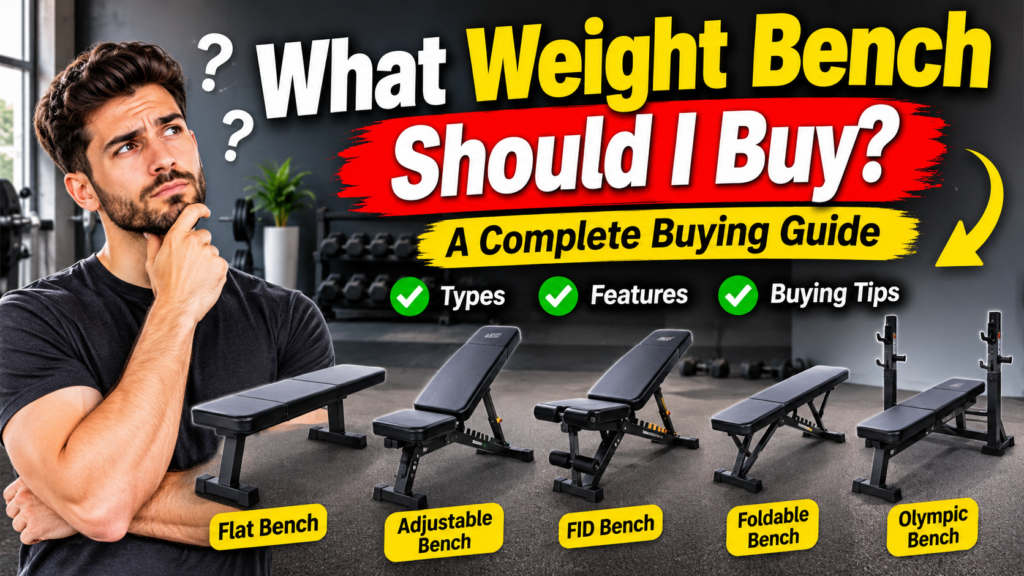
Weight benches come in several types, including flat, adjustable, FID, foldable, and Olympic benches. Each type offers different benefits depending on how you train.
This guide explains the differences, important buying considerations, and how to choose the right weight bench for your home gym.
Quick Answer: What Weight Bench Should Most People Buy?
For many home gym owners, a sturdy adjustable flat-to-incline weight bench is the most versatile option. It supports exercises such as flat bench presses, incline presses, seated shoulder presses, rows, and step-ups.
However, an adjustable bench isn’t necessarily the best choice for everyone.
- Beginners: Choose a mid-range adjustable bench with a clear weight rating and several useful incline positions. A budget flat bench paired with adjustable dumbbells is another good option.
- Dumbbell-focused lifters: Choose an adjustable bench with a small seat-to-back pad gap and multiple incline settings.
- Heavy barbell lifters: Prioritize a stable three-post flat bench or an adjustable bench with sufficient capacity at every angle.
- Small-space home gym owners: Look for a foldable bench or one that can be stored vertically.
- Budget-conscious buyers: A well-built flat bench under $150 can be a better purchase than a poorly constructed adjustable bench at the same price.
1. Understand the Different Types of Weight Benches
Before choosing a weight bench, it’s important to understand the main types available. Each design serves a different purpose.
Flat Weight Bench
A flat weight bench has a fixed, horizontal position. It doesn’t offer adjustable angles, making it one of the simplest and most affordable bench options.
It’s suitable for flat barbell presses, dumbbell chest presses, rows, step-ups, and other basic strength exercises.
Flat benches are generally lighter and easier to move than adjustable models.
Best for:
- Heavy bench pressing.
- Dumbbell chest workouts.
- Basic strength training.
- Beginners on a tight budget.
Main disadvantage: You cannot perform incline or decline exercises because the bench stays in one position.
Adjustable Weight Bench
An adjustable weight bench allows you to change the backrest angle. Most models support flat and incline positions, while some also offer adjustable seat angles.
This versatility makes adjustable benches popular among home gym owners.
You can use one bench for incline dumbbell presses, shoulder presses, flat bench presses, incline curls, and many other exercises.
Best for:
- General home gym training.
- Dumbbell workouts.
- Muscle building.
- Lifters who want exercise variety.
Main disadvantage: Adjustable benches usually cost more than flat benches and have additional moving parts. Some models also have noticeable gaps between the seat and back pad.
FID Weight Bench (Flat, Incline, Decline)
An FID bench supports three positions:
- Flat.
- Incline.
- Decline.
The decline position places your head lower than your hips and allows you to perform decline pressing movements.
For example, the REP AB-5200 2.0 offers optional decline functionality with specific adjustment configurations.
Best for:
- Bodybuilding enthusiasts.
- Lifters who regularly perform decline exercises.
- People who want maximum exercise variety.
Main disadvantage: FID benches are often more expensive and heavier. Many home gym owners don’t use the decline feature frequently enough to justify the extra cost.
Foldable Weight Bench
Foldable weight benches are designed for people who need to save space.
Depending on the model, they can fold flat, fold in half, or attach to a wall.
These benches are especially useful for apartments, shared garages, and small home gyms.
Best for:
- Small apartments.
- Limited workout spaces.
- People who need easy storage.
- Home gyms that share space with other activities.
Main disadvantage: Stability varies between models. Check the frame construction, folding mechanism, and weight capacity before purchasing.
For example, BarBend’s tested PRx Profile is a wall-mounted option with a listed 1,000-pound rating when correctly installed.
Olympic Weight Bench
An Olympic weight bench includes built-in uprights that hold a barbell.
This design allows you to perform barbell bench presses without purchasing a separate power rack.
However, you should carefully check the safety features before buying one.
Look for adjustable safety catches or spotter arms, and make sure the bench dimensions match your lifting style.
Best for:
- Barbell-focused home gyms.
- People who want a combined bench and rack setup.
- Traditional strength training.
Main disadvantage: Olympic benches generally require more space, and their fixed design may offer less flexibility than a separate bench and rack.
Weight Bench Types Compared
| Bench Type | Best For | Main Advantage | Main Disadvantage |
|---|---|---|---|
| Flat | Heavy pressing and tight budgets | Simple, sturdy, affordable | No incline exercises |
| Adjustable | Most home gyms | Versatile and practical | Higher price |
| FID | Decline training | Maximum exercise variety | Extra cost and weight |
| Foldable | Small apartments | Saves floor space | Stability varies |
| Olympic | Barbell-focused training | Bench and rack combination | Requires more space |
2. Flat vs Adjustable vs FID: Which Should You Choose?
Choosing between flat, adjustable, and FID benches depends on how you train.
According to REP Fitness, flat benches are suitable for lifters focused on traditional pressing, while adjustable benches offer more flexibility for incline presses, shoulder exercises, and other movements.
You can also read REP’s flat vs adjustable weight bench guide for additional manufacturer guidance.
| Factor | Flat Bench | Adjustable Bench | FID Bench |
|---|---|---|---|
| Exercise versatility | Limited | High | Highest |
| Stability | Typically very good | Depends on construction | Depends on construction |
| Price | Lowest | Moderate | Highest |
| Storage | Compact | Some models store upright | Varies |
| Weight capacity | Often high | Varies by angle | Varies by model |
| Maintenance | Minimal | Adjustment parts need checking | More moving parts |
| Ideal training | Heavy pressing | General strength training | Bodybuilding variety |
Choose a flat bench if:
- You mainly perform flat bench presses.
- You have a limited budget.
- You already own adjustable dumbbells.
- You don’t need incline exercises.
Choose an adjustable bench if:
- You want to perform multiple exercises.
- You train with dumbbells.
- You want incline and shoulder pressing options.
- You need one versatile bench for your home gym.
Choose an FID bench if:
- You regularly perform decline exercises.
- You want the widest range of bench angles.
- You understand the additional cost and complexity.
For most home gym owners, an adjustable bench offers the best balance of versatility and practicality.
3. 10 Important Things to Check Before Buying a Weight Bench
Choosing the right bench involves more than comparing prices. Here are ten important features to evaluate before making your purchase.
1. Weight Capacity
Weight capacity is one of the most important specifications to check.
You need to understand the difference between your bodyweight, the weight you’re lifting, and the bench’s advertised maximum capacity.
For example, if you weigh 200 pounds and lift a 300-pound barbell, the combined load is approximately 500 pounds.
A bench rated for 600 pounds may accommodate that load, but you should also consider your future strength progression.
Some benches have different weight ratings depending on their adjustment position.
For example, Titan’s TITAN Series Adjustable Bench is listed at 1,000 pounds in the flat position and 600 pounds at an incline.
Always check the manufacturer’s capacity rating for the position you’ll use most frequently.
You can also explore BarBend’s weight bench comparisons for independent product evaluations.
2. Frame Construction and Steel Quality
The frame determines how well a weight bench supports heavy loads.
Look for:
- Strong steel construction.
- Appropriate steel thickness.
- Quality welds.
- Solid frame connections.
- A stable base design.
11-gauge steel is commonly used in heavier-duty weight benches.
Remember that frame thickness alone doesn’t guarantee quality. Overall construction and weld quality also matter.
3. Bench Height
Bench height affects how comfortably you can perform exercises.
A bench that’s too tall may prevent shorter lifters from placing their feet flat on the floor.
Many weight benches measure approximately 16.5 to 17.5 inches in height.
For example, REP references the International Powerlifting Federation’s bench height range of approximately 16.5 to 17.7 inches.
Choose a height that allows you to maintain comfortable foot placement and proper positioning during pressing exercises.
4. Back Pad Width and Length
The back pad supports your upper body during pressing exercises.
A pad that’s too narrow may feel uncomfortable, while an excessively wide pad can interfere with shoulder movement.
Many standard weight benches have back pads approximately 11 to 12.25 inches wide.
Some manufacturers offer wider options for lifters with broader shoulders.
You should also consider pad length, especially if you’re taller than average.
5. Seat and Back Pad Gap
Adjustable benches often have a small gap between the seat and backrest.
A large gap can create discomfort around your lower back or tailbone during certain exercises.
Some premium models are designed to minimize this issue.
For example, Rogue’s Adjustable Bench 3.0 lists a 1-inch gap, while REP’s AB-5200 2.0 lists a 1.4-inch gap.
If you perform frequent dumbbell presses, paying attention to this detail can improve comfort.
6. Adjustment Angles
If you’re purchasing an adjustable bench, check the available backrest angles.
Common positions include:
- Flat.
- 30-degree incline.
- 45-degree incline.
- 60-degree incline.
- Near-upright positions.
A bench with several adjustment positions provides more flexibility.
For example, having smaller angle increments can help you find a comfortable position for incline presses and shoulder exercises.
Don’t pay extra for decline functionality unless you know you’ll use it.
7. Adjustment Mechanism
Adjustable benches generally use different mechanisms to change their positions.
Ladder-style adjustment: This design allows the backrest to rest on a supporting ladder mechanism. It is usually quick and convenient.
Pop-pin adjustment: This system uses locking pins to secure the selected position.
Both systems can work well when properly designed and manufactured.
Prioritize secure locking, ease of adjustment, and overall build quality.
8. Stability and Foot Design
A stable bench is essential for comfortable strength training.
Before buying, consider:
- Base width.
- Frame design.
- Rubber feet.
- Leg placement.
- Overall construction.
A bench that rocks or wobbles during pressing exercises can become frustrating.
BarBend notes that three-leg designs can provide additional foot placement room, while four-leg designs often provide a stable base.
9. Padding and Upholstery
The padding should provide enough support without feeling excessively soft.
Look for:
- Firm foam.
- Durable upholstery.
- Good grip.
- Comfortable support.
- Easy-to-clean materials.
A slippery surface can make it difficult to maintain your position during heavy exercises.
Also check whether replacement pads are available from the manufacturer.
10. Storage and Portability
If your home gym has limited space, storage should be part of your buying decision.
Useful features include:
- Transport wheels.
- Carry handles.
- Folding mechanisms.
- Vertical storage capability.
- Compact dimensions.
For example, REP’s AB-5200 2.0 has a listed storage footprint of approximately 3.1 square feet when stored vertically.
A heavier bench may offer excellent stability, but it can also be difficult to move regularly.
4. What Weight Bench Should You Buy Based on Your Training Goals?
Your training style should influence your final decision.
For Beginners
Beginners should prioritize stability, comfort, and reasonable pricing.
A mid-range adjustable bench is a good starting point because it supports different exercises as your training develops.
However, if your budget is limited, a quality flat bench is also a practical option.
For Dumbbell Training
If you mainly perform dumbbell exercises, an adjustable bench is usually the better choice.
Look for:
- Multiple incline positions.
- A comfortable back pad.
- A small seat-to-back gap.
- Good stability.
- A suitable weight capacity.
If you’re building a complete dumbbell setup, check our guide to the best adjustable dumbbells for home gym.
For Heavy Barbell Bench Press
Heavy barbell lifters should prioritize stability and weight capacity.
A three-post flat bench can be an excellent option.
For example, REP’s FB-5000 is listed with an 11-gauge steel frame and a 1,000-pound capacity.
An adjustable bench can also work, provided its capacity is sufficient for the position you’re using.
For Muscle Building and Hypertrophy
An adjustable bench is useful for bodybuilding-style training because it allows you to change exercise angles.
You can perform:
- Flat dumbbell presses.
- Incline dumbbell presses.
- Seated shoulder presses.
- Incline curls.
- Supported rows.
Decline functionality is optional for most lifters.
For Strength and Powerlifting
Powerlifting-focused buyers should pay attention to bench height and pad dimensions.
REP references an IPF pad width of approximately 11.4 to 12.6 inches.
If you plan to compete, check the current federation equipment rules before purchasing.
For Small Apartments and Home Gyms
Choose a compact bench that doesn’t permanently occupy valuable floor space.
Look for folding mechanisms, upright storage, transport wheels, and manageable dimensions.
For Advanced Home Gym Owners
Experienced lifters should choose based on their specific training requirements.
A premium adjustable bench may be worthwhile if you regularly change angles and perform heavy dumbbell work.
Some advanced home gym owners may also prefer having both a dedicated flat bench and an adjustable bench.
5. How Much Should You Spend on a Weight Bench?
Weight bench prices vary depending on construction, adjustment features, brand, and weight capacity.
Here are approximate US market price categories.
| Category | Price Range | What to Expect |
|---|---|---|
| Budget | Under $150 | Basic flat benches and entry-level models |
| Mid-range | $150–$300 | Entry adjustable benches and quality flat benches |
| Premium | $300–$500 | Heavier frames and better adjustment systems |
| High-end | $500+ | Premium materials, refined adjustments, and advanced features |
A weight bench is only one part of a complete home gym. Before spending your entire budget on one piece of equipment, review our home gym equipment checklist.
Budget Options: Under $150
Budget benches are suitable for beginners and people who mainly perform basic exercises.
For example, BarBend has listed the Marcy Flat Utility Weight Bench at approximately $86 with a 600-pound rating.
Bells of Steel also offers a Flat Utility Bench.
At this price point, carefully inspect the frame, padding, stability, and warranty.
Mid-Range Options: $150–$300
This category offers a good balance between quality and affordability.
One example is the Titan Performance Series Adjustable Bench.
Its listed specifications include:
- Regular price of $259.99.
- 650-pound capacity at any angle.
- 3-inch 11-gauge steel.
- Seven backrest positions.
- 17.25-inch bench height.
- Upright storage capability.
It doesn’t offer decline functionality, but it provides useful versatility for most home gym workouts.
Premium Options: $300–$500
Premium benches generally offer stronger frames, improved stability, and more refined adjustment systems.
Titan’s TITAN Series Adjustable Bench is listed at $489.99, with a 1,000-pound flat capacity and 600-pound incline capacity.
Another option is the Ironmaster Super Bench Pro V2, which BarBend selected as its best incline/decline bench.
High-End Options: $500+
High-end benches are designed for buyers who want premium construction and additional features.
Two examples worth comparing are:
REP AB-5200 2.0
Listed features include:
- $549.99 regular price.
- 11-gauge steel.
- 1,000-pound capacity.
- Ten backrest angles.
- Optional decline functionality.
- 1.4-inch pad gap.
- Approximately 115-pound product weight.
Rogue Adjustable Bench 3.0
View the Rogue Adjustable Bench 3.0
Listed features include:
- $595 regular price.
- 3 × 3-inch, 11-gauge steel frame.
- Ten backrest positions.
- Three seat positions.
- 1-inch pad gap.
- Built-in upright storage.
This model supports flat and incline positions, but not decline.
Rogue does not publish a weight capacity on its product page, so heavy lifters should contact the manufacturer for confirmation.
6. Weight Bench Features That Are Worth Paying Extra For
Not every premium feature is worth the additional money.
However, certain upgrades can make a noticeable difference over time.
Better adjustment systems: A secure and convenient adjustment mechanism is useful if you regularly change bench angles.
Stronger frames: Quality steel construction and a stable base provide confidence during heavy lifting.
Higher-quality upholstery: Durable, grippy padding can improve comfort and help the bench last longer.
Smaller pad gaps: A smaller gap between the seat and backrest can improve comfort.
Vertical storage: This feature is especially useful for small home gyms.
Better warranty coverage: Compare manufacturer warranty terms before purchasing.
Features Most Beginners Can Skip
Beginners generally don’t need to spend extra money on:
- Decline adjustment positions.
- Accessory attachment ports.
- Premium cosmetic finishes.
- Specialized bodybuilding features.
Focus on stability, comfort, and suitable weight capacity first.
7. Common Weight Bench Buying Mistakes
Even experienced home gym owners can make mistakes when purchasing a weight bench.
Here are some common problems to avoid.
1. Buying based only on maximum weight capacity
A high capacity number doesn’t automatically mean a bench is stable or comfortable. Check its construction and capacity at different angles.
2. Choosing the cheapest available bench
A low-priced bench may save money initially, but poor construction can make it unsuitable for regular training.
3. Ignoring bench height
A bench that’s too tall can make proper foot placement difficult, especially for shorter lifters.
4. Ignoring stability
Check the base design, rubber feet, frame construction, and independent reviews.
5. Paying for unnecessary decline functionality
Many people rarely use decline exercises. Don’t spend extra unless you actually need this feature.
6. Forgetting to measure your space
Measure your available floor area and check the bench’s dimensions in both its normal and stored positions.
7. Ignoring warranty and return policies
Weight benches can be heavy and expensive to return. Check the return period and shipping responsibilities before ordering.
8. How to Choose a Weight Bench for a Small Home Gym
Small home gyms require more careful equipment selection.
A large bench can take up valuable space, especially when you also need room for dumbbells, racks, and other equipment.
Start by checking the bench’s dimensions.
For example, REP’s AB-5200 2.0 has a listed in-use footprint of 57.6 × 25.8 inches and can be stored vertically.
Rogue’s Adjustable Bench 3.0 also includes a built-in upright storage stand.
Before purchasing, consider:
- Available floor space.
- Storage dimensions.
- Transport wheels.
- Folding functionality.
- Room needed around the bench.
- Ceiling clearance for vertical storage.
You should also make sure there’s enough room to move dumbbells safely during exercises.
If space is your biggest concern, a compact flat bench or wall-mounted foldable bench may be a better solution.
For more options, check our guide to the best foldable weight bench for small spaces.
9. Do You Really Need an Adjustable Weight Bench?
Not everyone needs an adjustable weight bench.
An adjustable model is particularly useful if you perform incline presses, seated shoulder presses, and different dumbbell exercises.
However, a flat bench may be sufficient if your training mainly involves flat pressing, rows, and step-ups.
The extra cost is justified when you regularly use the additional positions.
BarBend estimates that adjustable benches average approximately $400, compared with around $165 for flat benches.
If you’ll use incline and upright positions regularly, an adjustable model can be a worthwhile investment.
If you rarely need those positions, a high-quality flat bench may be the smarter purchase.
10. Final Buying Recommendation: Which Weight Bench Should You Buy?
Choosing the right weight bench becomes easier when you focus on your actual training requirements.
Use these questions to narrow down your options:
- Do you need incline or shoulder-press positions? If yes, choose an adjustable bench. If not, a flat bench may be sufficient.
- Do you lift heavy barbells? Prioritize stability and weight capacity at your working angle.
- Is your home gym small? Look for folding or vertical storage features.
- What’s your budget? Spend on frame quality and stability before cosmetic extras.
- Do you regularly perform decline exercises? Consider an FID bench only if you genuinely need that functionality.
For most home gym owners, a well-built adjustable flat-to-incline bench is a practical long-term investment.
However, a quality flat bench remains an excellent option for heavy pressing and budget-focused setups.
The best choice is the bench that matches your training style, available space, and budget.
Frequently Asked Questions
1. What is the best type of weight bench for a home gym?
For most people, a sturdy adjustable flat-to-incline bench is a versatile choice because it supports a wide range of exercises.
However, heavy pressers and budget-conscious buyers may prefer a flat bench.
2. Should I buy a flat or adjustable weight bench?
Choose an adjustable bench if you want incline presses, shoulder presses, and more exercise variety.
Choose a flat bench if you mainly perform traditional pressing exercises and want a simple, affordable option.
3. How much weight capacity should a weight bench have?
Choose a capacity comfortably above your bodyweight plus the weight you plan to lift.
Also consider future strength progression and check whether the capacity changes at different bench angles.
4. Is a 600-pound weight bench capacity enough?
For many lifters, yes.
For example, a 190-pound lifter pressing a 315-pound barbell creates a combined load of approximately 505 pounds.
However, heavier lifters may prefer a higher-capacity model.
5. What is a good bench height?
Many weight benches measure approximately 16.5 to 17.5 inches.
The right height depends on your body proportions and whether you can comfortably place your feet flat on the floor.
6. Are foldable weight benches stable?
Stability depends on the design and construction.
A properly installed wall-mounted bench can be very stable, while some lightweight folding models may feel less solid under heavy loads.
Always check the manufacturer’s specifications and independent reviews.
7. Is a decline weight bench necessary?
No. Most home gym owners can build an effective chest workout using flat and incline pressing movements.
A decline bench is mainly useful for people who specifically want decline exercises.
8. How much should I spend on a good weight bench?
A solid flat bench may cost approximately $150 to $250, while a quality adjustable bench can cost around $250 to $600.
Your budget should prioritize frame construction, stability, and adjustment quality.
9. Can I use an adjustable bench for heavy bench pressing?
Yes, provided the bench is designed and rated for your intended load.
Check its weight capacity at the specific angle you’ll use and make sure the frame is stable.
10. What weight bench is best for beginners?
A mid-range adjustable bench with a clear weight rating, comfortable padding, and several incline positions is a good starting point.
A quality budget flat bench paired with adjustable dumbbells is another practical alternative.
Conclusion
The best weight bench is the one that matches how you train.
Before buying, check its weight capacity, bench height, pad dimensions, stability, adjustment system, and storage requirements.
If you want versatility, an adjustable bench is a strong choice for most home gyms. If you mainly perform flat pressing exercises, a quality flat bench can save money without sacrificing the features you actually need.
Focus on frame quality and stability first, and avoid paying extra for features you won’t use.
Compare the specifications carefully and choose a bench that supports your long-term training goals.
