
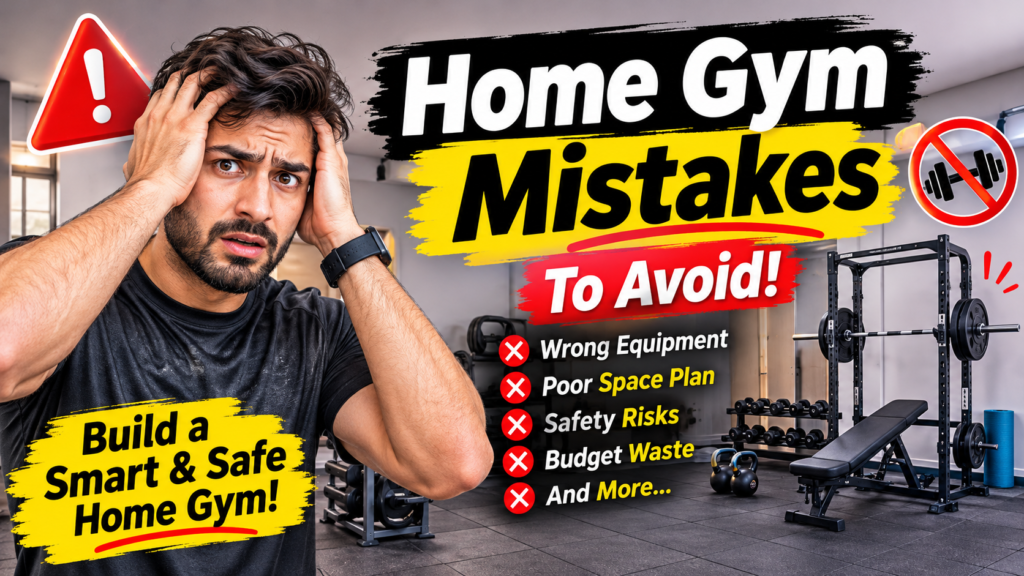
Most home gym mistakes come down to buying before planning. People order a rack, bench, and a pile of weight plates, then discover that the room is too small, the budget is gone, the flooring is wrong, or they never built a workout routine to use any of it.
Building a home gym is an exciting project, but making the wrong decisions can waste money, create safety risks, and make your workout space difficult to use.
This guide covers the most common home gym mistakes in the order you will encounter them: planning, buying, safety, training, and long-term maintenance. You will also find budget guidance, apartment versus garage gym comparisons, and practical checklists to help you avoid expensive mistakes.
Quick Answer: The biggest home gym mistakes include skipping safety equipment, buying equipment without measuring your space, spending too much on unnecessary machines, ignoring flooring, and training without a structured workout plan. Planning your space, budget, equipment, and training routine before purchasing anything can help you avoid most of these problems.
Disclosure: LiftQube earns affiliate commissions on some links. We have not physically tested the products mentioned here. Where we reference equipment, our recommendations are based on manufacturer specifications and independent reviews.
Why Do People Make Home Gym Mistakes?
Home gyms often fail for ordinary reasons. Buying equipment is exciting, but planning is not. Product pages show a finished, spotless gym rather than the delivery route, the low ceiling, or the weekly workout routine.
Another problem is that there is no gym staff to catch mistakes. At home, you are responsible for designing the space, inspecting equipment, and maintaining a safe workout environment.
Most home gym mistakes fall into five categories:
- Planning and space mistakes: The room does not have enough space for equipment or exercises.
- Equipment buying mistakes: Wasted money, incompatible equipment, and incorrect weight capacities.
- Safety mistakes: Poor flooring, unstable equipment, and missing safety features.
- Training mistakes: Working out without a structured plan or adequate recovery.
- Long-term mistakes: Poor maintenance, uncomfortable conditions, and inconsistent training.
Common Home Gym Mistakes to Avoid
Planning and Space Mistakes
1. Buying Equipment Without Measuring the Room
One of the most common home gym mistakes is purchasing equipment before measuring the available space.
A product’s listed footprint only tells you how much floor space the equipment occupies. It does not tell you how much additional room you need to exercise comfortably.
Before purchasing anything, measure:
- Room length and width: Measure the usable floor area and account for permanent obstacles such as stairs, water heaters, and electrical panels.
- Ceiling height: Measure from the floor to the lowest point, including lights, pipes, beams, and garage door tracks.
- Doorway and hallway width: Make sure large equipment can fit through doors, stairways, and elevators.
- Equipment footprint: Check the manufacturer’s assembled dimensions.
- Exercise clearance: Consider the additional space required for your planned movements.
- Storage space: Decide where plates, dumbbells, resistance bands, and benches will be stored.
Taking measurements before shopping can prevent expensive delivery and installation problems.
2. Measuring Equipment but Ignoring Exercise Space
A power rack might fit inside your room, but that does not automatically mean you have enough space to use it.
For example, a barbell is longer than most racks are wide. You also need room to load plates, move around the bar, and perform exercises safely.
Think about the movements you plan to perform:
- Squats
- Deadlifts
- Bench presses
- Overhead presses
- Pull-ups
- Cable exercises
Each movement requires a different amount of space.
Avoid relying on one universal clearance measurement. Check the manufacturer’s recommended space and ceiling requirements for your specific equipment.
The NSCA home gym setup guidance provides useful information about planning exercise spaces. However, commercial facility recommendations should not automatically be treated as home gym requirements.
3. Placing Equipment Too Close to Walls and Other Equipment
Pushing a power rack or cable machine directly against a wall might seem like a good way to save space.
However, this can make it difficult to adjust equipment, load weight plates, move a bench, or perform cable exercises.
Before deciding where to place your equipment, make sure you can comfortably access:
- J-hooks
- Safety arms
- Weight plate storage
- Cable attachments
- Bench adjustment positions
- Equipment adjustment pins
A practical layout should allow you to move around your equipment without constantly rearranging everything.
4. Ignoring Ceiling Height, Doorways, and Delivery Access
Ceiling height is especially important when installing power racks, pull-up stations, and other tall equipment.
A rack might fit in your garage, but garage door tracks, openers, and ceiling lights can interfere with overhead movements.
Delivery access is another commonly overlooked issue. Large equipment often arrives in heavy boxes that may not fit through narrow doorways or staircases.
Before ordering:
- Check the assembled dimensions.
- Check the packed dimensions.
- Review the product weight.
- Measure doorways and hallways.
- Consider staircases and elevator limitations.
- Confirm that the equipment can reach the intended room.
The NSCA facility safety checklist includes ceiling and facility considerations. Remember that its commercial facility measurements are not universal home gym rules.
5. Forgetting Storage and Future Expansion
Dumbbells, weight plates, resistance bands, benches, and other accessories take up more space than many beginners expect.
Without a proper storage plan, your home gym can quickly become cluttered.
Before buying equipment, decide where every item will go.
You should also consider future upgrades. For example, you might eventually want additional weight plates, rack attachments, or a second bench position.
Planning for future expansion can help prevent unnecessary purchases and repeated layout changes.
6. Ignoring Apartment-Specific Limitations
Apartment gyms have different challenges from garage gyms.
Noise, vibration, limited floor space, and building restrictions can affect which equipment you should purchase.
For example, dropping heavy weights in an apartment may disturb neighbors or damage flooring.
We will discuss apartment and garage gym mistakes in more detail later in this guide.
Equipment Buying Mistakes
7. Buying Too Much Equipment Too Early
Many beginners make the mistake of purchasing multiple machines, benches, dumbbells, and accessories before deciding what they actually need.
The result is often an expensive home gym filled with equipment that gets very little use.
Start with your fitness goals and workout routine.
For example, someone following a three-day full-body workout program may need only a few versatile pieces of equipment.
A practical approach is to prioritize versatile equipment before purchasing specialized machines.
Adjustable dumbbells, resistance bands, and an adjustable bench can provide several exercise options without requiring a large room.
If dumbbells are your first major purchase, explore our guide to the best adjustable dumbbells for a home gym.
You can also use our home gym equipment checklist to separate essential equipment from optional accessories.
8. Buying the Cheapest Equipment Available
Saving money is important when building a home gym, but purchasing the cheapest equipment without checking its quality can become an expensive mistake.
Low-quality equipment may have:
- Thin or poorly finished steel.
- Weak welds.
- Unstable frames.
- Poor adjustment mechanisms.
- Low-quality cables.
- Limited customer support.
This is particularly important for equipment that supports your body or holds heavy loads, such as power racks, benches, barbells, and cable machines.
However, expensive equipment is not automatically better.
Compare specifications, weight ratings, construction quality, warranty coverage, and long-term customer reviews before making a decision.
9. Spending the Entire Budget on One Expensive Machine
Another common home gym mistake is spending most of the available budget on one premium machine.
For example, purchasing an expensive cable machine may leave you without enough money for flooring, weights, a bench, or basic accessories.
A balanced setup with several versatile pieces of equipment can be more useful for beginners.
If you are considering cable equipment, compare its price and functionality with your complete workout plan first.
Our guide to cable machines for a home gym can help you understand important features such as pulley systems, weight stacks, and equipment dimensions.
10. Ignoring the Total Cost of Ownership
The product price is not always the final cost.
Additional expenses may include:
- Shipping or freight charges.
- Assembly tools.
- Flooring and rubber mats.
- Weight plates and collars.
- Accessories and attachments.
- Replacement parts.
- Delivery and installation.
You should also check the return policy before purchasing heavy equipment. Returning a large and heavy product can be expensive or difficult.
Always calculate the complete cost before making a major purchase.
11. Confusing User Weight Capacity With Equipment Capacity
Weight capacity is one of the most important specifications to check before purchasing home gym equipment.
However, user weight capacity and equipment load capacity are not always the same thing.
User weight capacity refers to the maximum body weight a bench, bike, or machine is designed to support.
Equipment load capacity refers to the maximum load a rack, barbell, or other equipment component is rated to handle. The exact definition depends on the manufacturer.
The NIDDK guide to staying active at any size also recommends checking the weight limits of exercise equipment.
Always read the manufacturer’s specifications carefully. If a capacity rating is unclear, contact the manufacturer before purchasing.
12. Ignoring Equipment Compatibility
Not every rack attachment, weight plate, barbell, or accessory works with every equipment brand.
For example, power rack attachments may depend on:
- Upright dimensions.
- Hole diameter.
- Hole spacing.
- Bolt patterns.
- Rack design.
Similarly, barbells and weight plates must have compatible sleeve and center-hole dimensions.
Before purchasing additional attachments, confirm compatibility with your existing equipment.
This can prevent wasted money on accessories that do not fit.
13. Choosing Equipment Based on Appearance Instead of Function
A home gym with matching equipment and attractive colors may look impressive, but appearance should not be your main purchasing consideration.
Focus on:
- Stability.
- Adjustability.
- Weight capacity.
- Construction quality.
- Warranty.
- Replacement parts.
- Compatibility.
- Available space.
Choose equipment that supports your workout goals rather than simply matching your preferred gym design.
14. Ignoring Warranty and Replacement Parts
A warranty can become important when equipment develops problems after regular use.
Before buying, check:
- Warranty duration.
- Frame and weld coverage.
- Coverage for moving parts.
- Upholstery coverage.
- Replacement parts availability.
- Customer service reputation.
Also read recent customer reviews to understand how the company handles warranty claims.
Home Gym Safety Mistakes
Safety should always be a priority when building and using a home gym.
Unlike commercial gyms, most home gyms do not have staff members available to inspect equipment or assist during heavy lifts.
Always follow the manufacturer’s assembly, installation, maintenance, and weight capacity instructions.
15. Skipping Proper Flooring
Using unsuitable flooring is a common home gym setup mistake.
Dropping or moving heavy weights on unprotected surfaces can damage hardwood, tile, and concrete floors.
Poor flooring can also increase noise and vibration.
Dense rubber flooring or appropriate rubber mats are commonly used in home gyms because they provide a protective surface for many types of exercise equipment.
When choosing flooring:
- Check its suitability for your equipment.
- Consider the weights you intend to use.
- Make sure the flooring lies flat.
- Avoid gaps and curled edges.
- Inspect it regularly for damage.
The NSCA safety checklist also identifies damaged flooring, gaps, and loose flooring sections as inspection concerns.
If you regularly use bumper plates, read our guide to the best bumper plates for a home gym.
Remember that bumper plates do not make careless weight dropping safe. Follow the manufacturer’s recommendations for plates and flooring.
16. Ignoring Equipment Assembly Instructions
Incorrectly assembling a power rack, bench, or machine can create unnecessary safety risks.
Missing bolts, incorrect washers, and loose connections can affect equipment stability.
Always:
- Read the complete assembly manual.
- Use the specified hardware.
- Follow the recommended assembly sequence.
- Tighten connections according to the instructions.
- Inspect the equipment before its first use.
- Recheck hardware as recommended by the manufacturer.
The NSCA professional standards and guidelines emphasize proper equipment setup and maintenance. Always follow the specific instructions supplied with your equipment.
17. Not Anchoring Equipment When Required
Some power racks and machines require floor or wall anchoring for stability, while others are designed to be freestanding.
Ignoring manufacturer anchoring instructions can create a tipping or stability hazard.
Never assume that heavy equipment is automatically stable.
Before installation:
- Read the manufacturer’s anchoring instructions.
- Confirm the correct installation surface.
- Check whether drilling is required.
- Get permission before modifying rented property.
- Contact the manufacturer or a qualified installer if you are unsure.
Never improvise an anchoring method.
18. Using a Power Rack Without Safety Equipment
A power rack can provide a safer environment for heavy lifting, but only when its safety features are used correctly.
During squats and bench presses, a failed repetition can leave you trapped under a barbell, especially when training alone.
To reduce this risk:
- Use safety arms or spotter arms designed for your rack.
- Set the safety height before beginning your workout.
- Confirm that safety attachments are locked correctly.
- Learn the appropriate technique for safely handling a failed repetition.
- Consider qualified supervision when learning heavy barbell exercises.
Do not assume that owning a power rack automatically makes every exercise safe.
19. Using an Unstable or Damaged Weight Bench
A weight bench must remain stable during exercises.
A bench that rocks, has damaged welds, or contains worn adjustment mechanisms can create unnecessary risks.
Before purchasing or using a bench, check:
- Frame stability.
- Adjustment locking pins.
- Weight capacity.
- Weld quality.
- Upholstery condition.
- Foot stability.
If you need a compact option, explore our guide to the best foldable weight bench for small spaces.
Always check both folded and unfolded dimensions and stability specifications.
20. Ignoring Rack and Bench Weight Ratings
Every major piece of equipment has specifications that should be checked before use.
For a power rack, pay attention to the ratings for:
- Rack structure.
- J-hooks.
- Safety arms.
- Other load-bearing attachments.
For a bench, check its stated weight capacity and what the manufacturer includes in that rating.
The lowest-rated component may limit the safe capacity of your complete setup.
Avoid equipment that does not provide clear capacity information.
21. Storing Weight Plates and Dumbbells Unsafely
Leaving weight plates against walls, dumbbells on the floor, or barbells leaning at an angle can create tripping and tipping hazards.
Use appropriate storage solutions, such as:
- Weight plate trees.
- Dumbbell racks.
- Barbell holders.
- Wall-mounted storage systems where suitable.
Keep walking areas clear and avoid overloading storage equipment.
Return your weights to their designated positions after each workout.
22. Continuing to Use Worn or Damaged Equipment
Equipment should be inspected regularly.
Look for:
- Frayed cables.
- Loose bolts.
- Cracked welds.
- Torn resistance bands.
- Damaged handles.
- Bent barbells.
- Worn adjustment mechanisms.
Do not continue using equipment that appears damaged or unsafe.
Remove it from service until it has been properly repaired or replaced according to the manufacturer’s instructions.
23. Allowing Children and Pets Unrestricted Access
Home gym equipment can create hazards for children and pets.
Weight plates, dumbbells, moving treadmill belts, and adjustable machines should not be left accessible without appropriate safety arrangements.
Consider:
- Using a secure gate or locked door.
- Keeping children and pets away during workouts.
- Storing weight plates and dumbbells securely.
- Unplugging powered equipment when appropriate.
- Removing weights and equipment accessories after use.
The NSCA’s home gym guidance specifically highlights children and pets as important home gym safety considerations.
24. Overlooking Electrical Safety
Treadmills, exercise bikes, and powered gym equipment require appropriate electrical connections.
Incorrect power connections or overloaded circuits can create electrical hazards.
Always:
- Follow the equipment’s electrical requirements.
- Use suitable outlets.
- Keep cords away from walkways.
- Avoid overloading electrical circuits.
- Follow the manufacturer’s instructions.
If you are unsure about electrical installation or outlet requirements, consult a licensed electrician.
Training Mistakes
A well-equipped home gym does not automatically produce good results.
Your workout structure, exercise technique, and consistency matter just as much as the equipment you purchase.
25. Starting Without a Structured Workout Program
Random workouts can make progress difficult to measure.
One day you may train chest, the next day legs, and then spend several days doing exercises without a clear structure.
Instead, choose a simple workout program that matches your experience and goals.
For example, beginners may start with a manageable full-body training routine two or three days per week.
The CDC adult physical activity guidelines recommend at least 150 minutes of moderate-intensity aerobic activity per week and muscle-strengthening activities on at least two days that work all major muscle groups.
Use these guidelines as a starting point when planning your overall activity.
26. Skipping Warm-Ups and Ignoring Exercise Form
Some beginners start lifting heavy weights immediately without preparing for the exercises.
A proper warm-up can include light movement and easier versions of the exercises you plan to perform.
Exercise technique should also be a priority.
Start with manageable weights, learn the correct movement patterns, and avoid increasing resistance before you can perform exercises with good control.
The NIDDK recommends considering guidance from a qualified fitness professional when learning strength-training exercises.
27. Increasing Weight Too Quickly
Progressive overload is an important part of strength training.
It means gradually increasing the challenge of your workouts through weight, repetitions, sets, or exercise difficulty.
However, increasing weight too quickly can make it difficult to maintain proper form.
Progress gradually and only increase resistance when your current workload can be completed with good technique.
The NIDDK’s strength-training guidance discusses selecting appropriate resistance and adjusting weights based on your ability to complete repetitions.
28. Not Tracking Workouts
If you do not record your workouts, it becomes harder to understand whether you are making progress.
A simple notebook or fitness app can help.
Record:
- Exercise name.
- Weight used.
- Number of sets.
- Number of repetitions.
- Workout date.
- Notes about performance.
Reviewing your records can help you make gradual and informed adjustments.
29. Neglecting Muscle Groups and Recovery
Some home gym owners focus heavily on chest and arms while neglecting their legs, back, shoulders, and other major muscle groups.
A balanced training routine should address all major muscle groups.
Recovery is equally important.
Avoid training the same muscles intensely on consecutive days without allowing sufficient recovery.
The CDC’s physical activity recommendations include all major muscle groups, while NIDDK advises allowing muscles time to recover between strength-training sessions.
Rest days are part of a proper workout plan, not wasted time.
30. Constantly Changing Workout Programs
Changing your workout program every few days can make it difficult to measure progress.
Some beginners constantly search for new exercises and routines instead of following a consistent plan.
Choose a suitable program and follow it long enough to evaluate your progress.
Make adjustments when your training records, recovery, or goals indicate that changes are needed.
31. Ignoring Warning Signs During Exercise
Some muscle soreness can occur when beginning a new exercise routine.
However, pain, chest tightness, extreme shortness of breath, and dizziness should not be ignored.
Stop exercising if you experience concerning symptoms and seek appropriate medical advice.
If you have an existing health condition or concerns about starting strength training, speak with a healthcare professional first.
This article provides general educational information and is not a substitute for medical advice.
Maintenance and Long-Term Mistakes
32. Not Cleaning or Inspecting Equipment
Sweat, dust, and chalk can gradually affect equipment surfaces and moving parts.
Clean equipment regularly according to the manufacturer’s recommendations.
Pay particular attention to:
- Bench upholstery.
- Barbell surfaces.
- Cable attachments.
- Handles.
- Adjustment mechanisms.
- Moving parts.
A quick visual inspection before workouts and more detailed maintenance at regular intervals can help identify problems early.
33. Ignoring Humidity, Ventilation, and Lighting
Poor environmental conditions can make a home gym uncomfortable and difficult to maintain.
Humidity can contribute to rust on barbells, plates, and metal components.
Poor ventilation can make workouts uncomfortable, while inadequate lighting can make equipment inspection more difficult.
Consider:
- Installing suitable ventilation.
- Using a fan.
- Managing humidity in damp spaces.
- Keeping equipment dry.
- Adding bright, even lighting.
The NSCA’s facility guidance also identifies lighting, temperature, flooring, and air circulation as important environmental considerations.
34. Not Creating an Equipment Storage System
A home gym without proper storage can quickly become cluttered.
Weight plates, dumbbells, resistance bands, and accessories should each have a designated place.
A storage system improves organization and keeps exercise areas clear.
It also makes workouts easier because you spend less time searching for equipment.
35. Ignoring Noise and Vibration
Noise is particularly important in apartments and shared buildings.
Dropping weights, running treadmills, and clanging plates can disturb neighbors and family members.
Consider:
- Appropriate flooring.
- Quieter equipment.
- Controlled weight placement.
- Suitable workout hours.
- Equipment designed for smaller spaces.
A quieter gym can make it easier to maintain a consistent workout schedule.
36. Buying Equipment That Cannot Be Upgraded
Your training needs may change over time.
Equipment that works well for beginners might become limiting as your strength and exercise preferences develop.
Before purchasing, check whether the equipment supports:
- Additional weight.
- Compatible attachments.
- Replacement components.
- Adjustable configurations.
- Future upgrades.
For people with limited floor space, multifunctional equipment can be especially useful.
Our guide to the best power tower for home workouts explains how one compact station can support exercises such as pull-ups, dips, and leg raises.
37. Designing a Gym That Looks Great but Is Difficult to Use
A visually attractive gym is nice, but functionality should come first.
If your workout space is uncomfortable, cluttered, poorly organized, or difficult to prepare, you may find yourself avoiding workouts.
Make your gym convenient:
- Keep frequently used equipment accessible.
- Maintain clear walking space.
- Create a comfortable environment.
- Keep your workout plan visible.
- Organize equipment after each session.
A practical home gym is one you can use consistently.
Quick Comparison Table: Common Home Gym Mistakes
| Common Mistake | Why It Is a Problem | How to Avoid It |
|---|---|---|
| Not measuring the room | Equipment may not fit properly | Measure the room and exercise clearance |
| Buying too much equipment | Wasted money and clutter | Start with versatile essentials |
| Confusing weight capacities | Equipment may be overloaded | Check manufacturer ratings |
| Skipping safety arms | Failed lifts can trap the lifter | Use appropriate rack safeties |
| Ignoring anchoring instructions | Equipment may become unstable | Follow the manufacturer’s manual |
| Poor flooring | Floor damage and increased noise | Use suitable protective flooring |
| Using damaged equipment | Components may fail under load | Repair or replace damaged equipment |
| Allowing children and pets unrestricted access | Increased safety risks | Secure the workout area |
| No workout program | Progress becomes difficult to measure | Follow a structured routine |
| Ignoring recovery | Fatigue and poor training consistency | Schedule adequate rest |
| No maintenance routine | Equipment may wear prematurely | Inspect and clean equipment regularly |
Home Gym Mistakes by Budget
Your budget affects which equipment you can purchase, but it should not determine whether you plan properly.
The following examples are illustrative budget-planning scenarios, not current product prices.
The $500 Home Gym
Common mistake: Spending most of the budget on one expensive machine and leaving little money for weights, flooring, or other essentials.
Better approach: Prioritize versatile, space-efficient equipment.
Depending on your training goals, you might consider:
- Adjustable dumbbells or a few fixed-weight pairs.
- Resistance bands.
- A suitable exercise mat.
- A basic adjustable bench if your program requires one.
You do not need an expensive machine to begin strength training. Bodyweight exercises can also be part of an effective home workout routine.
The $1,000 Home Gym
Common mistake: Buying a cheap rack and bench without leaving enough money for a barbell, plates, or suitable flooring.
Another problem is purchasing equipment that is not compatible.
Better approach: Decide whether your training will focus on dumbbells or barbell exercises.
Build one complete and functional setup instead of purchasing several incomplete pieces.
For practical planning ideas, read our guide on how to build a home gym under $1,000.
The $2,000 Home Gym
Common mistake: Spending too much on accessories and attachments before purchasing essential equipment.
Another mistake is buying a large system that does not fit the available space.
Better approach: Prioritize the foundation of your gym.
Depending on your goals, this may include:
- A suitable power rack or training station.
- Appropriate safety equipment.
- A stable weight bench.
- A barbell and plates or an adjustable dumbbell system.
- Suitable flooring.
- Organized storage.
Purchase additional attachments only when your workout routine requires them.
Important: At every budget level, include shipping, accessories, flooring, and storage in your calculations.
Apartment Gym vs. Garage Gym Mistakes
The location of your home gym affects which mistakes you are most likely to make.
An apartment gym and a garage gym have different requirements.
Apartment Gym Mistakes
1. Ignoring noise and vibration
Heavy weights, treadmills, and other equipment can transmit noise through floors and walls.
Choose suitable equipment and flooring, avoid dropping weights, and consider your building’s noise restrictions.
2. Ignoring lease and building rules
Some apartment buildings have restrictions on heavy equipment, drilling, noise, and modifications.
Review your lease and building rules before installing equipment.
3. Using unsuitable flooring
Apartment floors may have finished surfaces that can be scratched, dented, or damaged.
Use flooring appropriate for your equipment and the surface underneath it.
4. Purchasing oversized equipment
Limited space makes compact and foldable equipment valuable.
A foldable weight bench for small spaces can be worth considering if you need to store equipment after workouts.
5. Forgetting storage
Without proper storage, dumbbells, bands, and accessories can take over your living space.
Plan where every item will be stored before purchasing it.
Garage Gym Mistakes
1. Ignoring temperature
Garages can become very hot or cold depending on the climate.
Consider ventilation and temperature management when designing your workout space.
2. Underestimating humidity and rust
Moisture can damage metal equipment over time.
Keep equipment dry and consider appropriate moisture-control measures.
3. Poor lighting
Many garages have limited lighting.
Install bright, even lighting so you can see your equipment and exercise safely.
4. Assuming the floor is ready
Garage floors can be uneven, sloped, or cracked.
Check that your equipment sits level and remains stable.
5. Overlooking ceiling height
Garage door tracks, openers, and lighting fixtures can interfere with tall racks and overhead exercises.
Measure carefully before purchasing equipment.
6. Using the space for too many purposes
Garages often contain vehicles, tools, and storage items.
Mark out a dedicated workout area and keep it organized.
Home Gym Mistakes Checklist Before Buying Equipment
Before purchasing any major equipment, use this checklist.
- Fitness goals: Have you identified what type of training you will perform?
- Budget: Does your budget include shipping, flooring, weights, and accessories?
- Room dimensions: Have you measured the usable floor space?
- Ceiling height: Have you checked the lowest point in the workout area?
- Doorway access: Can the equipment reach the intended room?
- Equipment footprint: Have you checked the manufacturer’s dimensions?
- Exercise clearance: Is there enough space for your planned movements?
- Flooring: Is the surface appropriate for your equipment?
- Weight capacity: Have you checked the relevant manufacturer ratings?
- Warranty: Have you reviewed warranty coverage?
- Replacement parts: Are parts available if something breaks?
- Compatibility: Will your attachments and accessories fit?
- Storage: Do you have a designated place for each item?
- Maintenance: Do you understand the equipment’s maintenance requirements?
Completing this checklist before shopping can help prevent expensive purchasing mistakes.
Home Gym Safety Inspection Checklist
Regular equipment inspections are important for maintaining a safe workout environment.
Use the following checklist before workouts where practical and perform more detailed inspections regularly.
Power Racks
- Check for loose bolts.
- Look for cracks or bent uprights.
- Confirm the rack is stable.
- Verify anchoring if required by the manufacturer.
J-Hooks
- Confirm they are seated correctly.
- Check for bends or damage.
- Inspect protective liners.
Safety Arms
- Confirm they are locked securely.
- Check their positioning.
- Look for cracks or bends.
Weight Benches
- Check for wobbling.
- Confirm adjustment pins lock correctly.
- Inspect welds and upholstery.
Barbells
- Look for bending or damage.
- Check that sleeves function properly.
- Inspect collars and other accessories.
Weight Plates
- Look for cracks or chips.
- Check rubber coating.
- Inspect center holes.
Dumbbells
- Check handles and adjustment mechanisms.
- Confirm locking systems work.
- Inspect for loose or damaged components.
Cable Machines
- Inspect cables for fraying.
- Check pulleys.
- Inspect pins, clips, and connections.
Resistance Bands
- Look for cuts and tears.
- Check for thinning or damage.
- Inspect attachment points.
Flooring
- Check for gaps.
- Look for curled edges.
- Inspect damaged or loose sections.
Storage Systems
- Check stability.
- Avoid overloading.
- Make sure storage units are not leaning or tipping.
If any equipment is damaged or unsafe, stop using it until it has been properly repaired or replaced.
Mistakes to Avoid During Your First 30 Days
The first month of home gym ownership is an important time to establish good habits.
Many beginners make the mistake of purchasing unnecessary equipment, training too hard, or changing their workout routines too frequently.
Here are some practical ways to avoid those problems.
1. Do Not Buy Every Accessory Immediately
Start with your essential equipment.
After a few weeks of training, you will have a better understanding of which accessories you actually need.
2. Do Not Overtrain
Start with a manageable workout schedule.
Two or three well-planned weekly sessions may be a more practical starting point for many beginners than attempting to train every day.
3. Learn Exercise Technique
Use manageable weights and focus on performing exercises correctly.
Consider guidance from a qualified fitness professional when learning unfamiliar movements.
4. Take Recovery Seriously
Rest days and adequate recovery are part of a sustainable workout routine.
5. Follow One Workout Program
Avoid constantly switching between different workout routines.
Give your chosen program enough time to evaluate your progress.
6. Develop Equipment Maintenance Habits
Clean equipment, keep the floor clear, and inspect important components regularly.
A simple first-month plan can look like this:
- Weeks 1–2: Learn exercises, establish your workout schedule, and start tracking sessions.
- Weeks 3–4: Continue your routine and gradually increase weights or repetitions when your technique remains consistent.
Home Gym Mistakes: Which Ones Should You Fix First?
Not every home gym mistake has the same level of importance.
Some mistakes affect safety, while others mainly waste money or make workouts inconvenient.
| Mistake Category | Examples | Priority |
|---|---|---|
| Safety-critical | Missing safety equipment, ignored anchoring instructions, damaged equipment, exceeding weight limits | Fix before using the equipment |
| Expensive purchasing mistakes | Buying unnecessary equipment, incompatible accessories, ignoring shipping costs | Fix before purchasing |
| Space and convenience mistakes | Poor measurements, insufficient storage, awkward layouts | Fix early |
| Training mistakes | No workout plan, poor recovery, lack of progress tracking | Improve consistently |
Safety-related problems should always receive immediate attention.
The goal is not to make home gym training sound dangerous. It is to identify avoidable risks and create a properly planned workout environment.
Frequently Asked Questions
What Is the Biggest Home Gym Mistake?
One of the biggest mistakes is purchasing equipment before planning your available space, budget, and workout routine.
This often leads to equipment that does not fit, unnecessary purchases, and an underused workout space.
From a safety perspective, ignoring equipment instructions and failing to use appropriate safety features are particularly important mistakes to avoid.
What Are the Most Common Home Gym Mistakes Beginners Make?
Common beginner mistakes include:
- Buying too much equipment too early.
- Skipping room measurements.
- Choosing equipment without checking specifications.
- Ignoring flooring and safety equipment.
- Training without a structured routine.
- Increasing weights too quickly.
- Neglecting recovery.
Planning ahead can help prevent many of these problems.
How Much Space Do I Need for a Home Gym?
The amount of space depends on the equipment and exercises you plan to perform.
Start by measuring your available floor area and comparing it with the manufacturer’s equipment dimensions.
Remember to account for exercise clearance, ceiling height, and storage.
A small dumbbell-based workout space requires less room than a full barbell setup with a power rack.
Do I Need Rubber Flooring for a Home Gym?
Rubber flooring is a common choice for home gyms because it can protect floors and help manage noise and vibration.
However, the right flooring depends on your equipment, the type of exercises you perform, and the surface underneath.
Choose flooring designed for your intended use and follow manufacturer recommendations.
Do I Need to Anchor My Power Rack?
Not every power rack requires anchoring.
Some models are designed to be freestanding, while others require floor or wall anchoring.
Always follow the manufacturer’s installation instructions. Never assume that a heavy rack is automatically stable.
Is a Home Gym Safe for Beginners?
A home gym can provide a suitable workout environment for beginners when equipment is properly assembled, maintained, and used according to manufacturer instructions.
Start with manageable weights, learn correct exercise technique, and use appropriate safety equipment.
If you have health concerns, speak with a healthcare professional before starting a new exercise program.
Should I Buy Adjustable Dumbbells or a Barbell Set First?
The right choice depends on your workout goals, budget, and available space.
Adjustable dumbbells are generally compact and convenient for smaller workout areas.
A barbell setup offers different training possibilities but usually requires more space, plates, and additional equipment such as a rack and bench.
Choose the option that best matches your actual training routine.
How Do I Make a Home Gym Work in an Apartment?
Focus on compact equipment, suitable flooring, noise management, and a proper storage system.
Review your lease and building restrictions before installing heavy equipment or making modifications.
Avoid dropping weights and consider your neighbors when choosing workout times.
How Often Should I Train at Home?
The CDC recommends muscle-strengthening activities on at least two days per week, covering all major muscle groups, alongside aerobic activity.
Many beginners start with two or three manageable full-body sessions per week.
Your ideal schedule depends on your fitness level, recovery, and personal goals.
When Should I Replace Home Gym Equipment?
Equipment should be repaired or replaced when it develops damage that affects its stability or safe operation.
Examples include:
- Cracked welds.
- Bent structural components.
- Frayed cables.
- Damaged resistance bands.
- Loose structural connections.
- Broken adjustment mechanisms.
Stop using damaged equipment until it has been properly repaired or replaced.
Final Thoughts
Most home gym mistakes are avoidable with proper planning.
Before purchasing equipment, measure your space, establish a realistic budget, and decide which exercises you want to perform.
Choose versatile equipment that matches your fitness goals rather than buying unnecessary machines and accessories.
Pay particular attention to flooring, equipment assembly, weight capacities, and safety features. Regular maintenance and a structured workout routine will also help you get more value from your home gym.
Here are six practical steps to take before building or upgrading your home gym:
- Measure your room, ceiling height, doorways, and available workout space.
- Establish a realistic budget and include additional costs.
- Choose equipment based on your actual workout plan.
- Install appropriate flooring and safety equipment before heavy lifting.
- Inspect equipment regularly and follow manufacturer instructions.
- Start with a manageable 30-day workout routine and track your progress.
If you are still deciding what equipment to purchase, begin with our home gym equipment checklist and build your setup around your actual training needs.
Disclaimer: This article is for general educational purposes and is not medical, legal, or professional safety advice. Always follow your equipment manufacturer’s instructions. Consult a qualified professional for health concerns, electrical work, or equipment installation questions.
