
Affiliate Disclosure: LiftQube may earn a commission if you buy through links on this page, at no extra cost to you.
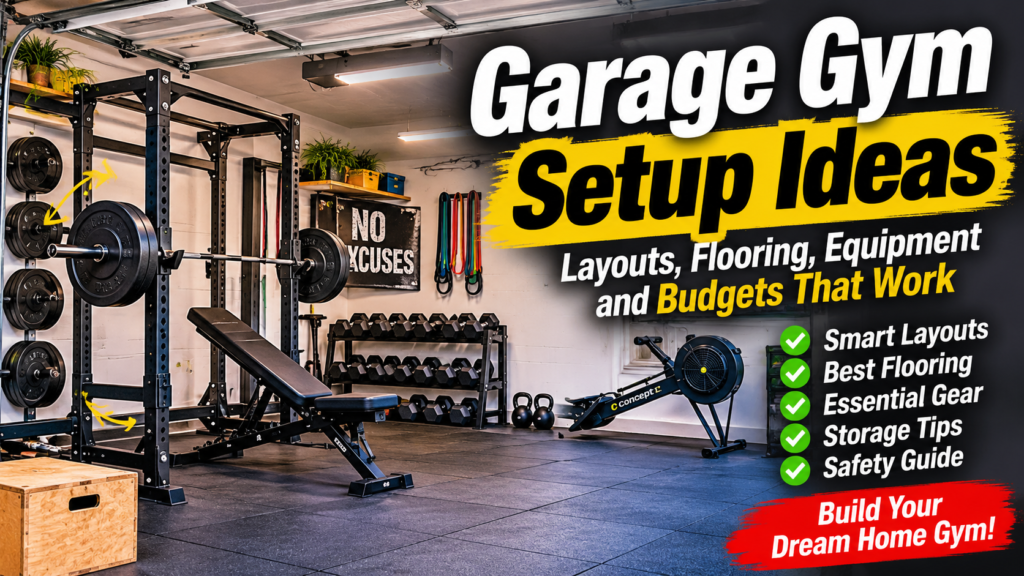
The best garage gym setup ideas start with a floor plan, not a shopping cart. A garage is some of the cheapest, most convenient training space a homeowner has, but it comes with a concrete slab, uneven ceiling height, swinging temperatures and, usually, a car that still needs somewhere to park. Plan around those realities and a home gym garage becomes the place you actually train. Ignore them and it becomes expensive storage.
This guide covers how to measure your garage, eight layout ideas, equipment, flooring, storage, climate, lighting, safety, budgets and how to build in stages. It is based on manufacturer specifications and published safety guidance, not LiftQube hands-on testing. Dollar figures are planning estimates, not current prices, and they will vary by retailer, region and season.
What Is a Garage Gym, and Is Your Garage a Good Candidate?
A garage gym is a home gym built in an attached or detached garage, either across the whole space or in one bay. The appeal is obvious: no commute, no waiting for a rack, and room for equipment that would never fit in a bedroom.
The trade-offs are just as real. Garages run hotter and colder than the rest of the house, slabs can be damp, noise and vibration carry to neighbors, and anything with an engine (cars, mowers, generators) is a carbon monoxide source. If your garage floods, leaks or has no usable wall space, fix that first. If you rent or share an HOA, check the rules before you drill, bolt or add circuits.
How to Plan Your Garage Gym Before Buying Equipment
Every experienced home lifter has a story about a rack that did not fit under the garage door track. Ten minutes with a tape measure prevents it.
Measure Length, Width and Ceiling Height
Measure the floor wall to wall, then measure again along the wall where the rack will go. Water heaters, electrical panels, steps and shelving often steal more floor than you expect.
For ceiling height, measure to the lowest thing overhead in each area you plan to train, not just to the ceiling. Lights, rafters, pipes and door hardware are usually the real limit.
Measure Garage Door Tracks and Openers
When the door is up, its tracks and the opener rail and motor sit under the ceiling and can block overhead movements. Measure clear height with the door both open and closed, and note the lowest point above every spot where you might press, pull up or load a bar.
If you still park in the garage, plan around the door’s travel too.
Allow for Footprint and Working Clearance
Footprint is the floor a machine covers. Working clearance is the extra room you need to use it. Spec sheets give you the first number; you work out the second by how you move.
For example, Rogue lists its RML-390F flat-foot power rack at a 48 by 49 inch footprint and 92.25 inches tall, and Concept2 lists its RowErg at 96 by 24 inches with a recommended 108 by 48 inch operating area. In both cases, the usable space is bigger than the machine.
There is no universal clearance rule. The right number depends on the equipment, your body, and whether you train alone. Treat any blanket figure you see online as a starting point, then test it with tape on your own floor.
Plan Barbell Loading Clearance
Olympic barbells are roughly seven feet long, and plates go on from both ends. Add the rack’s width, the plates stacked on each end, and room to stand and slide a plate on without twisting.
Also check how far plates stick out past the uprights once loaded, because that decides how close a wall, bench or car can sit.
Plan Walking Paths and Access
Mark a clear route from the garage door to the house door, from the door to the rack, and from the rack to your storage wall. You should be able to carry a plate without turning sideways.
Keep the path to your main exits clear at all times.
Pre-Purchase Measurement Checklist
Before ordering any equipment, check the following:
- Floor length and width, plus the width of the wall behind the rack.
- Ceiling height at the lowest point over each training zone.
- Garage door open and closed height, track and opener position.
- Location of outlets, panel, water heater, furnace and floor drain.
- Footprint and height of each piece from the manufacturer’s spec sheet.
- Bar length plus plate-loading room at each end.
- Door swing for the house door and, if parked, the car doors.
- Clear walking path to every exit.
- Tape or chalk outline of each machine on the floor before ordering.
Garage Gym Equipment Dimension Comparison
| Equipment | Specification Example or What to Check | Planning Note |
|---|---|---|
| Power rack | Rogue RML-390F: 48 × 49 inches footprint, 92.25 inches tall | Compare height to your lowest overhead point |
| Olympic barbell | Roughly 7 feet long; exact length varies by model | Add plate-loading room at both ends |
| Rowing machine | Concept2 RowErg: 96 × 24 inches; 108 × 48 inches operating area | Needs a long, clear lane |
| Power tower | Many models are listed around 83 to 90.6 inches tall | Check ceiling and door track |
| Weight bench | Varies widely; read unfolded and folded sizes | Incline positions need extra room |
| Treadmill | Varies; read running footprint and folded size | Follow the manual for space behind the belt |
| Adjustable dumbbells | Varies; read stand or tray size | Often the smallest strength footprint |
| Cable machine or trainer | Varies by design | Check footprint and height |
Garage Gym Layout Ideas for Different Garage Sizes
A good garage gym layout puts the heavy, permanent equipment on the walls, keeps the middle clear and leaves a path out.
Garage sizes vary a lot, so use the sizes below as planning examples, not standards. One-car bays are often cited at about 12 × 20 feet (240 square feet) and two-car garages at about 24 × 24 feet (576 square feet). Measure your own.
Garage Gym Layout Comparison
| Layout | Anchor Zone | Rack Position | Bench and Dumbbells | Cardio | Storage |
|---|---|---|---|---|---|
| One-car | Lifting corner | Back wall, centered | Bench folds beside the rack | Folding unit in a corner | Side wall |
| Two-car, dedicated | Lifting plus conditioning | Back wall of one bay | Dedicated bench station | Second bay | Full storage wall |
| Half garage, car parked | Wall-mounted | Folding or wall-mounted | Bench on casters or folded | Foldable only | Walls only |
| Small garage | Compact | Squat stand or half rack | Adjustable dumbbells, foldable bench | Optional | Vertical |
| Strength-focused | Platform and rack | Center of back wall | Bench near rack | Minimal | Plates near rack |
| Dumbbell-focused | Bench zone | Optional half rack | Dumbbell rack and adjustable bench | Optional | Dumbbell rack |
| Cardio-focused | Long lane | Optional | Bands and light dumbbells | Side wall | Compact |
| Complete premium | Four zones | Platform and full rack | Bench station | Dedicated zone | Dedicated wall |
1. One-Car Garage Gym Layout
Put the rack on the back wall, opposite the door, so the bar path runs along the long axis and the door stays usable.
Store the bench folded or on end beside the rack, and put dumbbells and plates on one side wall. In a 12-foot-wide bay, an 8-foot-wide lifting zone leaves about 4 feet for a walking lane. That is arithmetic on a common example, not a requirement, so check yours.
2. Two-Car Garage Gym Layout
With a full two-car space you can zone it. Run the lifting area along the back wall of one bay, make the other bay a conditioning and stretching zone, and give one long wall to storage.
Because the car is not coming in, the rack can be bolted down per the manufacturer’s instructions and the equipment can stay put.
3. Half-Garage Gym With a Parked Car
This is the most common compromise. Park the car, open the doors, and tape its outline on the floor. The gym lives outside that outline.
A folding or wall-mounted rack, a bench that folds or rolls, and interlocking flooring that lifts in sections let you clear the bay quickly.
Keep plates, bars and bands on walls so nothing sits where doors swing, and keep the house door clear.
4. Small Garage Gym Ideas
When floor space is tight, buy equipment that adjusts, folds or stores vertically. A squat stand or half rack, one pair of adjustable dumbbells and a bench that folds flat can cover a full program.
Our guide to the best foldable weight bench for small spaces covers the folded sizes and trade-offs.
If ceiling height is limited, skip standing overhead presses and choose a lower rack.
5. Strength Training Garage
Make the rack and platform the anchor. Center the rack on the back wall, put the bench inside or beside it, and keep plates on wall horns near the rack so you are not carrying them across the floor.
A mirror on a side wall, not in the bar path, helps with form checks.
6. Bodybuilding and Dumbbell-Focused Garage
Bodybuilding setups lean on dumbbells, an adjustable bench and cables.
Put the dumbbell rack or adjustable set along a wall facing the mirror wall, place the bench in the middle with room to carry dumbbells to it, and push a cable station against another wall.
Leg work can use the rack or a machine if you have the room.
7. Cardio-Focused Garage Gym
Cardio machines are long and need clear ends. Run a rower or treadmill along a side wall, keep a lane in front, and put a fan and outlet nearby.
Add a small strength corner with bands and a few dumbbells. Floor protection under machines cuts slab wear and vibration.
8. Complete Premium Garage Gym
A premium garage gym is usually a two-car space with four zones: a lifting platform and full rack, a bench and dumbbell area with a mirror wall, a cable station, and a cardio and recovery corner.
Climate control, dedicated circuits and wall storage keep it tidy and comfortable year-round.
Garage Gym Equipment: What You Need and What You Can Skip
Garage gym equipment falls into three groups: items you need for your training style, items that make it better, and items you can add later or skip.
Our home gym equipment checklist covers the complete list; the table below adapts it for a garage.
Essential vs Optional Equipment
| Equipment | Priority | Best For | Garage Size Fit |
|---|---|---|---|
| Power rack or squat stand | Essential for barbell training | Squats, presses, pulls | Squat stand fits small garages; full rack needs more room |
| Barbell and plates | Essential for barbell training | Strength | Any size, with wall storage |
| Adjustable dumbbells | Essential for dumbbell training | Hypertrophy, small spaces | Any size |
| Adjustable bench | Essential for most programs | Presses, rows | Foldable for small bays |
| Flooring | Essential | Slab and equipment protection | Any size |
| Bands and accessories | Useful | Warm-ups, assistance | Any size |
| Cable machine | Optional | Isolation work | Needs a wall |
| Power tower | Optional | Pull-ups, dips | Needs ceiling height |
| Rower, bike, treadmill | Optional | Conditioning | Needs length or a corner |
Power Racks and Squat Stands
The rack sets your layout, so choose it first. Full four-post racks are the most versatile, squat stands and half racks take less room, and wall-mounted folding racks suit shared bays.
Check height against your ceiling, and follow the manufacturer’s instructions on bolting.
Accessory compatibility also differs by design: for example, Rogue notes that band pegs and spotter arms should not be used with its flat-foot rack.
Barbells and Weight Plates
A standard Olympic barbell uses 2-inch sleeves, so confirm that your plates, bar and rack match.
Iron plates are usually cheaper per pound, while rubber bumper plates are made for controlled drops on a suitable surface and tend to be quieter.
See our guide to the best bumper plates for home gym if you plan to drop lifts.
Adjustable Dumbbells
One adjustable pair can replace a full rack, which is why they suit one-car and small garages.
Compare weight range, increments and drop tolerance in our guide to the best adjustable dumbbells for home gym.
If you are considering Bowflex, read the Bowflex SelectTech 552 review first, because the original 552 was subject to a 2025 recall.
Adjustable Benches
A flat-to-incline bench does the work of two. For garages you share with a car, folding or rolling designs matter more than extra adjustments.
Check the stated weight capacity, which includes your body weight plus the load.
Cable Machines and Power Towers
Cable machines add variety but take wall space and budget, so they are usually a later purchase.
Our list of the best cable machines under $1,000 compares compact options.
Power towers are free-standing pull-up and dip stations; check height against your lowest overhead point and read our guide to the best power tower for home workouts before buying.
Cardio Equipment
Buy cardio machines after the strength basics unless conditioning is your main goal.
Rowers need a long lane, treadmills need space behind the belt per the manual, and bikes are the most compact. Foldable and two-piece designs earn their price in a shared bay.
Resistance Bands and Accessories
Bands, collars, a jump rope and a pull-up option cost little and store easily. Hang them on wall hooks so they stay off the floor.
Garage Gym Flooring: What Works and What to Avoid
Garage gym flooring protects your slab, your equipment and your joints, and it quiets the room. Rubber is the standard answer, but the right type depends on what you do on it.
Rubber Gym Flooring and Interlocking Tiles
Roll rubber and interlocking rubber tiles suit cardio zones, bodyweight work and light lifting. Tiles can be lifted in sections, which helps in shared bays.
Choose a thickness that matches your heaviest lifts, and avoid thin foam under a barbell because it compresses and can tear.
Horse Stall Mats
Horse stall mats are thick recycled rubber originally sold for barns. Mats around 3/4 inch thick are a popular, low-cost base under racks and platforms.
They are heavy, often sold in sections of about 4 by 6 feet, and can smell for the first few weeks. Check that edges are tight so plates cannot catch.
DIY Garage Gym Lifting Platform
A DIY lifting platform is plywood layers topped with rubber or stall mats. It spreads force, levels a sloped slab and deadens drops.
Build it under the rack if you drop weights. If you only deadlift or press, a smaller platform may be enough.
Concrete Floor Protection
Before laying anything, sweep and check for moisture. If the slab sweats or stays damp, rubber on top can trap moisture, so fix the source first or use a surface designed for it.
Some owners seal or coat the slab, but follow the product’s cure times and check that rubber will adhere or sit flat on top.
Thickness, Noise and Vibration
Thicker rubber absorbs more impact, and bumper plates help further. Rubber reduces noise and vibration but does not eliminate it, especially if a slab shares a wall with a house or neighbor.
Flooring Mistakes to Avoid
- Putting thin foam under a barbell.
- Covering a wet slab without fixing the moisture.
- Leaving gaps or raised edges where plates can catch.
- Buying more flooring than the zones you use.
- Forgetting the area where you drop dumbbells or step off.
Garage Gym Storage and Organization Ideas
Good garage gym organization gets everything off the floor. Wall space is your most valuable asset.
- Wall-mounted plate storage: Horns or trees near the rack keep plates within reach.
- Dumbbell storage: A narrow rack or a stand for adjustable dumbbells saves floor space.
- Barbell holders: Wall-mounted horizontal or vertical holders protect the bar and free the floor.
- Band hooks: A row of hooks or a pegboard handles bands, ropes and straps.
- Shelving: Shallow shelves for chalk, collars and tape keep small items out of the way.
- Vertical storage: Stand foldable benches and bikes on end when possible.
- Zones: Keep the lifting zone, conditioning zone and storage wall separate so nothing drifts across the floor.
Store heavy items low, anchor wall racks to studs per the instructions, and keep stored plates out of walking paths.
Garage Gym Ideas on Different Budgets
A budget garage gym is possible at almost any level if you buy in the right order. The ranges below are planning estimates for new equipment before tax and freight. They assume mid-market brands and a modest starter set of plates. Used equipment can reduce them. Actual prices will differ.
$500 Garage Gym
Essentials:
- Adjustable dumbbells: $150–$200.
- Adjustable or foldable bench: $100–$130.
- Two stall mats covering roughly 48 square feet: $90–$150.
- Resistance bands: $20–$40.
Estimated total: $360–$520.
Optional additions include a pull-up bar and LED shop light.
$1,000 Garage Gym
Essentials:
- Squat stand or entry rack: $250–$380.
- Olympic barbell: $150–$220.
- Starter plates: $150–$220.
- Bench: $80–$130.
- Two stall mats: $90–$150.
Estimated total: $720–$1,100.
To stay at $1,000, buy used and keep the bench simple.
Optional additions include adjustable dumbbells and wall plate storage.
$2,000 Garage Gym
Essentials:
- Power rack: $550–$850.
- Barbell: $200–$350.
- Plates: $350–$550.
- Bench: $120–$250.
- Flooring for the lifting zone: $180–$300.
- Wall storage: $40–$100.
Estimated total: $1,440–$2,400.
Optional additions include adjustable dumbbells ($150–$300), a fan and lighting ($60–$150).
Premium Garage Gym
Strength core:
- Heavy-duty rack: $900–$1,800.
- Barbell: $300–$500.
- Bumper plates: $600–$1,200.
- Bench: $250–$500.
- Platform and flooring: $400–$900.
- Storage: $150–$400.
Estimated core total: $2,600–$5,300.
Optional upgrades:
- Cable machine: $600–$2,000.
- Cardio machine: $600–$2,500.
- Climate control and insulation: $300–$1,500 or more.
Adding all three brings the estimated range to about $4,100 to $11,300 or more.
Garage Gym Budget Comparison
| Tier | Best For | Core Purchases | Estimated Range | Main Trade-Off |
|---|---|---|---|---|
| $500 | Dumbbell training, small bays | Dumbbells, bench, mats, bands | $360–$520 | No barbell work |
| $1,000 | Starting barbell training | Rack, bar, plates, bench, mats | $720–$1,100 | Basic gear, used items help |
| $2,000 | Complete strength setup | Rack, bar, plates, bench, flooring, storage | $1,440–$2,400 | Few extras |
| Premium | Serious or shared training | Heavy rack, bumpers, platform | $2,600–$5,300 core | Cost and space |
Lighting, Mirrors and Appearance
A professional-looking gym does not need expensive decor. It needs light, order and a few consistent choices.
LED Lighting
Replace a single bare bulb with bright LED shop lights placed so they do not cast shadows over the rack. Good lighting also helps safety.
The Canadian Centre for Occupational Health and Safety recommends adequate light without glare and replacing flickering fluorescent tubes, since flicker can make moving parts look stationary.
Mirrors
A mirror on a side wall helps with form and makes a small bay feel wider. Mount it securely, and keep it out of the bar path.
Wall Paint
Light colors brighten the room, while a matte dark color hides scuffs. Choose washable paint and ventilate while it dries.
Signage and Rubber Flooring Design
One sign or accent wall is enough. Use flooring color to mark zones rather than adding decor.
Cable Management
Run cords along walls or ceilings and avoid trailing extension cords across the floor.
Music
A speaker mounted high saves floor space. Keep volume in mind if neighbors share a wall.
Temperature, Insulation, Humidity and Ventilation
Comfort decides whether you train in January and August, and air quality decides whether it is healthy.
Insulation and Sealing
Insulating the door and walls and weatherstripping gaps make heating and cooling more effective.
If the garage is attached, the EPA’s indoor air quality guidelines for single-family building upgrades recommend air sealing the walls, ceiling, door and penetrations between the garage and the living space, because garage air can carry pollutants such as carbon monoxide, benzene and other volatile compounds.
For heat, EPA calls for a properly installed supplemental heating system. For people who spend significant time in an attached garage, it also suggests a local exhaust fan rated for continuous operation and vented outdoors.
Scotland’s building standards guidance on ventilation says the separating construction between an attached garage and a dwelling should be as airtight as possible, while garages under 30 square meters (about 320 square feet) need no designed ventilation because gaps around doors provide some, and attempting airtight construction is inadvisable.
That is a UK building standard, not a US code or a rule for gyms, so treat it as context and check local requirements.
Heating Options
Electric garage heaters and mini-splits are common choices. Size the heater to the space and follow its circuit requirements.
Fuel-burning heaters need proper venting and installation under local codes, so use a licensed installer. EPA notes that unvented combustion appliances produce carbon monoxide and moisture, so avoid them in a space where you exercise.
Fans and Cooling
Wall or box fans, an open door with a cross breeze, and exhaust fans move air in summer. A mini-split cools and dehumidifies if the budget allows.
Never rely on a car or generator for any airflow.
Humidity, Condensation and Rust Prevention
Damp air rusts steel. EPA’s home guidance aims to keep indoor relative humidity below 60 percent, and a cheap hygrometer tells you where your garage sits.
Run a dehumidifier in humid climates, wipe bars and plates after sweaty sessions, and follow your barbell maker’s care instructions for oil and brushing. Store plates and bars off damp floors and away from the door.
Seasonal Maintenance
Twice a year, check bolts and pins on racks and benches, inspect cables and mats, test alarms and extinguishers, clean surfaces and touch up rust spots.
Keep a hygrometer reading in a log if you struggle with moisture.
Garage Gym Safety Considerations
Garage hazards are different from living-room hazards. These points rely on published government and occupational safety guidance, not on rules of thumb.
Carbon Monoxide and Vehicles
NIOSH’s carbon monoxide toolbox talk says fuels produce carbon monoxide, an invisible, odorless gas that can build up indoors, and warns never to use equipment powered by an internal combustion engine, such as a generator, in an enclosed or partially enclosed space like a garage.
In practice, never run a vehicle or fuel-burning generator in an occupied garage gym, even with the door cracked.
Warning signs include headache, dizziness, nausea and confusion. If you notice them, turn off the source, go outdoors and call 911. EPA also recommends working CO alarms where a home has an attached garage.
Fire Safety
The U.S. Fire Administration’s basement and garage fire safety guidance notes that garage fires tend to spread farther, injure more people and cost more than fires elsewhere in a home.
It advises storing gasoline, paint, propane and varnish in a shed away from the house, plugging only one charging appliance into an outlet, avoiding extension cords for charging and using a heat alarm rather than a smoke alarm in the garage.
Storage of Chemicals and Flammables
CCOHS’s general garage safety fact sheet is written for garage businesses, but its housekeeping points carry over.
It advises storing flammables in approved containers away from heat, putting rags soaked with flammable materials in approved metal containers and keeping fire extinguishers, doors and exits unblocked.
Electrical Safety
Use a licensed electrician for new circuits or outlets. Many treadmill manuals call for a dedicated circuit, so read yours.
Avoid trailing cords.
Emergency Exits and Access
Keep clear paths to the house door and garage door, and check your opener’s manual for the manual-release procedure. Do not block the extinguisher.
Safe Equipment Placement
Anchor or stabilize racks as instructed, use safeties or straps when training alone, keep plates low and keep children away from equipment.
This article is general information and not medical or legal advice. Consult a professional before starting a new exercise program, and check local building rules before you change wiring, fuel appliances or structure.
Common Garage Gym Setup Mistakes
Avoid these common mistakes when planning your garage gym:
- Buying before measuring: Footprint, height and loading room come first.
- Ignoring ceiling height and door tracks: The lowest overhead point is your limit.
- Choosing unsuitable flooring: Thin foam under a barbell is a false saving.
- Poor equipment placement: A rack in the middle of the room blocks everything else.
- Blocking garage access: Keep paths and exits clear.
- Ignoring ventilation: Plan airflow and a CO alarm before long sessions.
- Overspending on unnecessary machines: Cardio and cable machines can wait.
- Neglecting storage: Floor clutter is a trip hazard.
- Skipping maintenance and humidity control: Rust and loose bolts are preventable.
- Weak lighting and electrical planning: Dim light and extension cords cause trouble.
How to Build Your Garage Gym in Stages
You do not need to buy everything at once. Building in stages lets you learn what you use and spread cost.
Step-by-Step Garage Gym Building Sequence
- Declutter and measure the garage.
- Tape or chalk the layout, including the car path.
- Fix moisture, leaks and lighting.
- Lay flooring in the lifting zone.
- Install the anchor piece: rack, squat stand or dumbbells and bench.
- Add bar and plates, or dumbbells and bench.
- Mount storage on the wall.
- Add climate control, fans and a CO alarm.
- Add cardio or cable equipment if your goals need it.
- Review and adjust every few months.
Future Expansion
Stage one is floor, light and one anchor item. Stage two is core strength equipment. Stage three is comfort: insulation, fans, heat. Stage four is specialization: cables, cardio, premium upgrades.
Buy steel racks and benches used when possible, and buy bars and bumper plates new if the warranty matters to you.
Garage Gym Setup Checklist
Before considering your garage gym complete, make sure you have checked the following:
- Measurements and tape layout complete.
- Slab checked for moisture and cleaned.
- Flooring installed under the lifting zone.
- Lighting upgraded.
- Rack or stand installed per instructions.
- Plates, dumbbells and bars stored on walls.
- CO alarm and heat alarm installed.
- Extinguisher and first-aid supplies accessible.
- Exits and walking paths clear.
- Fan, heater and dehumidifier plan in place.
Final Thoughts
The best garage gym setup ideas are the ones that fit your garage, your goals and your budget. Measure first, protect the floor, buy the anchor piece before accessories, and treat air quality and fire safety as part of the build, not an afterthought.
Start small, and the garage gym can grow with you for years.
Frequently Asked Questions
How much space do I need for a garage gym?
There is no single answer. Many people start with a one-car bay of roughly 12 × 20 feet and plan a lifting zone plus a walking lane. Use manufacturer dimensions and a tape layout to confirm.
Can I park my car and still have a garage gym?
Yes. Use one bay, a folding or wall-mounted rack, a foldable bench and flooring you can lift. Tape the car’s outline, doors open, and keep equipment outside it.
What is the best flooring for a garage gym?
Rubber is the standard. Roughly 3/4-inch stall mats are common under racks and platforms, and interlocking tiles suit other zones. Check the slab for moisture first.
Do I need to insulate my garage gym?
It is not required for most setups, but it makes training more comfortable. Check local codes, and seal the wall shared with the house.
How much does a garage gym cost?
Planning ranges run from about $360 to $520 for a basic dumbbell setup up to $4,100 to $11,300 or more for a premium build with cables, cardio and climate control. These are estimates, and prices vary.
Is it safe to use a heater in a garage gym?
Electric heaters sized for garages are common. Fuel-burning heaters need proper venting and installation, and unvented ones create carbon monoxide and moisture. Install a CO alarm and hire a licensed installer.
How do I prevent my barbell from rusting?
Control humidity, wipe the bar after sweaty sessions, keep it off damp floors and follow the maker’s care instructions for oil and brushing.
What should I buy first for a garage gym?
Flooring and lighting, then your anchor piece: a rack or stand for barbell training, or adjustable dumbbells and a bench for dumbbell training. Add cardio and cables later.

Pingback: Best Home Gym Equipment for Beginners: What to Buy First (2026 Guide) - LiftQube – Home Gym Equipment Reviews & Buying Guides