
Affiliate disclosure: LiftQube is reader-supported. If you buy through links on this page, we may earn an affiliate commission at no extra cost to you. This does not affect our editorial opinions.
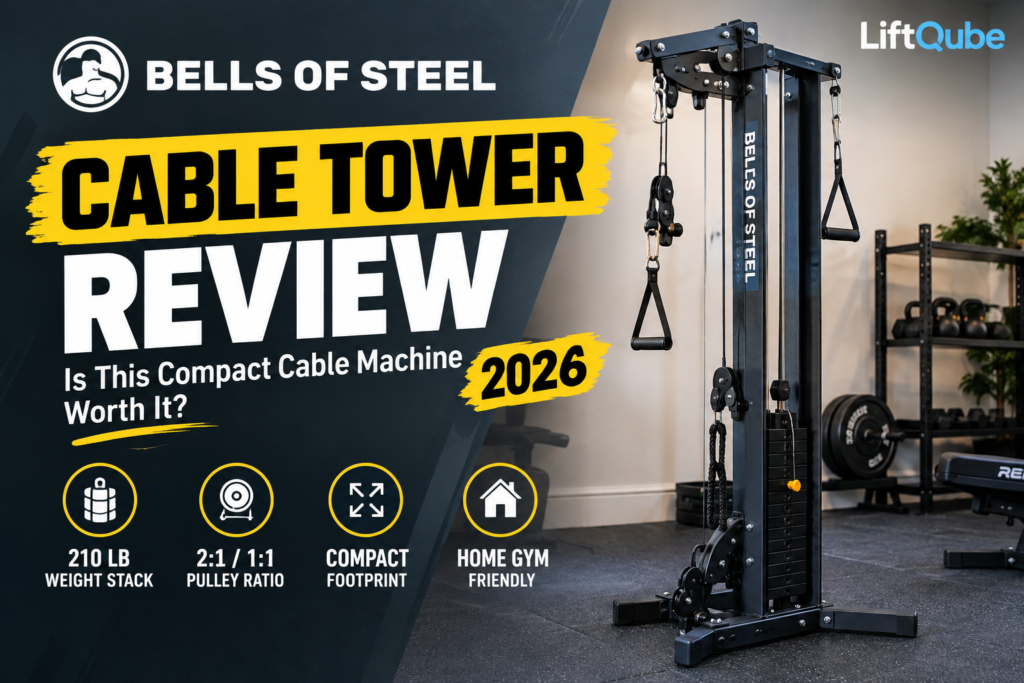
If you’ve been searching for a Bells of Steel Cable Tower review because you’re trying to decide whether a compact cable machine can actually replace a chunk of your gym membership, you’re asking the right questions. Cable towers are one of the most space-efficient ways to add real exercise variety to a home gym, and Bells of Steel’s version has become one of the most talked-about options in this category for 2026.
This review breaks down the specs, the 2:1 vs. 1:1 pulley system, the weight-stack vs. plate-loaded decision, and who this machine is — and isn’t — a good fit for, so you can make a confident buying decision.

- Superb Exercise Equipment – Be thrilled using this Bells of Steel Pulley Cable Machine. It will add hundreds of cable ma…
- Space-Saver Design – Compact Cable Machine with a footprint less than 2.5 ft x 2.5 ft. Bolt it down into the floor or us…
- You Deserve an Upgrade – Cable Tower with universal slot brackets at the top and bottom. The 5.75 inches open slot in th…
1. Bells of Steel Cable Tower Review: Quick Verdict
Overall rating: 8.7/10
The Bells of Steel Cable Tower earns its reputation as one of the best space-saving cable machines for home gyms. It packs a genuinely large exercise library into a footprint smaller than a standard power rack, with a design flexible enough for garages, basements, and even apartments with adequate ceiling height.
- Best feature: The dual pull-ratio system (2:1 default, 1:1 with the included adapter), which lets one machine behave like two.
- Biggest weakness: It’s a single-column tower, not a dual-column functional trainer — so true cable-crossover movements and simultaneous bilateral cable work are limited.
- Best type of buyer: Home gym owners with limited floor space who want serious exercise variety without a full commercial cable station.
- Do we recommend it? Yes, for the majority of home gym owners prioritizing space efficiency and versatility over commercial-gym-style crossover training.
- Who should avoid it: Lifters who specifically want a dual-tower functional trainer experience, or anyone unwilling to wall-, floor-, or rack-mount the unit for stability.
2. Bells of Steel Cable Tower: Key Specifications
Specifications below come directly from Bells of Steel’s official product listing and, where noted, from independent equipment reviewers. Because the Cable Tower ships in three loading configurations, some specs differ by version.
| Spec | Weight Stack (210 lb) | Plate-Loaded |
|---|---|---|
| Product type | Single-column, stack-loaded cable tower | Single-column, plate-loaded cable tower |
| Loading capacity | 210 lb selectorized stack (110 lb mini-stack also available) | Up to 250 lb cable capacity, user-supplied plates |
| Pulley ratio | 2:1 by default | 2:1 by default |
| 1:1 adapter | Included | Included |
| Height settings | 30+ numbered positions | 30+ numbered positions |
| Footprint (base) | 28.5″ x 21″ | 28.5″ x 21″ |
| Overall height | 80.75″ | 80.75″ |
| Cable travel (single/double) | 90.5″ / 45.75″ | 113″ / 55.5″ |
| Included handles | 2x adjustable nylon handles, 2x carabiners | 2x adjustable nylon handles, 2x carabiners |
| Mounting options | Wall, floor, or rack | Wall, floor, or rack |
| Frame construction | 14-gauge steel | 14-gauge steel |
| Pulley material | Aluminum | Nylon |
| Warranty | Limited lifetime (frame), 90-day (cables/pulleys) | Limited lifetime (frame), 90-day (cables/pulleys) |
| Unit weight | ~324 lbs (stack + frame) | ~85 lbs |
| Starting price (2026) | $1,315.99 (without upright) | $434.99 (without upright) |
Pricing and specs can change without notice, so always verify current numbers on the official Bells of Steel Cable Tower specifications page before purchasing.
- Superb Exercise Equipment – Be thrilled using this Bells of Steel Pulley Cable Machine. It will add hundreds of cable ma…
- Space-Saver Design – Compact Cable Machine with a footprint less than 2.5 ft x 2.5 ft. Bolt it down into the floor or us…
- You Deserve an Upgrade – Cable Tower with universal slot brackets at the top and bottom. The 5.75 inches open slot in th…
3. What Is the Bells of Steel Cable Tower?
The Bells of Steel Cable Tower is a single-column, freestanding (but mountable) cable machine designed to bring commercial-style cable training into a compact home gym footprint. Unlike a full functional trainer, it uses one central steel upright with a movable pulley carriage, rather than two opposing towers.
Here’s how it compares conceptually to other cable equipment:
- Functional trainers use two separate towers facing each other, which allows true bilateral cable-crossover exercises but requires significantly more floor space (often 6-8 feet of width).
- Lat pulldown machines are typically fixed-position, single-exercise machines with a seat and thigh pad, built for one or two specific movements.
- Low-row machines are similarly single-purpose, dedicated to horizontal pulling patterns.
- Dual cable towers (like Bells of Steel’s own Functional Trainer Cable Tower, which pairs two single towers) replicate a functional trainer but at a higher cost and larger footprint.
The single-tower Cable Tower sits in between: more versatile than a dedicated lat pulldown or row machine, but more compact and affordable than a true dual-tower functional trainer.
4. Design and Build Quality
According to the manufacturer, the frame is built from 14-gauge steel, and the weight-stack version uses aluminum pulleys while the plate-loaded version uses nylon pulleys. Bells of Steel states the unit is designed to handle a 250 lb maximum cable load on both versions.
Independent owner feedback aggregated by Bells of Steel’s own review platform (based on 369 verified reviews at the time of this review, with a 4.8-out-of-5 average and a 98% recommend rate) consistently describes the build as sturdy once properly mounted, with users highlighting solid construction and a clean, numbered parts list that simplifies assembly. Some reviewers reported minor pulley friction with light loads out of the box, with several noting the feel improved after lubrication or after upgrading to the aluminum pulley option.
LiftQube has not physically tested this unit ourselves; the assessment above reflects manufacturer specifications and publicly available owner feedback, which we’ve distinguished from marketing claims throughout this review.
- Superb Exercise Equipment – Be thrilled using this Bells of Steel Pulley Cable Machine. It will add hundreds of cable ma…
- Space-Saver Design – Compact Cable Machine with a footprint less than 2.5 ft x 2.5 ft. Bolt it down into the floor or us…
- You Deserve an Upgrade – Cable Tower with universal slot brackets at the top and bottom. The 5.75 inches open slot in th…
5. Footprint and Space Requirements
Space efficiency is the single biggest selling point of this machine, and it’s a big reason it shows up in searches for the best cable machines under $1,000 and similar buying guides.
According to Bells of Steel, the base footprint is 28.5″ x 21″ (roughly 2.5′ x 2.5′ including cable clearance), with an overall height of 80.75″. That’s dramatically smaller than a typical dual-tower functional trainer, which often needs 6-8 feet of width to accommodate both uprights plus workout clearance.
Practical space considerations:
- Small home gyms and garages: Fits comfortably against a wall, leaving most of the room open for a rack, bench, or floor space.
- Basements: The 80.75″ height works in most standard basement ceilings, though you should measure before buying, especially if you’re adding rubber flooring or a platform that reduces clearance.
- Bedrooms and apartments: Feasible if you have wall space for mounting and enough ceiling height, but check your lease for drilling restrictions before wall-mounting.
- Ceiling height: Bells of Steel explicitly recommends confirming ceiling clearance, particularly if you’re installing over stall mats or a raised floor.
- Wall clearance: For wall mounting, you’ll want a clear, unobstructed section of wall roughly 3 feet wide.
- Mounting requirements: The manufacturer recommends anchoring the unit to a wall, floor, or rack for stability, especially for heavier pulls — more on this in the assembly section below.
6. 2:1 vs 1:1 Pulley Ratio Explained
This is one of the most misunderstood specs on any cable machine, and it’s a mandatory topic for anyone comparing cable towers.
In a 2:1 pulley ratio setup, the cable routes through an extra pulley before reaching the handle. This means the resistance you feel at the handle is roughly half of the weight selected on the stack, but the cable travels twice as far for a given amount of handle movement. For example, if the stack is set to 100 lb on a 2:1 setup, the resistance felt at the handle is approximately half that amount, while the cable travels farther. This ratio is common on compact cable machines because it allows a smoother, lighter-feeling pull that’s well-suited to higher-rep accessory work like face pulls, curls, and lateral raises.
The Bells of Steel Cable Tower ships with a 1:1 adapter included. Attaching it changes the pulley routing so the resistance felt at the handle matches the actual stack weight pound-for-pound, with less cable travel per rep. This is the setting to use for heavier compound movements like seated rows or heavy lat pulldowns, where you want the full weight of the stack rather than a mechanically reduced version of it.
In short: 2:1 gives you smoother, lighter, higher-travel resistance for accessory work, while the 1:1 adapter gives you the true stack weight for strength-focused pulling. Having both built into one machine — rather than needing two separate machines — is a meaningful advantage of the Bells of Steel Cable Tower’s design.
7. Weight Stack vs Plate-Loaded Version
This is one of the biggest decisions buyers face, and the right answer depends heavily on budget and how you plan to train.
| Factor | Weight Stack (210 lb) | Plate-Loaded |
|---|---|---|
| Starting price | $1,315.99+ | $434.99+ |
| Convenience | Pin-select, instant weight changes | Manual plate loading/unloading |
| Maximum loading | 210 lb stack (250 lb cable rating) | Up to 250 lb cable rating, limited by plates on hand |
| Adjustment speed | Fastest — pull a pin | Slower — load/unload plates each change |
| Uses existing plates | No | Yes, if you already own Olympic plates |
| Best for small spaces | Yes, but heavier unit (~324 lbs) | Yes, and lighter unit (~85 lbs) to move/mount |
| Best user type | Anyone who wants fast transitions, circuits, or shared household use | Budget-conscious buyers who already own plates and don’t mind manual loading |
Recommendation: If pin-loaded convenience and speed between exercises matter to you — especially for supersets or a household with multiple users — the weight-stack version is worth the higher upfront cost. If you’re working with a tighter budget, already have plates from a barbell setup, or don’t mind manually loading weight, the plate-loaded version delivers the same core mechanics, footprint, and adjustability at a fraction of the price.
- Superb Exercise Equipment – Be thrilled using this Bells of Steel Pulley Cable Machine. It will add hundreds of cable ma…
- Space-Saver Design – Compact Cable Machine with a footprint less than 2.5 ft x 2.5 ft. Bolt it down into the floor or us…
- You Deserve an Upgrade – Cable Tower with universal slot brackets at the top and bottom. The 5.75 inches open slot in th…
8. Cable Smoothness and Performance
According to Bells of Steel, the pulley system and cable routing are engineered for a smooth, quiet pull, and the company markets the feel as comparable to commercial equipment.
Owner feedback aggregated across 369 verified reviews on the official product page generally supports that claim: reviewers commonly describe the machine as smooth and stable, particularly once mounted to a wall or rack. The most consistent critique in that feedback involves mild pulley friction at very light loads out of the box, which several reviewers said improved with lubrication or by upgrading to the aluminum pulley option (standard on the weight-stack version, optional on the plate-loaded version).
For heavier pulling, reviewers who use the 1:1 adapter for compound lifts like rows and pulldowns generally report a stable, rigid feel — provided the unit is properly anchored. This lines up with the manufacturer’s own guidance that mounting to a wall, floor, or rack is recommended for stability during dynamic or heavy movements.
9. Exercise Versatility
This is where the Cable Tower earns its reputation as a space-efficient workhorse. Bells of Steel markets it as supporting 100+ exercises, and the 30+ height settings make most standard cable movements achievable. Below are common exercises grouped by useful pulley height:
High pulley position:
- Lat pulldowns
- Straight-arm pulldowns
- Triceps pushdowns
- Rope pulldowns
Mid-height pulley position:
- Cable rows (seated, standing)
- Cable flyes (chest, at chest height)
- Face pulls
- Standing chest press
Low pulley position:
- Cable curls
- Cable crunches
- Wood chops (low-to-high)
- Glute kickbacks
- Cable pull-throughs
- Romanian deadlifts
Any height / core and rotational work:
- Pallof presses
- Lateral raises (low pulley to shoulder height)
- Rear-delt work (using the 1:1 setting for isolation work at various angles)
- Anti-rotation holds
Because the tower supports both bilateral (two-handle) and single-arm movements, it can also handle unilateral work that many single-column towers struggle with, which is one reason owner reviews frequently mention using it as a near-total gym replacement for accessory and hypertrophy training.
- Superb Exercise Equipment – Be thrilled using this Bells of Steel Pulley Cable Machine. It will add hundreds of cable ma…
- Space-Saver Design – Compact Cable Machine with a footprint less than 2.5 ft x 2.5 ft. Bolt it down into the floor or us…
- You Deserve an Upgrade – Cable Tower with universal slot brackets at the top and bottom. The 5.75 inches open slot in th…
10. Best Features
- Compact footprint — Roughly 2.5′ x 2.5′, small enough for garages, basements, and tight spare rooms.
- Dual pull ratios in one machine — The 2:1 default and included 1:1 adapter effectively give you two resistance profiles without buying two machines.
- 30+ height settings — Numbered positions make it easy to repeat the same exercise setup session after session.
- Choice of loading style — 110 lb, 210 lb, or plate-loaded options let you match the machine to your budget and training goals.
- Modular, expandable ecosystem — Compatible with 2.3″ x 2.3″ rack attachments like the Y-Dip, Seal Row Pad, and Landmine attachment for added versatility.
- Mounting flexibility — Can be wall-mounted, floor-mounted, or attached to a compatible rack, depending on your space.
- Strong value relative to commercial cable machines — Delivers a large share of functional-trainer versatility at a fraction of the footprint and, in the plate-loaded version, a fraction of the cost.
11. Biggest Drawbacks
Honesty matters more than sales copy here, so let’s talk about the real limitations.
- Single-column design: Unlike a true dual-tower functional trainer, you can’t perform simultaneous bilateral cable-crossover movements that rely on two independent, opposing cable paths.
- No true crossover experience: Certain exercises that benefit from two separately adjustable towers (like wide-stance cable crossovers) aren’t fully replicable on a single tower.
- Mounting is effectively required for heavy use: While the unit can technically stand freely, Bells of Steel recommends wall, floor, or rack mounting for stability during heavier pulls, which adds a setup step some buyers may not expect.
- 2:1 ratio halves resistance by default: Buyers unfamiliar with pull ratios may be surprised that, without the 1:1 adapter, the stack weight doesn’t equal the resistance felt at the handle.
- Attachment costs add up: The included handles cover the basics, but ropes, straight bars, ankle cuffs, and other specialty attachments are sold separately.
- Ceiling height matters: At 80.75″ tall, most rooms accommodate it, but buyers with low basement ceilings or platforms/mats that eat into headroom should measure carefully first.
- Assembly takes real time: Bells of Steel states assembly is straightforward and typically completable in a few hours with basic tools, though having a second person to help with the weight-stack rods makes it easier.
- Occasional pulley friction reports: A minority of owner reviews mention initial stiffness with light loads, generally resolved with lubrication or an aluminum pulley upgrade.
The goal of this section isn’t to talk you out of buying — it’s to make sure you know exactly what you’re getting.
- Superb Exercise Equipment – Be thrilled using this Bells of Steel Pulley Cable Machine. It will add hundreds of cable ma…
- Space-Saver Design – Compact Cable Machine with a footprint less than 2.5 ft x 2.5 ft. Bolt it down into the floor or us…
- You Deserve an Upgrade – Cable Tower with universal slot brackets at the top and bottom. The 5.75 inches open slot in th…
12. Bells of Steel Cable Tower Pros and Cons
| Pros | Cons |
|---|---|
| Compact ~2.5′ x 2.5′ footprint | Single-tower design limits true crossover work |
| 100+ exercise options across upper body, lower body, and core | Recommended (not optional) mounting for heavy use |
| Dual pull ratios (2:1 and 1:1) in one unit | 2:1 default ratio can confuse first-time buyers |
| Choice of 110 lb, 210 lb, or plate-loaded versions | Attachments beyond the included handles cost extra |
| 30+ numbered height settings for repeatable setups | Requires adequate ceiling clearance (80.75″ tall) |
| Limited lifetime frame warranty | Some owner reports of initial pulley friction at light loads |
| Expandable with 2.3″ rack attachments | Assembly takes a few hours and is easier with two people |
13. Who Should Buy the Bells of Steel Cable Tower?
The Cable Tower is a strong fit for:
- Small home gym owners who need maximum exercise variety from minimal floor space.
- Garage gym owners who already have a rack and barbell setup and want to add cable training without dedicating a huge section of the garage to it.
- People who already own a rack and want a cable attachment point that’s compatible with their existing 2.3″ hardware ecosystem.
- Lifters who want cable training without committing to a full functional trainer — whether for budget, space, or simplicity reasons.
- Anyone who prioritizes space efficiency over having every possible cable-crossover angle available.
- Superb Exercise Equipment – Be thrilled using this Bells of Steel Pulley Cable Machine. It will add hundreds of cable ma…
- Space-Saver Design – Compact Cable Machine with a footprint less than 2.5 ft x 2.5 ft. Bolt it down into the floor or us…
- You Deserve an Upgrade – Cable Tower with universal slot brackets at the top and bottom. The 5.75 inches open slot in th…
14. Who Should NOT Buy It?
This machine isn’t the right choice for everyone. Consider alternatives if you’re in one of these groups:
- Buyers who specifically want dual-tower crossover training — a true functional trainer (including Bells of Steel’s own dual-tower Functional Trainer Cable Tower) will serve you better.
- Commercial or high-traffic settings with multiple simultaneous users — a larger cable system built for volume use may be more appropriate.
- Anyone who only wants a dedicated lat pulldown and has no interest in the machine’s broader exercise library — a simpler, cheaper lat pulldown machine may be more cost-effective.
- Buyers who already own a power rack with cable attachment capability and don’t need a standalone tower — a rack-mounted cable attachment might make more financial sense.
- Renters or apartment dwellers who can’t mount equipment to walls or floors and don’t have a compatible rack — stability may be compromised without proper anchoring.
15. Bells of Steel Cable Tower vs Functional Trainer
| Factor | Bells of Steel Cable Tower | Typical Dual-Tower Functional Trainer |
|---|---|---|
| Footprint | ~2.5′ x 2.5′ | Often 6-8 feet wide |
| Exercise variety | Very high (100+ exercises) | Very high, plus true crossover movements |
| Cable crossover capability | Limited (single column) | Full bilateral crossover support |
| Cost | Starts around $435 (plate-loaded) | Typically $1,500-$3,000+ |
| Resistance | 2:1 default, 1:1 with adapter | Usually 2:1, with adapter options on some models |
| Space required | Minimal | Substantial |
| Adjustability | 30+ height settings | Comparable, on two independent towers |
| Best use case | Small spaces, budget-conscious buyers, general accessory/strength work | Larger gyms, buyers who want true crossover training |
Winner by scenario: For space-constrained home gyms, the Cable Tower wins on footprint and value. For buyers with the square footage and budget for a full dual-tower setup — and who specifically want crossover exercises — a functional trainer is the better long-term investment.
- Superb Exercise Equipment – Be thrilled using this Bells of Steel Pulley Cable Machine. It will add hundreds of cable ma…
- Space-Saver Design – Compact Cable Machine with a footprint less than 2.5 ft x 2.5 ft. Bolt it down into the floor or us…
- You Deserve an Upgrade – Cable Tower with universal slot brackets at the top and bottom. The 5.75 inches open slot in th…
16. Bells of Steel Cable Tower vs Lat Pulldown Machine
A dedicated lat pulldown machine is purpose-built for one movement pattern (and sometimes a low row, if it’s a combo unit), usually with a fixed seat and thigh pad. The Cable Tower trades some of that ergonomic specificity for dramatically more versatility — you gain access to dozens of additional exercises, but you’ll need your own bench for seated movements.
Choose a dedicated lat pulldown if pulldowns and rows are your only priority and you want a fixed, purpose-built seat setup. Choose the Cable Tower if you want one machine that also handles curls, pushdowns, flyes, core work, and more — especially if floor space is limited and you can’t justify two separate machines.
17. Bells of Steel Cable Tower vs Other Cable Machines
Compared to other compact cable towers on the market, the Bells of Steel Cable Tower stands out for its combination of a 250 lb cable capacity, 30+ height settings, and the choice between 110 lb, 210 lb, and plate-loaded configurations — giving buyers more flexibility in matching the machine to their budget than many single-configuration competitors.
If you’re comparing it against smaller, single-ratio compact towers, pay close attention to weight capacity, pull ratio options, and whether a 1:1 adapter is included or sold separately, since these details vary significantly between brands and directly affect how heavy you can realistically train. For a broader look at options in this price range, our guide to the best cable machines under $1,000 breaks down several alternatives, including where the plate-loaded Cable Tower fits in.
If you’re still building out the rest of your strength training setup, it’s also worth thinking about how a cable tower complements free-weight equipment — pairing it with the best adjustable dumbbells for a home gym or a quality set like the Bowflex SelectTech 552 review gives you a well-rounded combination of dumbbell and cable resistance training in a small footprint.
- Superb Exercise Equipment – Be thrilled using this Bells of Steel Pulley Cable Machine. It will add hundreds of cable ma…
- Space-Saver Design – Compact Cable Machine with a footprint less than 2.5 ft x 2.5 ft. Bolt it down into the floor or us…
- You Deserve an Upgrade – Cable Tower with universal slot brackets at the top and bottom. The 5.75 inches open slot in th…
18. Assembly and Setup
According to Bells of Steel’s own FAQ, assembly is straightforward and typically completed in a few hours with basic tools, with clear instructions included. The company notes that having a second person on hand is helpful for certain steps, particularly guiding the weight-stack rods into place on the stack-loaded version.
Key setup considerations:
- Mounting: Bells of Steel recommends anchoring the tower to a wall, floor, or compatible rack for stability, especially before performing heavy lat pulldowns or dynamic movements.
- Wall mounting hardware: For wall anchoring into concrete, the manufacturer recommends Tapcon+ concrete screws.
- Back upright (optional): An optional back upright adds front-to-back stability, which is particularly useful if you’re floor-mounting or attaching the tower to a rack rather than a wall.
- Common setup mistakes to avoid: Skipping the mounting step entirely, not confirming ceiling clearance before installation, and not double-checking wall stud or concrete anchor points before drilling.
We haven’t personally assembled this unit, so the guidance above reflects the manufacturer’s published instructions and FAQ rather than first-hand testing.
19. Maintenance
Based on manufacturer guidance and general cable-machine best practices, reasonable maintenance steps include:
- Cable inspection: Periodically check cables for fraying, kinking, or visible wear, particularly near the pulley contact points.
- Pulley inspection: Check that pulleys spin freely without excessive resistance; several owner reviews mention improved smoothness after light lubrication of the pulley bearings.
- Bolt and hardware checks: Periodically re-check wall, floor, or rack mounting bolts for tightness, especially after the first few weeks of use as hardware can settle.
- Cleaning: Wipe down the frame and weight stack regularly to prevent dust and moisture buildup, which is especially relevant in garages and basements.
Always follow Bells of Steel’s official product manual for maintenance recommendations specific to your configuration, since exact guidance may vary between the weight-stack and plate-loaded versions.
20. Warranty and Customer Support
As of this review, Bells of Steel backs the Cable Tower with a Limited Lifetime Warranty on the frame, plus a 90-day warranty on cables and pulleys. The company also states it stocks spare parts for faster replacement shipping if something fails outside of normal wear and tear. Normal wear and tear and cosmetic scratches are not covered.
For full, current terms, refer directly to the Bells of Steel warranty information page, since warranty details can change over time.
- Superb Exercise Equipment – Be thrilled using this Bells of Steel Pulley Cable Machine. It will add hundreds of cable ma…
- Space-Saver Design – Compact Cable Machine with a footprint less than 2.5 ft x 2.5 ft. Bolt it down into the floor or us…
- You Deserve an Upgrade – Cable Tower with universal slot brackets at the top and bottom. The 5.75 inches open slot in th…
21. Is Bells of Steel Cable Tower Worth It in 2026?
For the right buyer, yes. The core value proposition — a large share of functional-trainer versatility in roughly a quarter of the footprint, with a choice of loading styles to fit different budgets — is difficult to match at this price point in 2026.
The plate-loaded version, starting under $450, is one of the more accessible entry points into serious cable training available today, while the weight-stack version trades a higher price for pin-loaded convenience that’s genuinely useful for anyone training with a partner or running circuits.
Limitations are real but predictable: you’re trading true dual-tower crossover capability for compactness and affordability, and you’ll want to budget for proper mounting hardware and possibly additional attachments. For buyers who understand those tradeoffs going in, owner satisfaction data (a 4.8-out-of-5 average across 369 reviews and a 98% recommend rate at the time of writing) suggests the machine consistently delivers on its core promise.
Resistance training in general — including cable-based training — is well supported by exercise science as an effective way to build strength and muscle when programmed appropriately; for readers interested in the underlying research, ACSM’s 2026 resistance training guidelines and the broader ACSM Position Stands are useful starting points, along with ACSM resistance-training research available through PubMed.
Final rating: 8.7/10
22. Frequently Asked Questions
Is the Bells of Steel Cable Tower worth it? For most home gym owners prioritizing space efficiency and exercise variety, yes. It delivers strong versatility and reasonably smooth performance at a competitive price, particularly in the plate-loaded configuration.
Is the Bells of Steel Cable Tower good for a home gym? Yes. Its compact footprint (roughly 2.5′ x 2.5′), multiple mounting options, and 100+ exercise capability make it well-suited to garages, basements, and spare rooms with adequate ceiling height.
How much weight does the Cable Tower have? The selectorized version offers a 110 lb or 210 lb weight stack, while the plate-loaded version supports up to a 250 lb cable capacity using your own Olympic plates.
What does the 2:1 pulley ratio mean? In a 2:1 setup, the resistance felt at the handle is roughly half the weight selected on the stack, while the cable travels farther per rep — useful for lighter, higher-rep accessory work.
Can you convert the Cable Tower to 1:1? Yes, using the included 2-to-1 adapter, which changes the pulley routing so the resistance felt at the handle matches the actual stack weight.
Does the Bells of Steel Cable Tower need to be mounted? Bells of Steel recommends mounting it to a wall, floor, or rack for stability, especially for heavier pulldowns or dynamic movements.
How much space does it need? The base footprint is 28.5″ x 21″, with an overall height of 80.75″, plus wall clearance if mounting.
Can it replace a functional trainer? Partially. It replicates much of a functional trainer’s exercise variety in a smaller footprint, but it can’t fully replace true dual-tower bilateral crossover movements.
Can you do lat pulldowns? Yes, lat pulldowns are one of the primary movements the high pulley position is designed for.
Can you do cable flyes? Yes, using the mid-height pulley position with both handles for bilateral chest flyes.
Is the plate-loaded or weight-stack version better? Neither is universally “better” — the plate-loaded version is more affordable and ideal if you already own plates, while the weight-stack version offers faster, pin-loaded weight changes at a higher price.
Is it good for small apartments? It can work well in apartments with adequate ceiling height and wall space for mounting, though renters should confirm they’re permitted to drill into walls before purchasing.
23. Final Verdict
Buy it if: You want strong cable-training versatility in a compact footprint, you’re comfortable mounting the unit for stability, and you value the flexibility of choosing between 110 lb, 210 lb, or plate-loaded configurations.
Skip it if: You specifically need true dual-tower crossover training, you can’t mount equipment in your space, or you’re set on a dedicated single-purpose lat pulldown or row machine.
Best for: Home gym owners and garage gym builders who want maximum exercise variety without dedicating a large section of their space — or budget — to a full functional trainer. It also pairs naturally with a broader home gym build; if you’re still filling out your setup, our guides to the best power tower for home workouts, the best bumper plates for home gym, and the REP AB-3000 2.0 review cover complementary equipment worth considering alongside a cable tower.
Overall rating: 8.7/10
