
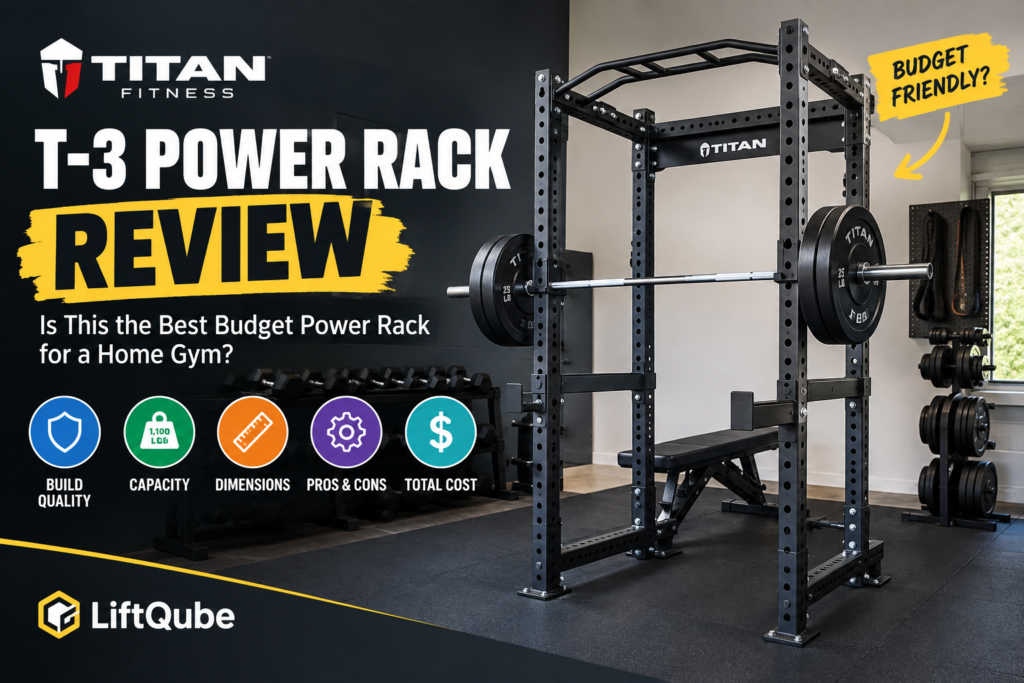
If you’ve spent any time comparing home gym racks under $700, you’ve almost certainly run into the Titan T-3 Series Power Rack. It shows up near the top of nearly every “budget power rack” list, and for good reason: 11-gauge steel, Westside hole spacing, and a starting price that undercuts most of its 2×3 and 3×3 competition.
This Titan T-3 Power Rack review is built to answer one question: is it actually the right rack for your gym, or are you better off spending more (or less) elsewhere? We’ll walk through the real specifications, what’s actually included in the box, where the T-3 falls short, and how it stacks up against the REP PR-4000 and Rogue R-3 — two racks buyers compare it against constantly.
The biggest reason to consider the T-3: it delivers commercial-style 11-gauge steel construction and useful features like Westside spacing at a price point that’s genuinely accessible for a first home gym. The biggest potential drawback: a short one-year warranty and 2×3 uprights that limit some attachment compatibility compared to newer 3×3 racks. By the end of this review, you should know exactly which camp you fall into.
A quick note on accuracy: Titan sells several products under the “T-3” name, including the standard T-3 Series Power Rack, the T-3 Half Rack, T-3 Space Saving Rack, T-3 Folding Power Rack, and T-3 Squat Stands. This review covers the standard four-post T-3 Series Power Rack only. Don’t assume specs are interchangeable between these products — they aren’t.
Titan T-3 Power Rack Review: Quick Verdict
| Category | Rating / Summary |
|---|---|
| Overall Rating | 4.3 / 5 |
| Best For | Budget-conscious lifters, beginners, garage gym owners |
| Not Ideal For | Buyers who want a lifetime warranty or a deep 3×3 attachment ecosystem |
| Build Quality | Solid 11-gauge steel, bolt-together construction |
| Value | Excellent for the base price |
| Stability | Good when bolted down; adequate for most home use unbolted |
| Adjustability | Westside hole spacing through the bench zone, 2″ spacing elsewhere |
| Attachments | Decent and growing, but smaller than REP or Rogue’s ecosystems |
| Ease of Use | Straightforward bolt-together assembly |
| Overall Verdict | One of the best value power racks for a first serious home gym |
The Titan T-3 Power Rack earns its reputation as one of the most popular entry points into “real” strength training equipment. According to current manufacturer information, it uses 2″ x 3″, 11-gauge steel uprights in a bolt-together design, which is a meaningful step up from the thinner-gauge steel and welded-tube racks found in the sub-$300 category.
Where the T-3 pulls ahead of cheaper alternatives is in the details: Westside hole spacing for precise J-hook and safety positioning, a dual pull-up bar setup, and multiple height and depth configurations. Where it falls behind pricier racks is warranty length and the size of its attachment catalog.
For a beginner or intermediate lifter building a garage gym on a real budget, the T-3 is a genuinely sound purchase. For someone chasing a fully modular, decades-long “forever rack,” it’s worth reading the comparison sections below before you buy.

- T-3 SERIES SHORT SQUAT STAND: Standing at 73.5″, the short squat stand delivers rock-solid stability without requiring f…
- PROTECTIVE STANDARD J-HOOKS: UHMW-padded J-hooks safeguard your bar during racking and unracking, supporting up to 1,000…
- WESTSIDE SPACING FOR PRECISE HANDLING: The uprights are equipped with Westside hole spacing through the bench and clean …
Titan T-3 Power Rack Specifications
Specifications below reflect current manufacturer information from Titan Fitness. Some older third-party reviews list a 1,000 lb rackable capacity and 5/8″ holes — Titan’s current listings show an upgraded “version 2″ upright with 1,100 lb rackable capacity and 11/16” holes, so double-check the listing for the exact configuration you’re buying.
| Spec | Detail |
|---|---|
| Price | Roughly $480–$650 depending on height/depth configuration and current promotions |
| Steel | 2″ x 3″ 11-gauge steel, bolt-together construction |
| Height Options | 82″ or 91″ |
| Depth Options | 24″ (interior) or 36″ (interior) |
| Interior Width | 42″ |
| Hole Size | 11/16″ (current listings); some older reviews cite 5/8″ |
| Hole Spacing | Westside (1″) through the bench/clean-pull zone; 2″ spacing above/below; 6″ side hole spacing throughout |
| Rackable Capacity | 1,100 lb (current listings; older units listed 1,000 lb) |
| Whole Rack Capacity | 4,400 lb |
| Rack Weight | Roughly 186–230 lb depending on configuration |
| Pull-Up Bars | 1.25″ standard bar and 2″ fat bar, both included |
| J-Hooks | 2 nylon-lined J-hooks, rated to 1,000 lb combined |
| Finish | Powder-coated; available in black, red, or navy/blue |
| Warranty | 1-year limited warranty; extended coverage available through Mulberry |
Because Titan periodically updates uprights, hole sizing, and pricing, always confirm current specs on the Titan T-3 Series Power Rack product page before ordering.
Titan T-3 Build Quality and Construction
The T-3’s core selling point is its 11-gauge steel. In power rack terms, a lower gauge number means thicker steel, and 11-gauge is generally considered the minimum thickness for a rack intended to handle serious barbell training. Titan pairs that steel with 2″ x 3″ uprights, which is a narrower profile than the 3″ x 3″ tubing found on higher-end racks like the REP PR-4000.
That narrower tube isn’t automatically a dealbreaker. 2″ x 3″ steel has been the backbone of budget-to-midrange racks for years, largely because it’s the same profile used on the original Westside Barbell-style racks that inspired much of the category. It’s plenty strong for the vast majority of home lifters; it simply limits which third-party attachments will bolt on cleanly, since many newer accessories are designed around 3″ x 3″ tube spacing.
The rack uses bolted, rather than welded, joints. Bolt-together construction has two practical upsides for home gym owners: it ships in a more manageable package, and it’s slightly easier to level on an uneven garage floor before final tightening. The tradeoff is that bolted connections are generally considered marginally less rigid than fully welded frames, though with correctly torqued hardware this isn’t a common complaint in owner feedback.
On finish and QC, independent reviewers have generally reported clean welds on the sub-assemblies and a durable powder coat, though — as with any imported budget-tier equipment — occasional reports of shipping damage or minor cosmetic imperfections do turn up in owner feedback. This is a real consideration but not unique to Titan; it’s common across the budget rack category.
- T-3 SERIES SHORT SQUAT STAND: Standing at 73.5″, the short squat stand delivers rock-solid stability without requiring f…
- PROTECTIVE STANDARD J-HOOKS: UHMW-padded J-hooks safeguard your bar during racking and unracking, supporting up to 1,000…
- WESTSIDE SPACING FOR PRECISE HANDLING: The uprights are equipped with Westside hole spacing through the bench and clean …
Titan T-3 Power Rack Size and Dimensions
The T-3 Power Rack ships in four core configurations: two heights (82″ and 91″) crossed with two interior depths (24″ and 36″). Interior width stays fixed at 42″ across all versions.
24-Inch vs 36-Inch Depth
Choose 24″ if: floor space is tight, you’re setting up in a single-car garage bay, or your primary lifts are squats, overhead press, and pull-ups where extra depth adds little functional benefit. The 24″ depth keeps the rack’s overall footprint compact, which matters in smaller home gyms.
Choose 36″ if: you plan to bench press inside the rack regularly, want more working room for setup and unracking, or intend to add rear-mounted accessories like plate storage or a lat pulldown down the road. The extra 12 inches gives noticeably more breathing room for bench work and reduces the chance of banging elbows or a spotter arm on the frame.
If you’re only ever squatting and pressing, 24″ is fine and saves floor space. If bench pressing inside the rack is a regular part of your routine, most lifters find 36″ meaningfully more comfortable.
82-Inch vs 91-Inch Height
Choose 82″ if: you’re working in a basement, garage, or room with a lower ceiling. This height gives more clearance margin and is often the only workable option in converted spaces with ductwork, garage door tracks, or low joists.
Choose 91″ if: you have the ceiling clearance and want the maximum pull-up bar height, additional room for overhead pressing without feeling boxed in, or plan to eventually add taller accessories.
Before ordering either height, measure your actual ceiling clearance rather than the room’s nominal height — garage door tracks, light fixtures, and ductwork often eat into usable vertical space. A general rule: leave at least a few inches of buffer above the pull-up bar for safe hanging and kipping room.
Titan T-3 Weight Capacity and Safety
Titan’s current published rackable capacity for the T-3 is 1,100 lb, with a stated whole-rack capacity of 4,400 lb. For context, that rackable figure refers to the weight the J-hooks and safety bars are rated to hold when a bar is resting in them — not necessarily the absolute load the frame could theoretically survive under dynamic loading.
For the overwhelming majority of home gym users — including most intermediate and advanced lifters — a 1,100 lb rackable rating is far beyond what they’ll ever load onto the J-hooks. It’s serious lifters attempting max-effort squats or bench presses well north of 500–600 lb who should pay closer attention to a rack’s capacity ratings and compare them carefully across brands.
A few safety notes worth taking seriously:
- Safeties matter more than the rack rating. The T-3’s standard package includes J-hooks but does not include safety bars or straps in the base configuration on most listings — these are typically sold as an add-on. If you’re training alone, safety bars aren’t optional; they’re the difference between a failed rep and a serious injury.
- Bolting down is recommended. Titan, like most rack manufacturers, recommends anchoring the rack to the floor for added stability, particularly for heavier lifts like rack pulls or dynamic movements that can introduce lateral force.
- Follow the manufacturer’s assembly and load guidance. Don’t assume a “1,100 lb capacity” rating means the rack is indestructible or risk-free under any condition — it isn’t, and no rack is. Proper assembly, torque on hardware, and periodic bolt checks all matter for long-term safety.
None of this makes the T-3 unusually risky compared to other racks in its class — it doesn’t. It simply means the numbers on a spec sheet are a starting point for a safety conversation, not the end of one.
- T-3 SERIES SHORT SQUAT STAND: Standing at 73.5″, the short squat stand delivers rock-solid stability without requiring f…
- PROTECTIVE STANDARD J-HOOKS: UHMW-padded J-hooks safeguard your bar during racking and unracking, supporting up to 1,000…
- WESTSIDE SPACING FOR PRECISE HANDLING: The uprights are equipped with Westside hole spacing through the bench and clean …
Titan T-3 Hole Spacing and Adjustability
The T-3 uses what’s known as Westside hole spacing, a layout popularized by Westside Barbell’s original rack design. In plain terms: instead of uniform 2-inch spacing throughout the entire upright, the holes tighten to 1-inch spacing through the “bench zone” — the section of the rack where you’d typically set J-hooks and safeties for bench pressing.
Why this matters in practice:
- Bench press: With only 2-inch spacing, you can sometimes be stuck choosing between a J-hook height that’s slightly too low (awkward, hard liftoff) or slightly too high (unracking risk). 1-inch spacing lets you dial in the exact liftoff height for your arm length and bench setup.
- Squats: Similarly, tighter spacing helps taller or shorter lifters find a J-hook height that matches their natural unrack position without compromise.
- Safety bar/strap positioning: Precise spacing also lets you set safeties just below your bottom position, rather than leaving several extra inches of “just in case” clearance that can turn a missed rep into a longer, harder fall.
- Different user heights: In shared households or gyms with multiple lifters, finer hole spacing makes it easier for each person to find their ideal setup rather than compromising.
Titan also lists 6-inch side hole spacing throughout the entire upright on current listings, which is relevant for mounting certain side-loaded accessories like dip attachments or plate storage.
What Comes With the Titan T-3?
Included
Based on current manufacturer listings, the standard T-3 Series Power Rack ships with:
- Four heavy-duty steel uprights (2″ x 3″, 11-gauge)
- A 1.25″ standard pull-up bar
- A 2″ fat grip pull-up bar
- Two nylon-lined J-hooks
- All necessary assembly hardware
Optional Accessories
These are sold separately and are not included in the base rack price:
- Safety bars, pin/pipe safeties, or safety straps — arguably the most important add-on for solo lifters
- Weight plate holders — optional accessories with a listed 49mm sleeve diameter and roughly 11.5″ of loadable plate length
- Dip attachments — for adding dip stations to the rack frame
- Pulley/lat pulldown systems — for cable-style accessory work
- Landmine attachments — for landmine press and rotational movements
- Spotter arms — an alternative to pin/pipe safeties for some lifters
Don’t assume any of the above ships in the box. If you’re building a complete setup, plan on adding at least safety bars before your first heavy training session.
Titan T-3 Attachments and Upgrade Potential
One of the more practical benefits of the T-3 platform is that it’s designed to be built out gradually. Rather than buying every accessory on day one, most owners start with the base rack, safeties, and a bar, then add plate storage, a dip attachment, or a pulldown system as budget allows.
Titan sells a range of T-3-specific attachments designed to bolt directly onto the standard hole pattern, and the rack’s Westside spacing and 6-inch side holes support a reasonable range of add-ons. That said, compatibility isn’t universal. Because the T-3 uses 2″ x 3″ tubing rather than the increasingly common 3″ x 3″ profile, not every third-party attachment — including some from other brands — will fit without modification. If you’re eyeing a specific accessory from outside Titan’s own catalog, verify tube size and hole spacing compatibility before buying.
- T-3 SERIES SHORT SQUAT STAND: Standing at 73.5″, the short squat stand delivers rock-solid stability without requiring f…
- PROTECTIVE STANDARD J-HOOKS: UHMW-padded J-hooks safeguard your bar during racking and unracking, supporting up to 1,000…
- WESTSIDE SPACING FOR PRECISE HANDLING: The uprights are equipped with Westside hole spacing through the bench and clean …
Titan T-3 Power Rack Pros and Cons
| Pros | Cons |
|---|---|
| Strong value at the base price point | 2×3 uprights limit compatibility vs. newer 3×3 systems |
| 11-gauge steel construction | Only a 1-year warranty vs. lifetime frame warranties elsewhere |
| Westside hole spacing for precise setup | Safety bars not included in the base package |
| Dual pull-up bars included standard | Some reports of finish/QC inconsistencies, common to budget imports |
| Multiple height and depth configurations | Bolting down is recommended for full stability, adding setup effort |
| Bolt-together design eases assembly and leveling | Total ready-to-train cost is higher than the base sticker price suggests |
| Reasonably wide (though smaller than premium brands) attachment catalog | Attachment ecosystem is smaller than REP or Rogue |
Titan T-3 vs Other Power Racks
Titan T-3 vs REP PR-4000
| Category | Titan T-3 | REP PR-4000 |
|---|---|---|
| Starting Price | ~$480–$650 | Starting around $800 (base configuration) |
| Steel | 2″ x 3″ 11-gauge | 3″ x 3″ 11-gauge |
| Rackable Capacity | 1,100 lb | 1,000 lb |
| Hole Spacing | Westside (1″) bench zone, 2″ elsewhere | Westside (1″) bench zone, 2″ elsewhere |
| Height Options | 82″, 91″ | 80″, 93″ |
| Depth Options | 24″, 36″ | 24″, 30″, 41″ |
| Attachments | Moderate, Titan-specific catalog | Extensive, including cable/lat pulldown systems |
| Warranty | 1-year limited | Lifetime frame warranty |
| Best Buyer | Budget-first buyers who want strong basics | Buyers who want a modular “grow with you” ecosystem and a longer warranty |
The REP PR-4000 uses thicker 3″ x 3″ tubing and backs the frame with a lifetime warranty, which is a meaningful long-term advantage. It also supports a considerably larger range of official attachments, including cable-machine add-ons. The tradeoff is price: even a modestly configured PR-4000 typically runs a few hundred dollars more than a T-3 in an equivalent size. For a first rack on a tight budget, the T-3 remains the more accessible entry point. For buyers planning to build a heavily accessorized “forever gym,” the PR-4000’s ecosystem and warranty are hard to ignore.
Titan T-3 vs Rogue R-3
| Category | Titan T-3 | Rogue R-3 |
|---|---|---|
| Starting Price | ~$480–$650 | Roughly $695–$870 depending on version/config |
| Construction | 2″ x 3″ 11-gauge, bolt-together | 2″ x 3″ 11-gauge, welded (or bolt-together version) |
| Depth | 24″ or 36″ | 24″ (welded); 24″ or 30″ (bolt-together) |
| Hole Spacing | Westside (1″) bench zone, 2″ elsewhere | Westside (1″) bench zone, 2″ elsewhere |
| Warranty | 1-year limited | Limited lifetime |
| Attachments | Titan’s T-3 accessory line | Rogue’s extensive Infinity attachment ecosystem |
| Brand Reputation | Budget-focused, direct-to-consumer | Long-standing reputation, US-made frame |
| Best Buyer | Maximum value per dollar | Buyers prioritizing brand pedigree, resale value, and a lifetime warranty |
Interestingly, the Rogue R-3 and Titan T-3 use nearly identical core steel specs — both are 2″ x 3″, 11-gauge, Westside-spaced racks. The real differentiators are warranty length, brand ecosystem, and price. Rogue’s R-3 typically costs noticeably more, largely reflecting its US manufacturing, established Infinity attachment catalog, and lifetime frame coverage. If budget is the deciding factor and you don’t need Rogue-specific attachments, the T-3 gets you comparable core steel for meaningfully less money. If long-term resale value, brand reputation, or warranty peace of mind matter more to you than saving a few hundred dollars upfront, the R-3 is the stronger long-term bet.
- T-3 SERIES SHORT SQUAT STAND: Standing at 73.5″, the short squat stand delivers rock-solid stability without requiring f…
- PROTECTIVE STANDARD J-HOOKS: UHMW-padded J-hooks safeguard your bar during racking and unracking, supporting up to 1,000…
- WESTSIDE SPACING FOR PRECISE HANDLING: The uprights are equipped with Westside hole spacing through the bench and clean …
How Much Does the Titan T-3 Really Cost?
This is where a lot of buyers get caught off guard. The advertised base price of the Titan T-3 — often in the $480–$650 range depending on configuration and current promotions — is not the price of a ready-to-train setup. It’s the price of a rack with two pull-up bars and a set of J-hooks. Nothing more.
To actually train safely, most buyers will need to budget for:
- Safety bars, pin/pipe safeties, or safety straps — essential for anyone training without a spotter
- Upgraded J-hooks, if you want a different style than the standard nylon-lined hooks
- Plate storage (weight plate holders), which keep your workout area organized and your plates off the floor
- A dip attachment, if bodyweight training is part of your routine
- A pulley/lat attachment, if you want cable-style exercises without a separate machine — see our guide to the best cable machines under $1,000 if you decide a standalone unit makes more sense for your space
- Shipping, which can add meaningfully to the total depending on your location and the retailer
- Anchoring hardware and installation time, since bolting the rack to a concrete floor is the manufacturer-recommended setup for full stability
None of these costs are exotic — they’re normal for any rack in this category, including the REP PR-4000 and Rogue R-3. But it’s worth planning your budget around the realistic “ready-to-train” total rather than the headline base price. For many buyers, that means budgeting meaningfully above the advertised sticker price once safeties and a couple of core accessories are factored in.
Who Should Buy the Titan T-3 Power Rack?
- Beginners building a first home gym: The T-3 provides a genuine step up from bodyweight-only setups or a basic power tower — see our breakdown of the best power tower for home workouts if you’re still deciding between a full rack and a simpler station — without a steep price barrier.
- Budget-conscious lifters: If your priority is solid 11-gauge steel and Westside spacing at the lowest realistic price point, the T-3 delivers.
- Garage gym owners: The compact footprint options (especially 24″ depth and 82″ height) fit well in single-car garages and basements.
- Intermediate lifters: Most intermediate lifters will never approach the T-3’s 1,100 lb rackable capacity, making it more than sufficient for years of progressive training.
- Small-space home gym owners: The 24″-deep, 82″-tall configuration is one of the more compact full power rack footprints available at this price.
- T-3 SERIES SHORT SQUAT STAND: Standing at 73.5″, the short squat stand delivers rock-solid stability without requiring f…
- PROTECTIVE STANDARD J-HOOKS: UHMW-padded J-hooks safeguard your bar during racking and unracking, supporting up to 1,000…
- WESTSIDE SPACING FOR PRECISE HANDLING: The uprights are equipped with Westside hole spacing through the bench and clean …
Who Should NOT Buy the Titan T-3?
- Buyers who want a premium 3×3 ecosystem: If you know you’ll eventually want a cable/pulldown attachment, an extensive accessory catalog, or maximum third-party compatibility, the REP PR-4000’s 3″ x 3″ tubing is a better long-term foundation.
- Users who strongly prioritize warranty length: A 1-year warranty is short compared to the lifetime frame coverage offered by REP and Rogue. If peace of mind over a 10+ year ownership window matters to you, factor that in.
- Heavy/serious competitive lifters pushing extreme loads: While 1,100 lb rackable capacity covers the vast majority of lifters, those regularly working near or above that threshold should compare capacity specs across brands carefully rather than assuming any budget rack is the right fit.
- Buyers with unusual space or height requirements: If neither the 82″/91″ height nor 24″/36″ depth options work for your room, a more customizable rack (like REP’s multi-depth PR-4000 lineup) may fit better.
Things to Know Before Buying the Titan T-3
- Measure your ceiling height first. Don’t rely on a “standard” garage or basement height assumption — measure the actual clearance, including any obstructions like garage door tracks or ductwork.
- Measure your available floor depth. Confirm you have enough clear space in front of and behind the rack for the depth option you’re choosing, plus room to walk around it.
- Decide between 24″ and 36″ based on how you train. If bench pressing inside the rack is central to your routine, lean toward 36″.
- Decide whether you will anchor the rack. Bolting down is recommended for stability; make sure your floor (concrete slab vs. wood subfloor) supports that, and budget the extra time.
- Calculate accessory costs before you order. Safety bars alone should be considered a near-mandatory add-on, not an optional extra.
- Think about future attachments. If you already know you want a dip station, plate storage, or a pulldown system, price those in now rather than treating them as a “someday” purchase.
- Check the latest manufacturer specifications before purchasing. Titan updates hole sizing, capacity ratings, and pricing periodically — confirm current specs directly on the product listing rather than relying solely on older reviews (including this one, over time).
While you’re planning your setup, it’s worth thinking beyond the rack itself — a well-rounded home gym typically also includes a bench (see our picks for the best foldable weight bench for small spaces) and a set of plates or dumbbells, like those covered in our guide to the best adjustable dumbbells for a home gym.
Titan T-3 Power Rack FAQ
Is the Titan T-3 Power Rack worth it? For budget-focused buyers who want solid 11-gauge steel construction and Westside hole spacing without paying premium-brand prices, yes — it’s one of the stronger value options in its category. Buyers who prioritize warranty length or a large attachment ecosystem may prefer a pricier alternative.
Is the Titan T-3 good for beginners? Yes. Its rackable capacity and core feature set (dual pull-up bars, adjustable J-hooks, Westside spacing) comfortably support years of beginner-to-intermediate progression.
How much weight can the Titan T-3 hold? Current manufacturer listings show a 1,100 lb rackable capacity and a 4,400 lb whole-rack capacity. Some earlier units listed a 1,000 lb rackable rating, so confirm the figure on your specific listing.
Is the Titan T-3 stable? It’s reasonably stable for typical home use, and Titan recommends bolting it to the floor for maximum stability, particularly for movements like rack pulls that introduce lateral force.
Does the Titan T-3 need to be bolted down? It’s not strictly mandatory for lighter, controlled lifting, but Titan recommends it, and most safety-conscious owners choose to anchor the rack, especially before heavy or dynamic lifts.
What is the difference between the 24-inch and 36-inch T-3? The 24″ version has a smaller footprint and suits squat/press-focused setups with limited floor space. The 36″ version offers more working room, which is particularly useful for bench pressing inside the rack.
Is the Titan T-3 good for a garage gym? Yes — the compact depth and height configurations, particularly the 24″/82″ combination, make it one of the more space-efficient full power racks on the market.
Can you add a lat pulldown to the Titan T-3? Titan doesn’t currently offer as extensive an official cable/pulldown ecosystem as REP’s Ares system for the PR-4000. If a pulldown or cable station is a priority, a standalone cable machine (see our guide to the best cable machines under $1,000) or a rack with a more built-out pulley ecosystem may be a better fit.
Titan T-3 vs REP PR-4000: which is better? The PR-4000 offers thicker 3″ x 3″ steel, a lifetime warranty, and a larger attachment ecosystem for a higher price. The T-3 offers strong core specs at a noticeably lower cost. Budget-first buyers tend to prefer the T-3; buyers planning a heavily modular long-term setup tend to prefer the PR-4000.
Titan T-3 vs Rogue R-3: which should you buy? Both use nearly identical core steel specs. The R-3 costs more but adds a lifetime warranty, US manufacturing, and Rogue’s established Infinity attachment catalog. The T-3 delivers comparable core construction for less money. Choose based on how much you value brand pedigree and long-term warranty coverage versus upfront savings.
Titan T-3 Power Rack Review: Final Verdict
The Titan T-3 Power Rack earns its place as one of the most recommended budget power racks for a reason: 11-gauge steel, Westside hole spacing, and dual pull-up bars at a price that makes a “real” home gym rack accessible to far more buyers.
Buy it if:
- You’re building a first home gym and want proven 11-gauge steel construction without a premium-brand price tag
- Your training needs (squats, bench, pull-ups, presses) fit comfortably within a 1,100 lb rackable capacity
- You’re comfortable buying safety bars and other accessories separately rather than as part of a bundled package
- Floor space is limited and you want a compact 2×3 footprint
Skip it if:
- You want a lifetime frame warranty out of the box
- You’re planning an extensively modular setup with cable attachments, lat pulldowns, or a wide range of third-party accessories
- You’re a serious competitive lifter who wants maximum headroom above the published capacity ratings
Overall rating: 4.3 out of 5. The Titan T-3 Power Rack isn’t the most feature-rich or best-warrantied rack on the market, but for the price, it delivers dependable core construction that will serve the vast majority of home gym owners well for years. If your budget is the primary constraint and you’re willing to buy safeties and accessories as you go, it’s a smart, defensible purchase.
Sources: Specifications referenced in this review are based on current manufacturer information from Titan Fitness, REP Fitness, and Rogue Fitness product listings, along with independent reviewer observations where noted. Always verify current specs and pricing directly with the manufacturer before purchasing, as these details can change.
External References:
- Titan Fitness T-3 Series Power Rack (official product listings)
- Titan Fitness Limited Warranty policy
- REP Fitness PR-4000 Power Rack (official product page)
- Rogue Fitness Bolt-Together R-3 Power Rack (official product page)
- Mayo Clinic: Strength training — get stronger, leaner, healthier (safety guidance)
