

Introduction
Bumper plates are the piece of equipment that quietly determines whether a home gym actually gets used. Iron plates look great on a rack, but the moment you miss a clean, fail a jerk, or just want to drop the bar at the bottom of a deadlift instead of babying it to the floor, iron plates put your barbell, your floor, and your joints at risk. A good set of bumper plates removes that hesitation, which is a big part of why they’ve become the default choice for anyone building a serious home gym.
Finding the best bumper plates for home gym use isn’t as simple as picking whatever set has the most reviews, though. Rubber compound, hub construction, and thickness all vary a lot between brands, and those differences show up the moment you start training. A crumb-rubber plate that’s cheap and quiet might be too thick to load heavy on a standard sleeve. A high-durometer competition plate that barely bounces might be overkill — and overpriced — for someone doing bodyweight-plus-plates conditioning work in a garage.
The criteria that actually matter are durability (will the rubber crack or separate from the hub within a year or two), bounce (how much the plate rebounds when dropped), thickness (how much bar sleeve you’ll have left once plates are stacked), noise (how loud the impact is, which matters enormously in apartments and shared-wall houses), and value (what you’re paying per pound relative to the build quality). Odor is a smaller but real concern, especially with recycled or crumb-rubber plates that haven’t off-gassed yet.
This guide breaks down eight bumper plate sets that each do something different well, based on published manufacturer specifications and independent testing data from established fitness-equipment reviewers. Whether you’re outfitting a garage gym for CrossFit-style workouts, chasing Olympic lifting numbers, or just trying to keep the noise down for the people living below you, there’s a plate on this list built for that specific situation.
Quick Answer: Our Top Bumper Plate Picks
| Rank | Bumper Plate | Best For | Material | Main Advantage | Main Drawback |
|---|---|---|---|---|---|
| 1 | REP Fitness Black Bumper Plates | Best Overall | Virgin rubber, hooked steel inserts | Extra-thick 10lb plate, factory tested to 12,000+ drops | Durometer rating not publicly disclosed |
| 2 | Rogue Echo Bumper Plates V2 | Best Value | Virgin rubber, stainless steel insert | Dead-bounce feel (88 durometer) at a mid-tier price | 10lb and 15lb plates are thin and less abuse-resistant |
| 3 | Titan Fitness Economy Bumper Plates | Best Budget | Rubber, stainless steel insert | Lowest entry price for a full weight range | Wider tolerance and thicker profile than premium plates |
| 4 | Nike Grind Bumper Plates | Best for CrossFit | Recycled Nike Grind rubber | Sustainable material, drop-tested 10,000 times | Moderate bounce (durometer 65) isn’t a true dead bounce |
| 5 | Eleiko IWF Weightlifting Training Plate | Best for Olympic Lifting | Proprietary SBR rubber | IWF-certified accuracy (±0.5%), 10-year warranty | Among the most expensive plates on the market |
| 6 | Bells of Steel Dead Bounce Bumper Plates | Best for Quiet Home Gyms | Virgin rubber, stainless 3-point insert | Low odor, dead-bounce feel, gentle on flooring | Brand doesn’t publish an exact durometer number |
| 7 | Rogue KG Competition Plates (IWF) | Best Competition Bumper Plates | Rubber, chrome steel disc insert | IWF-approved, ±15g tolerance, 94 durometer | Premium price point |
| 8 | Titan Fitness EZ-Grip Elite Urethane Color Plates | Best Premium Option | Steel core, urethane coating | Very low bounce and noise, long-term durability | Interlocking design isn’t fully compatible with standard plates |
Who each plate suits: The REP Black plates fit anyone who wants one dependable set that handles cross-training, HIIT, and Olympic-style lifts without a big price jump. The Rogue Echo works for lifters who want Rogue’s reputation and a dead-bounce feel without paying competition-plate prices. Titan’s Economy line is for beginners or budget-conscious buyers who want to start lifting today. Nike Grind suits CrossFit-style training where aesthetics and sustainability matter alongside performance. Eleiko is built for weightlifters who train the snatch and clean & jerk seriously and want IWF-grade precision. Bells of Steel’s Dead Bounce plates are the pick for apartment or shared-wall training where noise and floor impact are the top concern. Rogue’s KG Competition Plates suit lifters who compete or want meet-identical equipment at home. Titan’s EZ-Grip Urethane plates are for buyers who want the quietest, longest-lasting plates and don’t mind paying more.
How We Chose the Best Bumper Plates
Durability
We prioritized plates with steel or stainless-steel hub inserts — ideally hooked, anchored, or bolted into the rubber rather than simply pressed in — since that’s the part of a bumper plate most likely to fail first. Hub separation from repeated drops is the single most common failure point on cheap bumper plates.
Bounce
Bounce is measured using the Shore A durometer scale, which typically runs from about 65 (soft, high-bounce) to 94+ (hard, dead-bounce). Lower-durometer plates rebound more when dropped; higher-durometer plates settle almost immediately. Neither is objectively “better” — it depends on whether you’re doing Olympic lifts from the floor (where dead bounce helps control) or general dropping in a garage (where some bounce is tolerable).
Weight Accuracy
Weight tolerance is usually expressed as a percentage (±1% is standard for home gym plates) or, on competition-grade plates, as a fixed gram tolerance (±10–15g). Tighter tolerances matter more for competitive lifters tracking exact loads than for general strength training.
Thickness
Thicker plates mean less usable barbell sleeve space once you stack several. This becomes a real limitation for stronger lifters loading 300+ pounds, since a standard Olympic sleeve is only about 16 inches long.
Hub / Insert Quality
Stainless steel resists corrosion better than standard steel, and inserts with hooks, anchors, or a bolted design tend to stay seated in the rubber longer than a simple pressed-in ring.
Noise
Noise comes from both the plate’s rubber density and how much it bounces — a plate that thuds and stays still is generally quieter overall than one that bounces and re-impacts the floor multiple times.
Odor
Recycled and crumb-rubber plates are more prone to a “new tire” smell out of the box than virgin rubber or urethane plates. This usually fades over weeks, but it’s worth knowing before you order a set for a small, enclosed space.
Value for Money
We looked at price relative to build quality and warranty length rather than which plates were simply cheapest, since a plate that fails in a year isn’t actually a good value.
Warranty
Warranty length is a reasonable proxy for how confident a manufacturer is in its own rubber and hub construction — ranging from a few months on thin 10lb plates up to a decade on premium competition plates.
Home Gym Compatibility
We considered standard 2″ (50mm) Olympic barbell sleeve fit, diameter consistency across weights (important for deadlifts, since mismatched diameters change bar height off the floor), and whether a plate is realistically suited to a garage, basement, or apartment setup.
8 BEST BUMPER PLATES FOR HOME GYM
1. REP Fitness Black Bumper Plates — Best Overall
Best For: General strength training, cross-training, and Olympic-style lifts in one set Material: Virgin rubber with hooked steel center inserts Available Weights: 10, 15, 25, 35, 45, and 55 lb (also available in kg) Best Feature: Steel inserts with hooks molded directly into the rubber for added hub durability Main Drawback: REP does not publicly disclose the Shore A durometer rating
Why We Recommend It
REP Fitness built its Black Bumper Plates around a simple idea: most home gym owners need one set of plates that can handle everything from HIIT circuits to heavy squats to the occasional missed clean, without needing a second, more specialized set later. The steel inserts have hooks molded into the surrounding rubber, which according to REP’s product specifications increases durability compared to a plain pressed-in ring — a meaningful detail since hub separation is the most common way cheaper bumper plates fail.
The 10lb plate is worth calling out specifically: REP makes it extra-thick (about 1 inch) specifically to reduce the risk of bending or cracking, which is the weight most often abused in dumbbell-adjacent or accessory work. Across the board, REP states the plates are factory-tested to withstand more than 12,000 drops from eight feet, a figure most competing brands in this price range don’t publish.
Based on the available specifications, construction, reputation, and user-focused criteria, the Black Bumper Plates land in the “low bounce” category even without a published durometer number, and independent reviewers have consistently placed them in the mid-to-upper 80s on the Shore A scale — in line with plates that cost noticeably more.
Key Features
- Hooked steel center inserts molded into the rubber
- 1% weight tolerance
- Extra-thick 10lb plate for added durability
- Factory-tested to 12,000+ drops from 8 feet
- Fits all standard 2″ Olympic barbell sleeves
- Available in both lb and kg versions
Pros
- Low bounce without the price tag of competition plates
- Reinforced hub design specifically targets the most common bumper plate failure point
- Attractive black-and-white design that looks consistent across a full set
- Wide weight range covers most home gym needs
Cons
- No published durometer rating makes it harder to compare bounce numerically against competitors
- Not IWF-certified, so not usable in sanctioned weightlifting competition
- 10lb and 15lb plates only carry a 6-month warranty
Who Should Buy It
Anyone setting up a single, do-everything bumper plate set for a home gym — cross-training, general strength work, and Olympic-style lifts included — will get strong value here. It’s also a solid pick if you want plates that look cohesive as a matched set rather than mixing colors.
Who Should Skip It
Competitive weightlifters who need IWF certification for meet prep should look at the Eleiko or Rogue Competition options further down this list instead.
Our Verdict
The REP Black Bumper Plates earn the “Best Overall” spot because they don’t force a trade-off — you get reinforced hub construction, a genuinely thick 10lb plate, and documented drop testing at a price that stays reasonable for a full home gym set.

- Premium 2-Inch Olympic Compatibility: These weight plates feature a 2-inch center hole, making them fully compatible wit…
- Durable Rubber-Coated Construction: Each plate is coated in a high-quality rubber finish to minimize noise, reduce impac…
- Integrated Grip Handles for Easy Lifting: Designed with ergonomic grip holes, these grip weight plates make loading and …
2. Rogue Echo Bumper Plates V2 — Best Value
Best For: Budget-conscious lifters who still want a near-dead-bounce feel Material: Virgin rubber with stainless steel insert Available Weights: 10, 15, 25, 35, and 45 lb (also 55 lb and kg versions) Best Feature: Shore A durometer of 88 on the 25–45lb plates for a genuinely low, controlled bounce Main Drawback: Thinner 10lb and 15lb plates are less suited to repeated heavy drops
Why We Recommend It
Rogue’s Echo line has become something of a default recommendation in the home gym community, and the specs explain why. The 25lb, 35lb, and 45lb plates carry a Shore A durometer rating of 88, which reviewers consistently describe as a “dead bounce” — enough control that a dropped bar won’t roll away from you, without the premium pricing of Rogue’s Competition series. The 10lb and 15lb plates are rated slightly harder at 90 durometer to help compensate for their thinner profile.
Construction-wise, the Echos use a stainless steel insert rather than standard steel, which resists corrosion better over years of use, and Rogue backs the 25–45lb plates with a 3-year warranty (the thinner 10lb and 15lb plates get a shorter 180-day warranty, reflecting their reduced drop tolerance). The plates are also approved for the U.S. Army Combat Fitness Test, which is a reasonable proxy for real-world durability under repeated impact.
Based on the available specifications, construction, reputation, and user-focused criteria, the Echo V2 plates sit in a genuine sweet spot: noticeably better bounce control than true budget plates, at a price that undercuts most competition-grade options.
Key Features
- Shore A durometer of 88 (25–45lb) / 90 (10–15lb)
- Stainless steel center insert
- IWF-standard 450mm diameter across all weights
- ±1% weight tolerance
- Approved for the Army Combat Fitness Test (ACFT)
- 3-year warranty on 25lb and heavier plates
Pros
- Dead-bounce feel at a mid-tier price point
- Stainless steel insert resists rust better than standard steel
- Consistent 450mm diameter keeps deadlift and clean starting height uniform across weights
- Strong secondary/resale market if you ever upgrade
Cons
- 10lb and 15lb plates are noticeably thinner and carry a much shorter warranty
- A full set only goes up to 260 lb before you need to buy a second set or add individual pairs
- Slightly more expensive than true budget options like Titan’s Economy line
Who Should Buy It
Lifters who want Rogue’s build quality and a controlled, low bounce without paying competition-plate prices. It’s also a strong pick for anyone planning to eventually resell or upgrade, given Rogue’s strong resale demand.
Who Should Skip It
If your budget is tight and you just need to start training, Titan’s Economy Bumper Plates (below) will get you lifting for meaningfully less money.
Our Verdict
The Rogue Echo V2 earns “Best Value” because it delivers a genuine dead-bounce feel and durable stainless steel construction at a price point most home gym owners can justify without hesitation.

- GREAT FOR HOME GYM TRAINING – Ideal for garage gyms, home gyms, and general strength training environments looking for d…
- STEEL FLOATING HUB – Features a durable steel floating hub for reliable performance, a secure fit on Olympic barbells, a…
- MEDIUM-BOUNCE RUBBER BLEND FOR CONTROL – Proprietary rubber blend Olympic plate construction provides medium-bounce and …
3. Titan Fitness Economy Bumper Plates — Best Budget
Best For: First-time buyers and anyone equipping a home gym on a strict budget Material: Rubber with steel-lined stainless collar insert Available Weights: 10, 15, 25, 35, 45, 55, and 100 lb (also sold as a 230 lb set) Best Feature: Lowest cost-per-pound of any plate on this list with a full weight range Main Drawback: Wider weight tolerance (up to 3%) than most other plates here
Why We Recommend It
Not everyone needs — or can afford — competition-grade tolerances on day one. Titan’s Economy Bumper Plates exist specifically for the lifter who wants to start training now rather than saving up for a premium set. According to Titan’s published specs, the plates use a low-bounce rubber exterior around a 50.6mm steel-lined collar, are sized to IWF standard 450mm diameter, and come with raised edges for easier carrying and re-racking.
The trade-off for the low price is a wider weight tolerance — independent testing has found these plates can run up to 3% off their stated weight, compared to the 1% standard on most mid-tier plates. For general strength training and conditioning work, that difference is largely irrelevant. For anyone chasing precise progressive overload numbers, it’s worth knowing.
Based on the available specifications, construction, reputation, and user-focused criteria, the Economy line represents the most complete low-cost path into bumper plate training, spanning from a 10lb plate all the way to a 100lb single plate and a bundled 230lb set.
Key Features
- 450mm IWF-standard diameter across all weights
- Steel-lined stainless collar, 50.6mm opening
- Available individually (10–100lb) or as a 230lb bundled set
- Color-coded IWF-standard options available alongside black
- Raised edges for easier handling
Pros
- Lowest entry price for a full-range bumper plate set
- Widest weight range on this list, up to a 100lb single plate
- Fits standard barbells and most plate storage/trees
- Good outdoor and basement durability for the price
Cons
- Weight tolerance can run up to 3% off stated weight
- Thicker profile than premium plates, limiting how much you can load per sleeve
- Bounce is higher than dead-bounce competition-style plates
Who Should Buy It
Anyone building their very first home gym, outfitting a garage on a tight budget, or buying in bulk for a school or community weight room where per-plate cost matters more than competition-level precision.
Who Should Skip It
Competitive lifters who need to hit exact training percentages, or anyone who plans to load very heavy on a standard sleeve, should look at a thinner, tighter-tolerance option instead.
Our Verdict
Titan’s Economy line is the clear pick when the goal is simply to start lifting without a big upfront investment — you’re trading some tolerance and thickness for a genuinely accessible price.

- COLOR CODED WEIGHTS: The Economy Bumpers are color-coded to international Weightlifting Federation (IWF) standards for e…
- LOW BOUNCE RATE: Crush your next PR with bumper plates built to take a beating. These plates feature a tough rubber exte…
- EASY-GRIP EDGES: Feature raised edges for a rock-solid grip and easy handling when making weight adjustments or during f…
4. Nike Grind Bumper Plates — Best for CrossFit
Best For: CrossFit-style training, HIIT, and functional fitness with an eye toward sustainability Material: Nike Grind recycled rubber (made from footwear manufacturing scrap) Available Weights: 10, 15, 25, 35, and 45 lb, sold individually Best Feature: Made from recycled Nike Grind material, drop-tested 10,000 times Main Drawback: Moderate bounce (durometer 65) rather than a true dead bounce
Why We Recommend It
CrossFit-style training puts a different demand on bumper plates than powerlifting or Olympic weightlifting does: plates get dropped constantly, often from a variety of heights and angles during metabolic conditioning work, and they need to survive that abuse visually as well as structurally. Nike’s Grind Bumper Plates are built from Nike Grind, a recycled material sourced from Nike’s own footwear manufacturing scrap, which gives each plate a distinctive speckled look and a genuine sustainability angle that resonates with a lot of CrossFit gym culture.
According to Nike’s published specifications, the plates are drop-tested 10,000 times to meet durability standards, carry a ±1% weight tolerance, and use a moderate-bounce compound rated around 65 on the Shore A durometer scale — noticeably softer than the dead-bounce plates elsewhere on this list. That’s a real trade-off for Olympic lifting, but for general CrossFit-style dropping and conditioning circuits, the extra bounce isn’t a practical downside.
Based on the available specifications, construction, reputation, and user-focused criteria, these plates stand out less for raw performance numbers and more for combining solid durability testing with a recycled-material story that fits how a lot of functional-fitness gyms already think about their equipment.
Key Features
- Made with recycled Nike Grind rubber from footwear manufacturing scrap
- Drop-tested 10,000 times per Nike’s published testing standard
- ±1% weight tolerance
- Sold individually (buy two per desired weight)
- Distinctive, batch-unique speckled colorway
Pros
- Genuine recycled-material construction with a real sustainability story
- Strong drop-test durability claims from the manufacturer
- Distinctive look that stands out from all-black plate sets
- Well-suited to the varied, high-frequency dropping of CrossFit-style training
Cons
- Moderate bounce (durometer 65) means less control than dead-bounce plates
- Sold individually rather than in pairs, which can complicate ordering
- Plates may yellow over time with UV/sunlight exposure, per Nike’s own product notes
Who Should Buy It
CrossFit athletes and functional-fitness enthusiasts who want plates built for frequent, varied dropping, and who like the recycled-material angle and distinctive appearance.
Who Should Skip It
Olympic lifters and anyone doing heavy lifts off blocks will likely prefer a lower-bounce, higher-durometer plate like the Eleiko or Rogue Competition options.
Our Verdict
Nike Grind Bumper Plates are a strong, distinctive choice for CrossFit-oriented training where durability under frequent dropping matters more than achieving the lowest possible bounce.

- Durable Crumb Rubber Construction: Made from dense crumb rubber with mixed color particles to prevent damage to floors a…
- Designed for Olympic Bars: Specifically crafted with a 2” center sleeve to ensure a perfect, snug fit on all Olympic-siz…
- Stainless Steel Center Sleeve: Features a high-quality stainless steel insert that allows smooth and effortless bar inse…
5. Eleiko IWF Weightlifting Training Plate — Best for Olympic Lifting
Best For: Serious Olympic weightlifters training the snatch and clean & jerk Material: Proprietary SBR rubber over a zinc-plated steel hub Available Weights: 10, 15, 20, and 25 kg, sold individually Best Feature: IWF-certified for training use with ±0.5% weight and diameter tolerance Main Drawback: One of the most expensive bumper plates available on the market
Why We Recommend It
Eleiko has built its reputation almost entirely around Olympic weightlifting equipment, and the IWF Weightlifting Training Plate reflects that focus in a way general-purpose bumper plates simply don’t. According to Eleiko’s own specifications, these plates are calibrated to within ±0.5% of their stated weight and diameter — a far tighter tolerance than the ±1% standard on most home gym bumpers — and are certified by the International Weightlifting Federation for training use.
The plates use Eleiko’s proprietary SBR rubber compound along with what the company describes as a patented impact-distribution design, and are tested by dropping them repeatedly onto a wooden competition platform; Eleiko states its newer plates have withstood 100,000 drops in that testing without damage. That level of engineering comes with a 10-year warranty, which is among the longest offered on any bumper plate.
Based on the available specifications, construction, reputation, and user-focused criteria, this is the plate for lifters who train the competitive lifts seriously enough that tolerance, rebound consistency, and hub precision genuinely affect their training data — not just a nice-to-have.
Key Features
- IWF-certified for training use
- ±0.5% weight and diameter tolerance
- Proprietary SBR rubber with patented impact-distribution design
- Zinc-plated steel hub, 50.5mm collar opening
- 10-year manufacturer warranty
- Thinner profile designed to allow heavier bar loading
Pros
- Among the tightest weight tolerances available on any bumper plate
- Extremely low, consistent bounce for lifting off blocks or platforms
- Industry-leading 10-year warranty
- No smell out of the box thanks to the SBR rubber compound
Cons
- Significantly more expensive than every other plate on this list
- Sold individually in kg only for the IWF-certified version, which requires more planning to build a full set
- Overkill for lifters who aren’t training competitive Olympic lifts specifically
Who Should Buy It
Competitive or serious Olympic weightlifters who want meet-identical calibration and rebound behavior in their home training environment, and who are willing to pay for it.
Who Should Skip It
General strength trainees, CrossFitters, and budget-conscious beginners will get far more value from the REP Black, Rogue Echo, or Titan Economy plates.
Our Verdict
The Eleiko IWF Training Plate is the most precisely engineered plate on this list, and it’s priced accordingly — a justified investment for dedicated weightlifters, unnecessary for almost everyone else.

- GREAT FOR HOME GYM TRAINING – Ideal for garage gyms, home gyms, and general strength training environments looking for d…
- STEEL FLOATING HUB – Features a durable steel floating hub for reliable performance, a secure fit on Olympic barbells, a…
- MEDIUM-BOUNCE RUBBER BLEND FOR CONTROL – Proprietary rubber blend Olympic plate construction provides medium-bounce and …
6. Bells of Steel Dead Bounce Bumper Plates — Best for Quiet Home Gyms
Best For: Apartments, shared-wall houses, and any space where noise and floor impact are the top concern Material: Virgin rubber with a 3-anchor-point stainless steel insert Available Weights: 10, 15, 25, 35, 45, and 55 lb Best Feature: Low odor out of the box and a genuinely controlled, gentle-on-flooring drop Main Drawback: Bells of Steel does not publish an exact durometer rating for these plates
Why We Recommend It
For lifters training in an apartment or a house with shared walls, the loudest part of a bumper plate isn’t necessarily the initial impact — it’s the secondary bounce and re-impact that happens with softer, high-rebound rubber. Bells of Steel markets its Dead Bounce line specifically around minimizing that second (and third) impact, and independent testers have measured the rubber at roughly 85–88 on the Shore A durometer scale, which lines up with genuinely low-bounce, controlled-drop behavior.
The plates use a thick stainless steel insert ring anchored at three points within the rubber, a design intended to prevent the hub-separation problem that affects cheaper crumb-rubber plates over time. Bells of Steel also specifically markets these as low-smell, which matters more than it might seem for anyone training in a small, enclosed apartment gym where off-gassing rubber has nowhere to ventilate.
Based on the available specifications, construction, reputation, and user-focused criteria, this plate earns its “quiet home gym” recommendation less from a single standout spec and more from the combination of controlled bounce, low odor, and a price point that stays reasonable — three things that matter most to someone training carefully around neighbors or family in shared living spaces.
Key Features
- 3-anchor-point stainless steel insert ring
- Virgin rubber compound with low odor out of the box
- ±1% weight tolerance
- Standard 450mm IWF diameter
- Available in all-black or color-coded versions
Pros
- Controlled, dead-bounce behavior reduces repeated floor impact noise
- Low odor makes it more livable in small or enclosed training spaces
- Reinforced 3-point hub anchoring targets a common durability weak point
- Competitively priced relative to other dead-bounce plates
Cons
- No published exact durometer number makes direct spec comparison harder
- Not IWF-certified, so not usable for sanctioned competition
- Warranty on lighter plates (10lb/15lb) is shorter than on heavier plates
Who Should Buy It
Apartment dwellers, renters, and anyone training in a house with shared walls or floors below who wants a genuinely quieter dropped-plate experience without paying competition-plate prices.
Who Should Skip It
If you’re training in a detached garage with no noise-sensitive neighbors, you may prefer to put that budget toward a plate with a published durometer rating and IWF certification instead, like the Rogue Competition line.
Our Verdict
Bells of Steel’s Dead Bounce plates are a smart, targeted pick for anyone whose biggest constraint is noise and floor impact rather than competition calibration.

- ♦️ Heavy-Duty Barbell Weights – Weight plates made durable enough for commercial and home gym weightlifting. With its 3-…
- ♦️ Shock-Absorbing – Our bumper plates will add mileage to your barbell by absorbing some of the impacts while reducing …
- ♦️ Odor-Friendly Weights for Home Gym- Our bumper plates are made from brand-new, high-quality virgin rubber to keep you…
7. Rogue KG Competition Plates (IWF) — Best Competition Bumper Plates
Best For: Competitive weightlifters and anyone who wants meet-identical plates at home Material: Rubber with a chrome-plated steel disc insert Available Weights: 10, 15, 20, and 25 kg, sold in pairs or sets Best Feature: Shore A durometer of 94 with a ±15g weight tolerance, IWF-approved Main Drawback: Premium price point well above general-purpose bumper plates
Why We Recommend It
Rogue’s KG Competition Plates are built to the same standard used in IWF-sanctioned weightlifting events, and the specifications back that up. According to Rogue’s published data, these plates average a Shore A durometer rating of 94 — among the highest of any plate covered in this guide — which produces the kind of minimal, near-instant settle that serious weightlifters expect when dropping a bar from overhead. The weight tolerance is tightened to ±15 grams rather than a broad percentage, and each plate is embossed with the official IWF logo.
Construction-wise, the plates use a chrome-plated steel disc insert with a raised rubber surface designed to keep plate-on-plate contact limited to the inner and outer flanges, which helps preserve the finish over repeated loading and unloading. Rogue backs the Competition line with a 5-year warranty, reflecting the higher-grade rubber and more rigorous manufacturing tolerance compared to its budget Echo series.
Based on the available specifications, construction, reputation, and user-focused criteria, this is the plate to buy if you want your home training environment to feel identical to what you’d load on a competition platform — the tolerance and bounce control are built for exactly that purpose.
Key Features
- Shore A durometer rating of 94 (dead bounce)
- ±15 gram weight tolerance
- Chrome-plated steel disc insert
- IWF-approved for competitive use
- 5-year manufacturer warranty
- Raised rubber surface to reduce plate-on-plate scuffing
Pros
- Among the lowest-bounce plates available, IWF-approved for competition
- Very tight gram-level weight tolerance
- Strong 5-year warranty reflects premium build quality
- Chrome insert and gloss-matte-gloss finish hold up well cosmetically over time
Cons
- Priced well above general-purpose bumper plates — reviewers have noted it costs meaningfully more per pound than Rogue’s own Echo line
- Sold in kg only for the IWF-certified version
- Precision this tight is unnecessary for most non-competitive training
Who Should Buy It
Competitive Olympic weightlifters, coaches outfitting a training hall, or serious home gym owners who specifically want meet-identical equipment and don’t mind paying for it.
Who Should Skip It
If you’re not training or coaching for competition, the Rogue Echo V2 or REP Black plates deliver most of the practical benefit at a fraction of the price.
Our Verdict
Rogue’s KG Competition Plates are the benchmark “meet-ready” option on this list — exceptional precision and bounce control for lifters who genuinely need it.
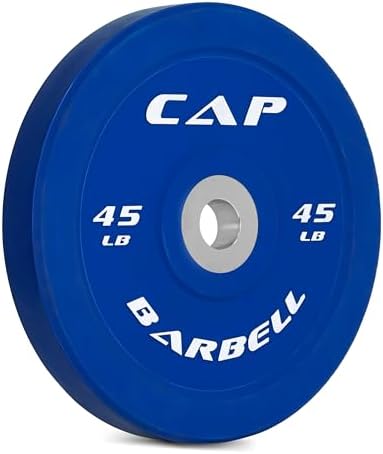
- PREMIUM TRAINING PERFORMANCE – CAP Competition Olympic bumper plates designed for serious lifters seeking low-bounce per…
- CHROMED STEEL HUB – Features a solid chromed steel hub for maximum durability, a secure fit on Olympic barbells, and smo…
- LOW-BOUNCE VIRGIN RUBBER FOR GREATER CONTROL: Constructed from high-quality virgin rubber to help reduce bounce for grea…
8. Titan Fitness EZ-Grip Elite Urethane Color Plates — Best Premium Option
Best For: Buyers who want the quietest, longest-lasting plates and are willing to pay a premium Material: Steel core with a thick, wear-resistant urethane coating Available Weights: 10, 25, 35, 45, and 55 lb, available individually, in pairs, or as a 230lb/340lb set Best Feature: Urethane coating instead of standard rubber for a notably quiet, low-bounce drop Main Drawback: Interlocking, textured design isn’t fully compatible with mixing in standard rubber bumper plates
Why We Recommend It
Urethane is a step up from standard rubber in a few specific ways: it tends to be quieter on impact, more resistant to cracking and UV degradation over time, and less prone to the “new rubber” smell that recycled or crumb-rubber plates can carry out of the box. Titan’s EZ-Grip Elite Urethane Color Plates use a steel core wrapped in that thick urethane coating, and according to Titan’s product specifications, the design is intended to keep its shape over repeated overhead drops better than a standard rubber-coated plate.
The plates also feature a textured, interlocking edge design specifically built for easy grip when loading and unloading — genuinely useful if you’re cycling through a lot of plate changes during a session — and they’re color-coded to IWF standards, so you can identify weight at a glance even in a fast-paced session. Titan sells these individually, in pairs, or bundled as 230lb and 340lb sets, which gives buyers flexibility depending on how much weight they need to start with.
Based on the available specifications, construction, reputation, and user-focused criteria, this is the plate for someone who has already decided they want urethane’s noise and longevity benefits and is willing to pay Titan’s premium tier price for it rather than shopping down to a rubber option.
Key Features
- Steel core wrapped in thick, wear-resistant urethane
- Textured, interlocking edge design for easy handling
- Color-coded to IWF standards
- Low bounce rate designed for a quieter workout
- Available individually, in pairs, or as 230lb/340lb sets
Pros
- Urethane construction tends to resist cracking and UV wear better than standard rubber long-term
- Noticeably quieter drop than most rubber bumper plates
- Textured grip edges make loading and unloading faster
- Flexible buying options from single plates to full sets
Cons
- Premium price relative to Titan’s own Economy and standard Elite rubber lines
- Interlocking edge design is built for use with matching plates, not necessarily standard rubber bumpers
- Urethane plates in general typically cost more per pound than comparable rubber options
Who Should Buy It
Home gym owners who’ve prioritized noise reduction and long-term durability above upfront cost, and who plan to build a matched set rather than mixing brands and plate styles.
Who Should Skip It
Buyers on a tighter budget, or anyone who already owns a rubber bumper plate set and wants to add compatible weights, may find the interlocking urethane design and price less practical.
Our Verdict
Titan’s EZ-Grip Elite Urethane Color Plates are the premium pick on this list — a genuine step up in noise control and long-term durability for buyers who value those upgrades enough to pay for them.

- EZ-GRIP OLYMPIC WEIGHT PLATES: Pair these sturdy weight plates with your favorite Olympic barbell and take your strength…
- DURABLE URETHANE CONSTRUCTION: Crafted with a robust steel core coated in thick wear-resistant urethane, these bumper pl…
- SPACE-SAVING INTERLOCKING DESIGN: These slim weight plates feature an innovative interlocking design that takes up less …
BUMPER PLATE BUYING GUIDE
How to Choose the Best Bumper Plates for a Home Gym
1. Choose the Right Material
Crumb rubber plates are made from small pieces of recycled rubber bonded together. They’re typically the cheapest option and reasonably durable, but they tend to be thicker for a given weight and can carry more of an off-gassing smell when new.
Virgin rubber plates use unrecycled rubber compound, which generally allows tighter manufacturing tolerances, a lower and more consistent bounce, and less odor out of the box. Most of the mid-tier and premium plates on this list — including the REP Black, Rogue Echo, and Bells of Steel Dead Bounce plates — use virgin rubber.
Urethane plates use a urethane coating over a steel core rather than a rubber compound. Urethane is generally quieter, more resistant to cracking and UV degradation, and holds its shape longer, but it costs more per pound than either crumb or virgin rubber.
2. Consider Plate Thickness
Thickness matters most once you start stacking multiple plates on a standard Olympic barbell sleeve, which is roughly 16 inches long. Thicker crumb-rubber plates can eat up that space quickly, limiting how much total weight you can load — a real constraint for heavier deadlifts and Olympic lifts where you need several large plates per side. Thinner, higher-tolerance plates like the Eleiko IWF Training Plate or Rogue Competition line are specifically designed to let stronger lifters load more weight in the same sleeve length.
3. Check Weight Accuracy
For general strength training, a ±1% weight tolerance (the home gym standard) is more than sufficient — a 45lb plate that’s off by a few tenths of a pound won’t meaningfully change your training outcome. Serious and competitive lifters, however, often care about gram-level accuracy, since small discrepancies can add up across a loaded bar and affect programmed percentages. That’s where competition-grade plates with ±10–15g tolerances, like the Eleiko or Rogue KG Competition plates, become worth the extra cost.
4. Look at the Bounce
High-bounce plates (lower durometer, roughly 65–75) rebound noticeably when dropped. This can be fine — even useful for reducing peak impact stress — in a garage with open space, but it means the bar may travel some distance after a drop.
Low-bounce or “dead-bounce” plates (higher durometer, roughly 86–94) settle almost immediately after hitting the floor. This is generally preferred for Olympic weightlifting, where lifters often drop the bar from overhead repeatedly and want it to stay in a predictable spot, and it’s also useful in smaller home gyms where you don’t want a bar bouncing toward a rack or wall.
5. Think About Noise
Denser, higher-durometer rubber and urethane compounds generally produce a shorter, duller impact sound than softer, high-bounce rubber, partly because there’s less secondary bouncing and re-impact. Material alone isn’t the whole story, though — flooring and technique play a large role too, which we cover in the noise section below.
6. Check the Hub and Insert
The center hub is where most bumper plate failures start. Look for stainless steel (more corrosion-resistant than standard steel) and a design that’s hooked, anchored, or bolted into the surrounding rubber rather than simply pressed in. Several plates on this list — REP Black, Rogue Echo, and Bells of Steel Dead Bounce — specifically call out reinforced hub designs for this reason.
7. Consider Odor
New rubber, especially recycled or crumb rubber, often carries a noticeable smell for the first few weeks of use as it off-gasses. This usually fades with time and ventilation, but it’s worth factoring in if your gym space is small, enclosed, or shares air with living areas. Virgin rubber and urethane plates typically have less odor out of the box than crumb rubber.
8. Check the Warranty
Warranty length is a reasonable, if imperfect, signal of how confident a manufacturer is in its own construction. Entry-level and thin plates (10lb/15lb) commonly carry shorter warranties (90 days to 6 months) simply because they see more abuse relative to their size, while premium and competition plates can carry warranties of 3 to 10 years.
WHAT SIZE BUMPER PLATE SET SHOULD YOU BUY?
What Size Bumper Plate Set Should You Buy?
160 lb Bumper Plate Set
A 160lb set (typically a pair of 25s, 35s, and 45s, or similar) is enough for most beginners to learn the major barbell lifts — squat, deadlift, and press variations — while they build a base level of strength. It’s a reasonable, lower-cost starting point if you’re not yet sure how much total weight you’ll eventually need.
230 lb Bumper Plate Set
A 230lb set is the most common “full starter set” size across brands, usually built from pairs of 10, 25, 35, and 45lb plates. This gives most intermediate lifters enough total weight for squats and deadlifts well past the beginner stage, especially when combined with a standard 45lb barbell.
260 lb Bumper Plate Set
A 260lb set typically adds a bit more total weight over the 230lb standard, often through slightly different plate combinations or an added pair. This size suits lifters who are already squatting or deadlifting in the 300+ pound range (including bar weight) and want some room to keep progressing without immediately needing more plates.
300+ lb Bumper Plate Setup
Beyond 260 lb, most lifters build up their set incrementally by adding individual pairs — commonly more 45s, or heavier singles like a 55lb or 100lb plate — rather than buying a single pre-bundled set. This is typical for advanced lifters training heavy deadlifts, squats, or Olympic lifts who need to keep loading the bar as their strength increases.
Beginner: 160 lb Intermediate: 230–260 lb Advanced: 260–300+ lb
These are general starting points, not universal rules — the right amount of weight depends on your current strength, your specific training goals, and which lifts you prioritize. A powerlifter chasing a heavy deadlift will need more total weight sooner than someone focused primarily on conditioning work. It’s also worth building your home gym around your other equipment; if you’re adding a best foldable weight bench for small spaces alongside your plates, you may want to budget for both at once rather than maxing out your plate purchase first.
BUMPER PLATES FOR DIFFERENT HOME GYMS
Best Bumper Plates for a Garage Gym
A detached or well-insulated garage generally has more tolerance for noise and bounce than an apartment, so a wider range of plates works well here. The REP Black or Rogue Echo plates are both strong all-around choices, and garages are also a good place to consider the Titan Economy set if budget is the main constraint — the extra bounce and thickness matter less when you have open floor space around the rack.
Best Bumper Plates for an Apartment
Noise and floor impact are the priority in an apartment. The Bells of Steel Dead Bounce plates were specifically built around this use case, and pairing them with proper flooring (covered below) makes a bigger practical difference than plate choice alone. Urethane options like Titan’s EZ-Grip Elite line are also worth considering if budget allows, since urethane tends to run quieter than rubber.
Best Bumper Plates for a Small Home Gym
In a tight space, thinner plates matter as much as bounce control, since you’ll want to load meaningful weight without the plates eating up all your bar sleeve or floor storage space. Competition-style plates like the Rogue KG Competition line or Eleiko IWF Training Plate are thinner than crumb-rubber options for a given weight, which helps in a compact footprint. If you’re also working around limited square footage, a best power tower for home workouts can add bodyweight training options without taking up barbell floor space.
Best Bumper Plates for CrossFit
CrossFit-style training demands plates that hold up to frequent, varied dropping across long conditioning workouts. The Nike Grind Bumper Plates were built with exactly this kind of use in mind, and REP’s Black Bumper Plates are a strong all-around alternative if you want a more traditional black colorway.
Best Bumper Plates for Olympic Lifting
Olympic weightlifting benefits most from a low, predictable bounce and tight tolerances, since lifters are repeatedly dropping the bar from overhead and want consistent behavior. The Eleiko IWF Training Plate and Rogue KG Competition Plates are both purpose-built for this, with the Eleiko edging ahead on published tolerance and the Rogue edging ahead on durometer rating.
Best Bumper Plates for Deadlifts
For deadlifts specifically, consistent plate diameter matters as much as bounce, since mismatched diameters change the bar’s starting height off the floor. Any of the IWF-standard 450mm plates on this list — which is most of them — will keep your pull height consistent. The REP Black and Rogue Echo plates are both well-suited here thanks to their low bounce, which helps control the bar on a dropped rep at the top of a heavy pull.
BUMPER PLATES VS IRON PLATES
Bumper Plates vs Iron Plates: Which Is Better for a Home Gym?
| Feature | Bumper Plates | Iron Plates |
|---|---|---|
| Noise | Quieter on impact, especially with dead-bounce or urethane compounds | Loud, metallic clang on any drop |
| Floor Protection | Rubber coating absorbs impact | No cushioning; can crack or damage flooring if dropped |
| Olympic Lifting | Designed to be dropped from overhead | Not designed for dropping; risk of injury and equipment damage |
| Deadlifts | Standardized 450mm diameter keeps pull height consistent | Diameter varies by weight, changing bar height off the floor |
| Thickness | Generally thicker per pound than iron | Thinner per pound, allowing more weight per sleeve |
| Cost | Generally more expensive per pound | Generally cheaper per pound |
| Durability | Can crack or degrade with UV/heat exposure over many years | Very long-lasting if not dropped |
| Best For | Olympic lifts, deadlifts, general dropping, noise-sensitive spaces | Accessory work, bench press, exercises where the bar isn’t dropped |
Bumper plates make sense for anyone doing deadlifts, Olympic-style lifts, or general strength training where dropping the bar is likely — which describes most home gym owners. Iron plates make more sense as a supplement for accessory lifts where you control the bar down every time (bench press, rows, most machine work) and where loading more weight per sleeve matters more than shock absorption. Many home gym owners end up with both: bumpers for the barbell lifts and iron plates or best adjustable dumbbells for a home gym for everything else.
NOISE SECTION
Are Bumper Plates Too Loud for a Home Gym?
Bumper plates are quieter than iron plates, but they are not silent, and it’s worth setting that expectation clearly before you buy. Even a dead-bounce, high-durometer plate makes a real, audible thud when dropped from overhead — it’s simply a shorter, duller sound than the metallic clang of iron hitting iron or concrete.
For apartment training or any shared-wall situation, plate choice is only part of the equation. Rubber flooring underneath your setup absorbs a meaningful amount of impact energy before it transfers into the subfloor, and a dedicated lifting platform (a wooden or rubber-topped platform built specifically for dropping weight) does even more to isolate that impact from the surrounding structure. Deadlift pads — thick rubber mats placed under the bar for pulling work — can further cushion drops during heavy sets. Beyond equipment, controlled lowering (guiding the bar down partway before releasing it, rather than dropping from full lockout every rep) meaningfully reduces both noise and impact, and is a habit worth building regardless of what plates you buy. Garage gyms generally have far more noise tolerance than apartments simply because they’re less connected to shared living space, but even there, courtesy toward neighbors is worth considering for early morning or late evening sessions.
This is a general equipment and training topic; if noise concerns are tied to a specific living situation or lease agreement, it’s worth checking your building’s policies directly.
FLOORING SECTION
Do Bumper Plates Damage Your Floor?
Bumper plates are designed to reduce floor damage compared to iron plates, but “designed to reduce” isn’t the same as “guaranteed not to.” On a properly finished concrete garage floor, dropping bumper plates directly is generally low-risk for the concrete itself, though repeated heavy drops in the exact same spot can eventually cause surface wear or minor cracking over years of use.
Hardwood floors are a different story — even bumper plates can dent, crack, or splinter hardwood if dropped directly, since wood doesn’t have concrete’s compressive strength. If you’re training over a wood subfloor (common in upstairs rooms, finished basements with wood flooring, or apartments), you should not rely on the bumper plates alone to protect the surface.
The practical solution in both cases is proper flooring: dedicated rubber gym flooring (interlocking tiles or rolled rubber, typically ¾” or thicker under a barbell area) spreads and absorbs impact before it reaches the subfloor, and a purpose-built lifting platform goes a step further by combining a rigid wood or rubber deck with cushioned flooring underneath specifically engineered for repeated heavy drops. For anyone doing regular deadlifts, Olympic lifts, or general dropping, investing in proper flooring alongside your bumper plates is genuinely worth the cost — it protects both your plates and your floor over the long run.
Frequently Asked Questions
Are bumper plates worth it for a home gym?
For most home gym owners, yes. They allow you to safely drop the bar during deadlifts and Olympic-style lifts, reduce noise and floor impact compared to iron, and maintain a consistent diameter that keeps your pull height uniform across different weights.
What are the best bumper plates for beginners?
Titan’s Economy Bumper Plates or the Rogue Echo V2 are both reasonable starting points — Titan for the lowest upfront cost, Rogue Echo if you want a slightly tighter tolerance and lower bounce for a modest price increase.
How heavy should my bumper plate set be?
It depends on your current strength and goals. A 160lb set works for many beginners, 230–260 lb covers most intermediate lifters, and advanced lifters typically build past 260–300+ lb by adding individual pairs over time.
Are bumper plates good for deadlifts?
Yes. Their standardized 450mm diameter keeps the bar at a consistent starting height regardless of the weight loaded, which iron plates (with their varying diameters per weight) don’t guarantee.
Are bumper plates good for Olympic lifting?
Yes, and for serious Olympic lifting, they’re essentially required — the sport depends on being able to drop the bar safely and repeatedly from overhead, which iron plates aren’t built to handle.
Are bumper plates quieter than iron plates?
Generally yes, thanks to the rubber or urethane coating absorbing impact energy, but they are not silent — a dropped bumper plate still produces an audible thud, especially on a hard, uncovered floor.
How long do bumper plates last?
This varies significantly by construction quality and how often they’re dropped, but well-built plates with reinforced hubs (stainless steel, hooked, or anchored inserts) from reputable manufacturers are generally built to handle years of regular home gym use, backed by warranties ranging from a few months to a decade depending on the plate and weight.
Do bumper plates smell?
Some do, especially recycled or crumb-rubber plates when new. The smell typically fades over time with ventilation. Virgin rubber and urethane plates generally have less odor out of the box.
Can bumper plates damage concrete floors?
Properly finished concrete generally holds up well to bumper plate drops, though repeated heavy drops in the same exact spot over years can cause gradual surface wear. Rubber flooring or a lifting platform further reduces this risk.
Are bumper plates better than iron plates?
Neither is universally “better” — it depends on the lift. Bumper plates are the better choice for anything involving dropping the bar (deadlifts, Olympic lifts, general safety), while iron plates can be a reasonable, cheaper option for accessory work where the bar is always controlled down.
Final Verdict: Which Bumper Plates Should You Buy?
There’s no single “best” bumper plate for every home gym — the right choice depends on your training style, budget, and living situation. Here’s how the eight picks break down by buyer type:
- Best Overall: REP Fitness Black Bumper Plates — a genuinely well-rounded, reinforced-hub set for almost any home gym.
- Best Budget: Titan Fitness Economy Bumper Plates — the lowest-cost path to a full weight range.
- Best Value: Rogue Echo Bumper Plates V2 — dead-bounce feel and stainless steel construction at a mid-tier price.
- Best for CrossFit: Nike Grind Bumper Plates — durable, sustainable, and built for frequent varied dropping.
- Best for Olympic Lifting: Eleiko IWF Weightlifting Training Plate — IWF-grade precision for serious weightlifters.
- Best for Quiet Home Gyms: Bells of Steel Dead Bounce Bumper Plates — controlled bounce and low odor for apartments and shared walls.
- Best Competition Option: Rogue KG Competition Plates (IWF) — meet-identical tolerance and bounce control.
- Best Premium Option: Titan Fitness EZ-Grip Elite Urethane Color Plates — the quietest, longest-lasting plates on this list.
Whichever set you choose, pair it with appropriate flooring and realistic expectations about noise — no bumper plate is silent, but the right one, used with proper technique and flooring, will make a real difference in how livable your home gym training is.
Note: Prices, availability, and current promotions on all products mentioned in this guide can change. Check the current listing on the manufacturer’s site or your preferred retailer before purchasing.
Some links on LiftQube.com are affiliate links. If you purchase a product through these links, we may earn a small commission at no extra cost to you. Our recommendations are based on research and product information, not on the commission we may receive.
