
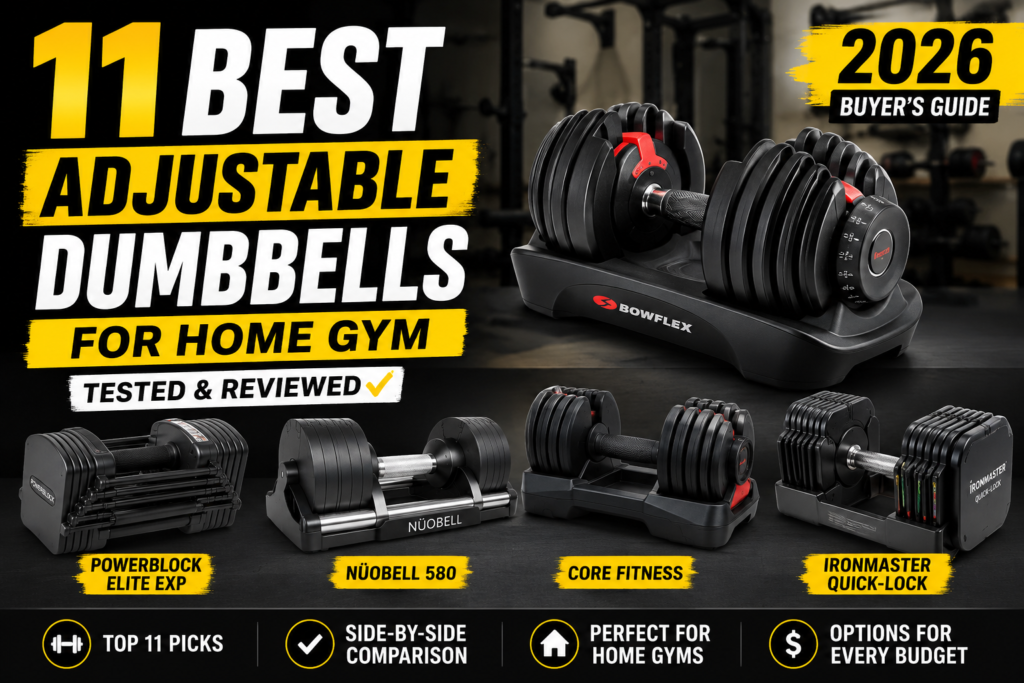
If you’ve started shopping for the best adjustable dumbbells for home gym training, you already know the problem: every listing claims to be “the best,” every comparison chart looks different, and the actual differences between a $250 set and an $800 set aren’t obvious until you’re the one standing in your garage wondering why the dial won’t click into place.
This guide cuts through that. We compared eleven of the most popular adjustable dumbbell systems on the market — from entry-level dial sets to plate-loaded systems that top out at 300 pounds — and evaluated each one against the same criteria: weight range, build quality, adjustment speed, durability, grip comfort, expandability, value, warranty, and how well each one actually fits into a real home gym, not a studio photo shoot.
Adjustable dumbbells solve a genuine space and cost problem. A full rack of fixed dumbbells from 5 to 50 pounds can run you $1,500–$3,000 and eat up six feet of wall space. A single pair of adjustables can replace that entire rack in a footprint smaller than a shoebox. But not every adjustable dumbbell delivers on that promise equally well, and the wrong choice can mean a wobbly handle, a weight range you outgrow in three months, or a mechanism that seizes up after a year of sweat and use.
Below, we’ll walk through exactly how each product performs, who it’s actually built for, and where it falls short — because no single set is right for everyone.
Quick Verdict
If you only read one section, read this one.
- Best Overall: Bowflex SelectTech 552 — the best mix of speed, value, and brand support for most home gyms.
- Best Premium / Best Feel: NÜOBELL 580 — closest to a traditional fixed dumbbell, with a wider 80 lb range.
- Best for Heavy Lifting: PowerBlock Elite EXP — expandable to 90 lbs, and the only system built to survive being dropped.
- Best Budget Pick: LifePro PowerFlow Plus — compact, simple, and genuinely comfortable for beginners.
- Best for Small Home Gyms: NÜOBELL 580 or PowerBlock Elite EXP — both keep a tiny, stable footprint regardless of weight selected.
- Best for Beginners: Core Home Fitness Adjustable Dumbbells — smooth twist-lock adjustment with no learning curve.
No adjustable dumbbell is perfect for every goal. If you already know you’ll be pressing over 90 lbs per hand within a year or two, skip ahead to our section on who should not buy adjustable dumbbells.
Top Picks Summary Table
| Product | Best For | Weight Range | Adjustment Type | Approx. Price |
|---|---|---|---|---|
| Bowflex SelectTech 552 | Best overall | 5–52.5 lbs | Dual-dial | $429 |
| PowerBlock Elite EXP | Heavy lifting / expandability | 5–50 lbs (expandable to 90 lbs) | Selector pin | $349 (Stage 1) |
| NÜOBELL 580 | Premium feel | 5–80 lbs | Single-handle twist | $745 |
| Core Home Fitness | Beginners | 5–50 lbs | Twist-lock | ~$379 |
| Ironmaster Quick-Lock | Serious strength training | 5–75 lbs (expandable to 120–165 lbs) | Screw-lock pin | $519–$699 |
| NordicTrack Select-A-Weight | Mid-range value | 10–55 lbs | Sliding pin | $349–$499 |
| ATIVAFIT Adjustable Dumbbells | Budget-to-mid flexibility | 11–88 lbs (model dependent) | Dial or pin | $200–$400 |
| Snode Adjustable Dumbbells | Drop-proof durability | 10–80 lbs | Cast-iron pin | $300–$450 |
| Flybird Adjustable Dumbbells | Compact budget option | 5–55 lbs (model dependent) | Twist-handle | $180–$380 |
| LifePro PowerFlow Plus | Best budget pick | Up to 55 lbs (model dependent) | Sliding dial | $130–$250 |
| Kensui AdaptaBELL | Plate-loaded flexibility | Up to 300 lbs (uses your own plates) | Screw-on end caps | $80–$150 (handles only) |
Prices fluctuate with sales and retailer; treat these as approximate ranges rather than fixed figures.
Comparison Table: Build & Performance
| Product | Build Material | Adjustment Speed | Drop-Safe? | Warranty | Expandable? |
|---|---|---|---|---|---|
| Bowflex SelectTech 552 | Steel plates, plastic housing | ~2 seconds | No | 2 years (extendable) | No |
| PowerBlock Elite EXP | Welded steel, cage design | 2–3 seconds | Yes | Lifetime (residential) | Yes |
| NÜOBELL 580 | Steel plates, aluminum handle | ~5 seconds | No | 2 years (extendable) | No |
| Core Home Fitness | Coated steel, aluminum cradle | ~3 seconds | No | 2 years | No |
| Ironmaster Quick-Lock | Solid steel plates | 10–20 seconds (manual pin) | Yes (plates detach) | Lifetime | Yes |
| NordicTrack Select-A-Weight | Steel plates, plastic tray | 3–5 seconds | No | 1–2 years (model dependent) | No |
| ATIVAFIT | Steel plates, mixed housing | 3–5 seconds | No | 1–2 years | Limited (model-dependent) |
| Snode | Cast iron | 3–5 seconds | Yes (marketed as drop-proof) | 1–2 years | No |
| Flybird | Steel core, plastic shell | ~3 seconds | No | 1 year | No |
| LifePro PowerFlow Plus | Alloy steel, plastic housing | ~3 seconds | No | 1 year | No |
| Kensui AdaptaBELL | Nylon or aluminum end caps | Manual (screw-on) | Yes (uses standard plates) | Varies | Yes (unlimited, uses your plates) |
How We Selected and Evaluated These Adjustable Dumbbells
We didn’t just pull spec sheets and call it a review. Every product on this list was assessed against nine criteria that actually matter once these dumbbells are sitting in your living room, garage, or spare bedroom.
Weight range. How much weight can you actually load, and does the range fit realistic beginner, intermediate, or advanced training needs? A dumbbell that stops at 25 lbs per hand is a different product than one that goes to 90.
Build quality. We looked at the materials used in the plates, handle, and locking mechanism — steel versus cast iron versus plastic-wrapped composites — and how each held up to repeated use based on aggregated owner feedback and manufacturer specifications.
Adjustment speed. This matters more than most buyers expect. A dial system that changes weight in two seconds keeps your heart rate up during supersets. A screw-lock pin that takes twenty seconds breaks your rhythm, though it often trades speed for durability.
Durability. Plastic housings look sleek but crack under repeated drops. Steel and cast-iron systems last longer but weigh more and cost more. We weighed long-term durability against realistic home-gym use, not gym-floor abuse.
Grip comfort. Handle diameter, knurling, and material (rubber, nylon-coated, or bare steel) all affect how a dumbbell feels during high-rep sets, especially once your hands start sweating.
Expandability. Can you buy a smaller set now and add weight later, or are you locked into a maximum from day one? This matters most for beginners who expect to get stronger.
Value for money. Price alone tells you nothing. We compared each product’s price against how many “sets” of traditional fixed dumbbells it effectively replaces.
Warranty. A generous warranty is a signal of manufacturer confidence. We compared standard coverage lengths and what’s actually covered — mechanism failure, plate cracking, or just defects on arrival.
Home gym suitability. Footprint, noise level, and whether the dumbbell length changes as you adjust weight (a factor that affects storage and balance) all factor into whether a product works in a real home, not just a warehouse gym.
Product Reviews
1. Bowflex SelectTech 552
Overview: The SelectTech 552 is the dumbbell most people picture when they hear “adjustable dumbbells,” and for good reason. It’s been a category leader for over a decade, and it remains the benchmark that most competitors are measured against.
Key Specifications:
- Weight range: 5–52.5 lbs per dumbbell
- Increments: 2.5 lbs up to 25 lbs, then 5 lb jumps
- Adjustment: dual-dial system
- Footprint: stays 16.9 inches long regardless of weight selected
- Warranty: 2 years standard, extendable to 3 or 5
Features: The dial mechanism lets you dial in a weight and lift the handle straight out of its plastic cradle, leaving the unused plates behind. The dumbbell’s length never changes, which keeps the balance consistent no matter what weight you’ve selected — a detail that matters more than it sounds like during pressing movements.
Pros:
- Fast, intuitive adjustment
- Consistent length and balance at every weight
- Widely available service and replacement parts
- Strong resale value due to brand recognition
Cons:
- 52.5 lb ceiling is limiting for advanced lifters
- Plastic housing will not survive being dropped
- Bulkier shape than some newer competitors
Best For: Beginners through intermediate lifters who want the fastest, most proven adjustment system on the market.
Who Should Avoid It: Anyone who regularly presses or rows over 50 lbs per hand, or anyone who trains in a way that risks dropping the weights.
Real-World Usage: For general strength training — presses, rows, curls, lunges, shoulder work — the 552 covers the vast majority of home gym needs without friction. The dial system genuinely does speed up circuit-style training compared to pin or screw systems.
Our Verdict: The Bowflex SelectTech 552 earns its reputation. It isn’t the most durable or the highest-capacity set on this list, but for the price and the sheer convenience of the dial mechanism, it remains one of the best adjustable dumbbells for home gym setups where space and simplicity matter more than maxing out weight capacity.

- QUICK ADJUSTMENT DIALS: Switch between weight settings with a quick twist of the dials, from 5 to 52.5 pounds per dumbbe…
- SPACE-SAVING DESIGN: Get more workout in less space by replacing 15 separate weights with a single, all-in-one set.
- PREMIUM METAL COMPONENTS: Reinforced with durable metal plates and a locking system to keep weights in-place.
2. PowerBlock Elite EXP
Overview: PowerBlock has been building adjustable dumbbells since 1991, longer than most competitors have existed, and the Elite EXP is the clearest expression of what that experience has produced: a boxy, unapologetically utilitarian dumbbell built to survive years of abuse.
Key Specifications:
- Weight range: 5–50 lbs per dumbbell (Stage 1), expandable to 70 lbs (Stage 2) and 90 lbs (Stage 3)
- Increments: 2.5 lbs
- Adjustment: magnetic selector pin
- Warranty: lifetime (residential use)
Features: The nested-plate, selector-pin design is the core differentiator here. Rather than a dial or twist mechanism exposed to the outside of the dumbbell, the plates are held inside a steel cage, which is the structural reason these can be dropped without damage — most other systems cannot make that claim.
Pros:
- Genuinely drop-safe due to the cage design
- True expandability: buy Stage 1 now, add stages as you get stronger
- Compact footprint that doesn’t grow in length as you add weight
- Lifetime residential warranty
Cons:
- Boxy, open-cage shape feels less like a traditional dumbbell
- Pin adjustment (2–3 seconds) is slightly slower than dial systems
- Lateral raises and other isolation moves can feel less balanced than with round-plate designs
Best For: Lifters who train seriously, want room to grow into heavier weight over time, or who train in a garage where equipment gets knocked around.
Who Should Avoid It: Anyone who strongly prefers the traditional round-plate feel of a fixed dumbbell, or anyone unwilling to pay for expansion kits over time.
Real-World Usage: The expandability model is the standout feature in practice. A beginner can buy the 50 lb Stage 1 set, then add the Stage 2 and Stage 3 kits over one to two years rather than replacing the entire set — a meaningfully different cost structure than most competitors, who require a full repurchase once you outgrow the weight ceiling.
Our Verdict: For anyone serious about long-term strength progression, the PowerBlock Elite EXP is arguably the smartest investment on this list. It’s not the prettiest or the fastest, but it is the most durable and the most future-proof.

- ADJUSTABLE DUMBBELLS SET: Elevate your fitness and performance with strength-training equipment that adjusts with you. T…
- COMPACT & PORTABLE: The adjustable, convenient, and compact dumbbells provide innovative strength training for an easy-t…
- EASY & QUICK ADJUSTABILITY: Quickly adjust the weight set up or down for your exercise with the secure magnetic polyprop…
3. NÜOBELL 580
Overview: The NÜOBELL 580 is the closest thing to a traditional fixed dumbbell that the adjustable category has produced. Swedish-engineered with a patented single-handle twist mechanism, it trades some adjustment speed for a noticeably more premium in-hand feel.
Key Specifications:
- Weight range: 5–80 lbs per dumbbell, in 5 lb increments
- Adjustment: single-dial twist-handle mechanism
- Handle: machined aluminum, 32mm diameter, knurled
- Warranty: 2 years standard, extendable to 4 with direct purchase
Features: Unlike dual-dial systems, the NÜOBELL uses one handle-mounted dial, which most reviewers find faster and more intuitive once you’re used to it. The plates interlock tightly at the top and bottom, which significantly reduces the rattle that plagues cheaper adjustable systems.
Pros:
- Feels closest to a real fixed dumbbell in the hand
- Wide 80 lb range covers advanced strength training
- Minimal rattle thanks to interlocking plate design
- Compact, stylish design available in multiple colors
Cons:
- Significantly more expensive than most competitors
- Cannot be dropped — the twist mechanism is not built for impact
- Some long-term owners report handle mechanisms wearing out after several years of heavy use
Best For: Lifters who want the most authentic dumbbell feel available in an adjustable format and are willing to pay a premium for it.
Who Should Avoid It: Budget-conscious buyers, or anyone who trains in a way where dumbbells regularly get dropped or handled roughly.
Real-World Usage: The 5 lb increments across all 16 settings make this one of the more precise systems for progressive overload, and the fact that it doesn’t feel “adjustable” once it’s in your hand is the single most repeated praise across owner reviews.
Our Verdict: If budget isn’t the deciding factor, the NÜOBELL 580 is hard to beat on feel and range. It’s a genuine best adjustable weights contender for anyone prioritizing the in-hand experience over price.

- 32 Dumbbells in 1 for Total Body Workout – Designed for both men and women, the Nuobell adjustable dumbbells offer a ran…
- Fast, One-Twist Adjustment – Easily switch weights with a simple twist, these adjustable dumbbells and free weights make…
- 5 lb Increments for Precision – Ranging from 5 to 80 lbs, these adjustable dumbbell set provides the same versatility as…
4. Core Home Fitness Adjustable Dumbbells
Overview: Core Home Fitness positions its adjustable dumbbells squarely at beginners and intermediate lifters who want a no-friction twist-to-adjust system without the premium price tag of the NÜOBELL or the bulk of the PowerBlock.
Key Specifications:
- Weight range: 5–50 lbs per dumbbell
- Increments: 5 lbs
- Adjustment: patented Twist-Lock mechanism, one-handed
- Warranty: 2-year limited warranty on dumbbells and stand
Features: The included aluminum cradle is lightweight but sturdy, and the dynamic-length design means the dumbbell shortens at lower weights for easier handling during lighter, higher-rep work.
Pros:
- Genuinely one-handed adjustment
- Comfortable, contoured soft-grip handle
- Competitively priced against Bowflex and NÜOBELL
- Coated plates resist wear from regular use
Cons:
- 5 lb increments are coarser than Bowflex’s 2.5 lb jumps at the low end
- 50 lb ceiling will be limiting for advanced lifters within a year or two
- Less brand history and service infrastructure than Bowflex or PowerBlock
Best For: Beginners who want simple, fast adjustments and don’t yet need weight above 50 lbs per hand.
Who Should Avoid It: Anyone planning to progress past 50 lbs per hand in the near term.
Real-World Usage: The twist-lock mechanism genuinely reduces the friction of switching weights mid-workout, which makes this a strong option for HIIT-style circuits where downtime between exercises needs to stay minimal.
Our Verdict: A smart pick for anyone just starting out. It won’t be the last dumbbell set a serious lifter ever owns, but as an entry point it removes nearly all of the usual adjustable-dumbbell friction.

- Pair of adjustable dumbbells with quick and easy weight adjustments from 5 to 50 lbs each
- Quick change weight adjustments with TwistLock technology. Allows you to change weight setting with 1 hand. Set dumbbell…
- Contoured, textured and soft grip handle design provides comfortable and secure grip control
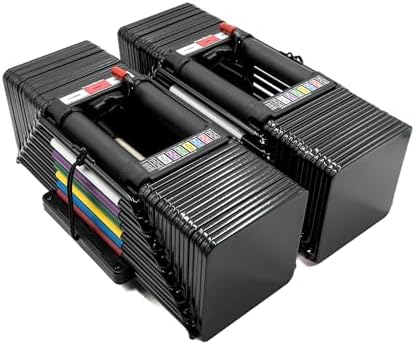
5. Ironmaster Quick-Lock
Overview: The Ironmaster Quick-Lock system takes a different approach entirely: instead of a dial or pin selecting between built-in plates, you manually load and lock plates onto the handle using a patented locking pin screw. It trades speed for a genuinely unlimited ceiling.
Key Specifications:
- Weight range: 5–75 lbs per dumbbell standard, expandable to 120 lbs and 165 lbs with add-on kits
- Increments: 2.5 lbs
- Adjustment: Quick-Lock screw-pin mechanism (manual)
- Warranty: lifetime
Features: The locking mechanism uses small ridges along a shaft that lock into place once inserted, rather than full threading — meaning it’s faster than a true spin-lock collar but still slower than a dial or pin system.
Pros:
- Highest realistic weight ceiling on this list (up to 165 lbs with kits)
- Genuinely drop-safe since plates detach on impact
- Steel construction built to outlast nearly every other option here
- Feels and looks like a traditional dumbbell
Cons:
- Manual plate-loading takes far longer than dial or pin systems (10–20+ seconds)
- Not ideal for fast circuit training or supersets
- Higher up-front cost for the higher-capacity kits
Best For: Experienced lifters who need serious weight capacity and don’t mind a slower adjustment process in exchange for durability and range.
Who Should Avoid It: Anyone doing high-intensity circuit training where adjustment speed between exercises matters.
Real-World Usage: For heavy compound lifts — think weighted step-ups, heavy rows, or floor presses — the Ironmaster’s ability to scale well past 100 lbs per hand is genuinely unique among products on this list that aren’t purely plate-loaded handles.
Our Verdict: Not the fastest, but the most serious option here for lifters chasing real strength numbers rather than convenience.
- ADJUSTABLE DUMBBELLS SET: Elevate your fitness and performance with strength-training equipment that adjusts with you. T…
- COMPACT & PORTABLE: The adjustable, convenient, and compact dumbbells provide innovative strength training for an easy-t…
- EASY & QUICK ADJUSTABILITY: Quickly adjust the weight set up or down for your exercise with the secure magnetic polyprop…
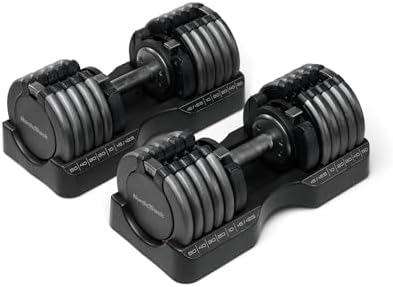
6. NordicTrack Select-A-Weight
Overview: Best known for treadmills and bikes, NordicTrack’s Select-A-Weight dumbbells are a lesser-known but solid mid-range entry that uses a straightforward sliding-pin mechanism.
Key Specifications:
- Weight range: 10–55 lbs per dumbbell
- Increments: 2.5–5 lbs (15 total settings)
- Adjustment: dual sliding pins
- Warranty: 1–2 years depending on model
Features: Octagonal-shaped plates prevent the dumbbells from rolling away when set on the floor — a small but genuinely useful detail that several competitors overlook.
Pros:
- Wide range of fine-grained weight increments
- Octagonal plates won’t roll
- Competitive pricing relative to Bowflex and NÜOBELL
- Comes with an iFit trial for guided workouts
Cons:
- Pin labeling on the tray isn’t always intuitive
- 10 lb minimum weight (the bare handle) is heavier than some competitors’ minimums
- Less brand-specific service network than Bowflex or PowerBlock
Best For: Buyers who want a wide range of fine increments at a mid-range price point.
Who Should Avoid It: Anyone who needs a true light-weight starting point below 10 lbs.
Real-World Usage: The 15-increment range makes this one of the better options for genuinely gradual progressive overload, which matters most for lifters rebuilding strength or working around an injury.
Our Verdict: An underrated mid-range option that often gets overlooked next to bigger fitness-equipment names, but delivers real value on weight granularity.
- [Smooth Weight Selector] – Adjust each Select-A-Weight dumbbell in 2.5, 5, and 10 lb increments to dial in the perfect r…
- [10 Lb. Handlebars] – Each 55 lb. Select-A-Weight adjustable dumbbell features a 10 lb. handlebar that can be used indiv…
- [Replace 30 Dumbbells] – Each Select-A-Weight dumbbell features 15 possible assortments, meaning that this innovative se…
7. ATIVAFIT Adjustable Dumbbells
Overview: ATIVAFIT has built a reputation as one of the more flexible budget-to-mid-tier adjustable dumbbell brands, offering multiple weight-range models so buyers aren’t paying for capacity they don’t need.
Key Specifications:
- Weight range: varies by model, from roughly 11 lbs up to 88 lbs
- Increments: typically 5.5 lbs
- Adjustment: dial or pin selector depending on model
- Warranty: typically 1–2 years
Features: ATIVAFIT sells several distinct weight-capacity models (roughly 27.5, 44, 66, and 88 lb maximums), which lets buyers pay only for the range they actually need rather than a one-size-fits-all set.
Pros:
- Multiple weight-tier options to match your budget and goals
- Steel-heavy construction on higher-end models reduces plastic reliance
- Relatively fast dial-and-button adjustment on newer models
Cons:
- Lower-end models report noticeable plate rattle
- Build quality varies more between models than most single-SKU competitors
- Weight increments (5.5 lbs) aren’t as fine as Bowflex’s 2.5 lb jumps
Best For: Buyers who want to right-size their weight range and budget rather than buying more capacity than they’ll use.
Who Should Avoid It: Anyone prioritizing a completely rattle-free, premium in-hand feel.
Real-World Usage: The tiered model lineup is genuinely useful for households with mixed strength levels — a lighter model can serve a beginner while a heavier model covers a more experienced lifter, without either party overpaying.
Our Verdict: A reasonable value pick, particularly if you already know roughly what weight range you need and don’t want to pay for headroom you won’t use for years.
- ADJUSTABLE DUMBBELLS SET: Elevate your fitness and performance with strength-training equipment that adjusts with you. T…
- COMPACT & PORTABLE: The adjustable, convenient, and compact dumbbells provide innovative strength training for an easy-t…
- EASY & QUICK ADJUSTABILITY: Quickly adjust the weight set up or down for your exercise with the secure magnetic polyprop…
8. Snode Adjustable Dumbbells
Overview: Snode differentiates itself with cast-iron construction and a design explicitly marketed as drop-proof — a rarity among pin- and dial-based adjustable systems.
Key Specifications:
- Weight range: 10–80 lbs per dumbbell
- Increments: typically 10 lbs
- Adjustment: cast-iron pin selector
- Warranty: typically 1–2 years
Features: The cast-iron build is heavier and more rugged than the steel-and-plastic hybrids common at this price point, and the drop-proof marketing reflects a genuinely more impact-resistant design than most dial-based competitors.
Pros:
- Cast-iron durability well beyond typical plastic-shelled competitors
- Wide 80 lb top-end range
- More impact-resistant than dial or twist systems
Cons:
- 10 lb increments are the coarsest on this list, limiting fine progressive overload
- Heavier overall unit weight makes it less convenient to move or store
- Fewer color/finish options than lifestyle-focused competitors
Best For: Lifters who train in a garage environment and want a durable, no-frills set that can take a beating.
Who Should Avoid It: Anyone who needs small, precise weight jumps for isolation work.
Real-World Usage: For compound lifts where the exact increment matters less than raw durability — think rows, presses, and lunges in a garage gym — the Snode holds up better under repeated use than most dial-based competitors in this price range.
Our Verdict: A strong pick specifically for buyers prioritizing toughness over precision.

- Weight adjustments: 3, 5, 7, 9, 11 LBS. Adjust the dumbbell weight by increasing or decreasing the plate. To meet your v…
9. Flybird Adjustable Dumbbells
Overview: Flybird has built a loyal following among budget shoppers thanks to a sleek twist-handle mechanism and genuinely competitive pricing, though the plastic-heavy build shows its limits over time.
Key Specifications:
- Weight range: 5–25 lbs or 15–55 lbs, depending on model
- Increments: 5–11 lbs depending on model
- Adjustment: twist-handle mechanism
- Warranty: typically 1 year
Features: The hexagonal plate design (updated from the original round plates) prevents rolling and allows the dumbbells to rest flat during floor-based exercises.
Pros:
- Genuinely affordable relative to steel-heavy competitors
- Twist mechanism is fast and intuitive
- Compact footprint suits small apartments
Cons:
- Plastic cradle feels flimsy compared to steel trays
- Larger weight increments (up to 11 lbs on the 55 lb model) limit fine progression
- Lifting the dumbbell out of the tray can feel awkward until you get used to it
Best For: Budget-conscious buyers and apartment dwellers who prioritize price and footprint over maximum weight range.
Who Should Avoid It: Anyone who wants fine-grained increments for slow progressive overload.
Real-World Usage: For light-to-moderate home training — think HIIT circuits, toning work, and general fitness rather than heavy strength training — the Flybird covers the basics well at a fraction of the cost of premium competitors.
Our Verdict: One of the more genuinely budget-friendly options here, with the caveat that the coarse increments and plastic build reflect the lower price point.

- 【2026 Newly Adjustable dumbbell】Design and produce fitness equipment for 20 years. FLYBIRD strength equipment are design…
- 【Replace Your Entire Dumbbell Rack】Why clutter your space with 10 dumbbells? FLYBIRD revolutionary 5-in-1 set covers 5 p…
- 【Value for Money】No need to separately buy different dumbbell weights multiple times. Maximize your space and your budge…
10. LifePro PowerFlow Plus
Overview: LifePro’s PowerFlow Plus is a compact, beginner-focused adjustable dumbbell that consistently earns praise for its intuitive sliding-dial mechanism and small, non-intimidating footprint.
Key Specifications:
- Weight range: up to 55 lbs depending on model (lighter models available)
- Adjustment: sliding dial mechanism
- Footprint: roughly 14 x 8 inches — one of the most compact on this list
- Warranty: typically 1 year
Features: The compact size makes this one of the easiest sets to store in a closet or beside a TV stand, and testers consistently note the dial as one of the more intuitive mechanisms among budget options.
Pros:
- Very compact — among the smallest footprints on this list
- Intuitive, quick dial adjustment
- Comfortable for true beginners
- Less plastic housing than some direct competitors
Cons:
- Lower weight ceiling than most premium and mid-range options
- Less suited to advanced lifters who need to progress past 55 lbs
- Fewer increments than higher-priced dial systems
Best For: True beginners, smaller-frame lifters, or anyone prioritizing a compact, non-intimidating design.
Who Should Avoid It: Intermediate or advanced lifters who will need more than 55 lbs per hand within the next year.
Real-World Usage: For a first home gym purchase, the small size and intuitive dial remove nearly every barrier to actually using the equipment regularly — arguably the most important factor for long-term adherence.
Our Verdict: Our pick for best adjustable dumbbells for beginners on a budget. It won’t be the last set a dedicated lifter owns, but it’s one of the easiest to start with.
11. Kensui AdaptaBELL
Overview: The Kensui AdaptaBELL is a genuinely different category of product: rather than a self-contained weight stack, it’s a set of dumbbell handles with screw-on end caps designed to use standard or Olympic weight plates you may already own.
Key Specifications:
- Weight capacity: up to roughly 300 lbs (AdaptaBELL MAX), limited only by the plates you load
- Adjustment: manual screw-on end caps (ACME thread system)
- Compatibility: works with both 28mm standard and 50mm Olympic plates
- Handle materials: nylon (standard) or knurled aluminum (MAX)
Features: The flat-end-cap design eliminates the post overhang common with DIY spin-lock dumbbell handles, which means you can rest the dumbbell on your thigh or knee during seated presses without a metal post digging in.
Pros:
- Essentially unlimited weight capacity if you already own plates
- Far cheaper than any self-contained system if you have a home barbell setup already
- Genuinely drop-safe, since it’s built around standard iron or bumper plates
- Compatible with plates from any brand
Cons:
- Requires you to already own (or separately buy) weight plates
- Manual loading is by far the slowest adjustment method on this list
- Not a self-contained “grab and go” solution for beginners
Best For: Lifters who already have a barbell and plate collection and want a cost-effective way to also do dumbbell work without buying an entirely separate system.
Who Should Avoid It: Anyone without existing plates, or anyone who wants fast mid-workout weight changes.
Real-World Usage: For lifters who already have a home barbell setup, this is by far the cheapest way to add serious dumbbell capacity — genuinely up to hundreds of pounds — without buying a second, redundant weight system.
Our Verdict: A smart, budget-conscious choice specifically for buyers who already have plates on hand. Not a fit for someone starting completely from scratch.

- LIGHTWEIGHT 140 LB PAIR CAPACITY: AdaptaBELL PRO uses DURACORE reinforced nylon-fiberglass composite for a portable plat…
- FITS TWO PLATE SIZES: Load plates with 28 mm standard or 50 mm Olympic center holes. Optional 2-inch centering adapters …
- FLAT-END DUMBBELL HANDLES: Plates sit close to the 34 mm grips without long posts extending past the ends, making the ha…
Which Adjustable Dumbbell Is Best For Different Goals?
Beginners: Core Home Fitness or LifePro PowerFlow Plus. Both offer simple, fast adjustment mechanisms and manageable weight ranges without overwhelming a first-time lifter.
Muscle Building: NÜOBELL 580 or PowerBlock Elite EXP. Both offer enough range (80–90 lbs) to support hypertrophy training well into intermediate and advanced territory.
Fat Loss: Bowflex SelectTech 552 or Core Home Fitness. Fast weight changes matter more than maximum capacity for circuit-style, calorie-burning workouts.
HIIT: Bowflex SelectTech 552 or NÜOBELL 580. Dial-based systems minimize downtime between exercises, which is critical for maintaining heart rate during intervals.
Seniors: LifePro PowerFlow Plus or Core Home Fitness. Lighter starting weights, simple adjustment, and compact, non-intimidating designs matter more here than raw capacity.
Women: Any set with a lighter starting weight and comfortable grip — Core Home Fitness, LifePro PowerFlow Plus, or the lower-capacity ATIVAFIT models all work well, though weight preference is highly individual.
Small Apartments: NÜOBELL 580, PowerBlock Elite EXP, or LifePro PowerFlow Plus. All three keep a compact, stable footprint regardless of the weight selected.
Heavy Lifters: Ironmaster Quick-Lock or PowerBlock Elite EXP (fully expanded to 90 lbs). Both offer realistic paths past the 50–55 lb ceiling that limits most dial-based systems.
Dial vs Twist vs Pin vs Plate-Loaded Systems
Adjustable dumbbells fall into four broad mechanism categories, and understanding the tradeoffs will tell you more about fit than any spec sheet.
Dial Systems (Bowflex SelectTech)
How it works: You rotate a dial on each end of the handle to select a weight, then lift the handle out of the cradle. Advantages: Fast — typically under two seconds per adjustment. Consistent dumbbell length regardless of weight. Disadvantages: Cannot be dropped. Plastic components wear over years of heavy use. Maintenance: Minimal — occasional dust removal from the cradle mechanism. Durability: Good for normal use; poor if regularly dropped or knocked around.
Twist-Handle Systems (NÜOBELL, Flybird, Core Home Fitness)
How it works: A single handle-mounted dial engages internal plate locks as you twist. Advantages: Often faster than dual-dial systems, and generally quieter with less plate rattle. Disadvantages: More complex internal mechanism, which can mean costlier repairs if something wears out. Maintenance: Minimal, though the twist mechanism should be kept free of debris. Durability: Good, but like dial systems, not built for drops.
Selector Pin Systems (PowerBlock, NordicTrack, Snode, ATIVAFIT)
How it works: A pin (or pins) slides into the stack of plates you want to lift, leaving the rest behind. Advantages: Mechanically simple, which tends to mean better long-term reliability. Some designs (like PowerBlock) are genuinely drop-safe. Disadvantages: Slightly slower than dial systems (2–5 seconds). Maintenance: Very low — pin systems have few moving parts to wear out. Durability: Generally excellent, especially with steel or cast-iron construction.
Plate-Loaded / Screw-Lock Systems (Ironmaster, Kensui AdaptaBELL)
How it works: You manually load individual plates onto a handle and secure them with a locking pin or screw collar. Advantages: Effectively unlimited weight capacity. Genuinely drop-safe since the plates aren’t held in a delicate mechanism. Disadvantages: By far the slowest adjustment method — not suited to fast circuit training. Maintenance: Low, though threads or locking pins should be kept clean and lightly lubricated. Durability: Excellent — these are the most mechanically simple systems on this list and tend to outlast every other category.
Also read our exclusive guide of Best Foldable Weight Bench for Small Spaces: 2026 Buying Guide & Reviews.
Adjustable Dumbbell Weight Progression Guide
Choosing the right weight range up front prevents you from either overpaying for capacity you won’t use for years, or outgrowing your dumbbells within months.
Beginners: Start with a range that tops out around 25–35 lbs per hand. Most beginners will spend the first several months building form and endurance well below this ceiling anyway. Sets like the Core Home Fitness or the lower-capacity ATIVAFIT models are well matched here.
Intermediate lifters: Look for a range up to 50–55 lbs per hand. This covers the vast majority of general strength training, from presses to rows to lunges. The Bowflex SelectTech 552, NordicTrack Select-A-Weight, and mid-range ATIVAFIT models fit this stage well.
Advanced lifters: Plan for 70–90+ lbs per hand, and consider expandable systems so you’re not forced into a full repurchase. The PowerBlock Elite EXP (expanded), Ironmaster Quick-Lock, NÜOBELL 580, and Kensui AdaptaBELL all support this range or beyond.
A simple rule of thumb: buy for where you’ll realistically be in 12–18 months, not where you are on day one — but don’t overspend on capacity you won’t touch for years, either.
Common Buying Mistakes
- Buying based on max weight alone. A 90 lb ceiling means nothing if the increments are too coarse for controlled progressive overload.
- Ignoring increment size. Jumping from 25 to 35 lbs in one step (a 10 lb jump) can stall progress that a 2.5–5 lb increment would allow.
- Not accounting for footprint changes. Some dumbbells get significantly longer at higher weights, which affects both storage and in-hand balance.
- Assuming all adjustable dumbbells are drop-safe. Most are not. Dropping a dial or twist-handle system is one of the most common causes of early failure.
- Underestimating floor space for the tray or cradle. The dumbbells themselves may be compact, but many systems require a dedicated tray that takes up more room than expected.
- Overbuying weight capacity as a true beginner. Paying a premium for an 80–90 lb range you won’t use for a year or more isn’t always the best use of your budget.
- Underbuying weight capacity and needing to repurchase. The opposite mistake — going too light — often costs more in the long run than buying a moderately higher range up front.
- Ignoring grip comfort. A dumbbell that’s technically well-built but uncomfortable to hold during high-rep sets won’t get used consistently.
- Not checking noise level. Rattling plates can be a real issue in apartments or shared living spaces — a factor rarely mentioned on spec sheets.
- Forgetting to check the actual increments, not just the range. “5–80 lbs” sounds appealing until you realize the jumps are 10 lbs instead of 5.
- Choosing based on price alone. The cheapest option often means more plastic, less precise increments, and a shorter usable lifespan.
Maintenance and Care Tips
Cleaning: Wipe down handles after every use to remove sweat, which can corrode metal components and degrade rubber or foam grips over time. Avoid spraying cleaner directly onto dial or twist mechanisms — apply it to a cloth instead.
Storage: Always store adjustable dumbbells in their designated cradle or tray. Leaving them loose on the floor increases the risk of accidental drops and exposes the mechanism to dust and debris.
Safety checks: Periodically test that the dial, pin, or twist mechanism locks fully before lifting. A partially engaged mechanism is one of the most common causes of dropped plates mid-set.
Maximizing lifespan: Avoid dropping any dumbbell not explicitly rated as drop-safe. Keep moving parts free of dust, and if a manufacturer recommends occasional lubrication (common with pin and screw systems), follow that guidance to prevent seizing.
Who Should NOT Buy Adjustable Dumbbells?
Adjustable dumbbells aren’t the right choice for everyone. Consider fixed dumbbells instead if:
- You train with a partner or in a shared space, where waiting to adjust a single set of dumbbells between users creates real friction.
- You do high-volume circuit or CrossFit-style training with multiple dumbbell stations, where several fixed pairs at set weights are more practical than one adjustable pair.
- You need to drop dumbbells regularly, such as in explosive or CrossFit-style training, and don’t want to pay for one of the few genuinely drop-safe adjustable systems.
- You strongly dislike the altered balance or feel that some adjustable systems have compared to a solid, fixed-weight dumbbell.
- Budget allows for a full fixed-weight rack and space isn’t a constraint — fixed dumbbells have no moving parts to wear out and will outlast almost any adjustable system.
Buying Guide
Weight range: Match the range to your realistic 12–18 month training trajectory, not just where you are today.
Adjustment mechanism: Choose based on your training style — dial and twist systems suit fast-paced circuit training, while pin and plate-loaded systems suit slower, heavier strength work.
Handle comfort: Look for knurling or a textured grip if you plan to do high-rep or overhead work, where sweat and slipping become real factors.
Build quality: Steel and cast iron last longer than plastic-heavy composites, though they typically cost more and weigh more.
Size: Confirm both the dumbbell’s footprint and the tray or cradle’s footprint — the latter is often larger than expected.
Expandability: If you’re a beginner who expects to get stronger, an expandable system like PowerBlock can save you from a full repurchase later.
Warranty: Longer warranties (lifetime, in PowerBlock’s and Ironmaster’s case) reflect genuine manufacturer confidence in long-term durability.
Budget: Set a realistic budget based on how long you expect to use the product — a higher up-front cost on a durable, expandable system can be cheaper over a five-year horizon than repeatedly replacing a budget set.
Space requirements: Measure your intended storage spot before buying, accounting for the tray, not just the dumbbells themselves.
Frequently Asked Questions
1. What are the best adjustable dumbbells for a home gym overall? For most home gyms, the Bowflex SelectTech 552 offers the best balance of speed, price, and reliability. For a more premium feel or higher weight range, the NÜOBELL 580 or PowerBlock Elite EXP are strong alternatives.
2. Are adjustable dumbbells worth it compared to buying fixed dumbbells? For most home gym owners, yes. A single pair of adjustable dumbbells can replace 10–16 pairs of fixed dumbbells at a fraction of the space and, often, a fraction of the total cost.
3. How much weight do I actually need in an adjustable dumbbell set? Beginners typically need up to 25–35 lbs per hand, intermediate lifters up to 50–55 lbs, and advanced lifters 70–90+ lbs. Buy for where you’ll realistically be in a year, not just today.
4. Can adjustable dumbbells be dropped? Most cannot — dial and twist-handle systems in particular are not built for impact. PowerBlock’s selector-pin cage design and Ironmaster’s plate-loaded system are among the few genuinely drop-safe options on this list.
5. What’s the difference between dial, pin, and plate-loaded adjustable dumbbells? Dial and twist systems adjust fastest (2–5 seconds) but generally can’t be dropped. Pin systems are slightly slower but often more durable. Plate-loaded systems are the slowest to adjust but offer the highest weight capacity and best drop resistance.
6. Do adjustable dumbbells feel different from fixed dumbbells? Somewhat, yes. Systems like the NÜOBELL 580 are specifically engineered to minimize this difference, while boxier designs like PowerBlock feel more noticeably different, especially during isolation exercises like lateral raises.
7. What is the best adjustable dumbbell for beginners? The Core Home Fitness Adjustable Dumbbells or LifePro PowerFlow Plus, both of which prioritize simple, fast adjustment and manageable weight ranges.
8. What is the best adjustable dumbbell for heavy lifting? The PowerBlock Elite EXP (fully expanded to 90 lbs) or the Ironmaster Quick-Lock (expandable up to 165 lbs) are the strongest choices for advanced lifters.
9. How much space do adjustable dumbbells actually save? A full 5–80 lb fixed dumbbell rack can require 15–50 square feet of floor space, while most adjustable dumbbell sets fit in under 5 square feet.
10. Are cheaper adjustable dumbbells worth buying? Budget options like Flybird or LifePro can be a reasonable choice for beginners or light-to-moderate training, but they typically use more plastic, offer coarser weight increments, and have shorter expected lifespans than mid-range and premium options.
11. How long do adjustable dumbbells typically last? With normal (non-dropped) use, most quality adjustable dumbbells last 5–10+ years. Pin and plate-loaded systems, with fewer moving parts, tend to have the longest realistic lifespans.
12. Do I need a stand for adjustable dumbbells? Most sets come with a basic tray or cradle that’s sufficient for storage. A dedicated stand is optional but can make lifting the dumbbells to a comfortable height easier, especially for heavier sets.
13. Can adjustable dumbbells replace a full home gym? For dumbbell-based strength training, largely yes. They won’t replace a barbell, squat rack, or cable machine, but for pressing, rowing, curling, and most accessory work, a quality adjustable set covers the vast majority of exercises.
Final Verdict
Choosing from the best adjustable dumbbells for home gym use ultimately comes down to matching the mechanism, weight range, and price to your actual training style — not just picking whatever has the highest weight ceiling or the lowest price tag.
- Best Overall: Bowflex SelectTech 552
- Best Budget: LifePro PowerFlow Plus
- Best Premium: NÜOBELL 580
- Best Heavy Lifting: PowerBlock Elite EXP
- Best Beginners: Core Home Fitness Adjustable Dumbbells
- Best Small Home Gym: NÜOBELL 580 / PowerBlock Elite EXP
Whichever set you land on, the biggest factor in whether adjustable dumbbells were “worth it” isn’t the spec sheet — it’s whether the adjustment process is fast and comfortable enough that you’ll actually reach for them consistently. Match the mechanism to your training style first, and the weight range second, and you’ll end up with a set that earns its space in your home gym for years.
Sources and manufacturer specifications should be cited here from authoritative retailer and manufacturer listings for each product mentioned above.
Affiliate Disclosure: This article may contain affiliate links. If you purchase through these links, we may earn a small commission at no extra cost to you. As an Amazon Associate, LiftQube earns from qualifying purchases. Our recommendations are based on independent research and honest evaluations.

Pingback: Best Foldable Weight Bench for Small Spaces: 2026 Buying Guide & Reviews - liftqube.com
Pingback: Best Bumper Plates for Home Gym in 2026: 7 Top Picks for Every Budget, Training Style & Space - LiftQube – Home Gym Equipment Reviews & Buying Guides